Standing in a queue in the local shop the other day, the man ahead of me turned round and said, “Hello, doctor, how are you?”
“Doing away,” I replied. “And yourself?”
“Very well.” And when he had left the shop, I said to the shopkeeper, “Who’s he?” The shopkeeper was very amused. He was able to identify the man for me. But then, my shopkeeper knows everybody. It’s a great talent, and one I don’t have.
The following day I was in a Starbucks coffee house and another man ahead of me said, “Hello, doctor, how are you?”
“Doing away,” I replied. “And yourself?”
“Very well.” But then, “Do you remember me?”
I always think it’s best to be completely up front, otherwise you will land yourself in all sorts of difficulty. “I’m afraid not.”
He introduced himself, and even gave his address. “Remember now?”
I said, “Forgive me. Since I retired, everything is a blur.” I’ve often found this to be a reassurance to people. Whatever confidential information I was once privy to, has been deleted from the memory banks. But I had the odd notion that the man in Starbucks was slightly miffed. Probably my imagination.
The following day I complimented my German teacher on her remarkable ability to remember the name of everybody in the class. I told her about these recurring episodes when I am accosted in the supermarket by somebody who says, “Hi, doc”, then points to a particular part of the anatomy, or holds up a limb. “It’s much better now!” Actually I’m on safer ground here. I explained to my teacher that I can’t remember names, but I can remember diagnoses. She found this very amusing.
We doctors call this difficulty with names, rather pompously, “nominal aphasia”. Actually it’s a misnomer. I believe nominal aphasia is actually a real clinical entity, perhaps a complication of a stroke, in which the unfortunate patient really can’t remember names, even of loved ones. It’s the sort of thing the neurologist Oliver Sacks would have written about in books like The Man Who Mistook his Wife for a Hat. But I doubt if my difficulty with names is truly pathological, more likely a character failing on my part; a reprehensible, remote detachment. After all, the technique of remembering names can be learned. When I was working in Broadford Hospital, Isle of Skye, at the beginning of this century, there was a general election, and the late, much missed Charles Kennedy dropped by, by helicopter, as you do. I was introduced to him. “This is James Calum Campbell.” (Or words to that effect.) He shook my hand, looked at my face as if taking a photograph, and said, “Hello, James Calum Campbell.” So, he had a technique.
Group introductions I find particularly difficult. You know the sort of thing. I find I have to introduce six people to six other people. I’d much rather go round the table and ask everybody to introduce themselves, as you might do at a committee meeting. But if it’s not a committee meeting, but rather a dinner party, that’s really not on. I am inclined to panic. All I can do is try to anticipate the event, and rehearse.
Then there is the socially awkward phenomenon of being on familiar terms with somebody you have been acquainted with for quite some time, but whose name escapes you. You really ought to have owned up months ago, but you let the opportunity pass you by, and now it’s too late. You suspect you might know their name, but you’re not sure. To give it a stab and get it wrong would be quite the faux pas. The only possible solution is to find some mutual acquaintance and extract the necessary information from them.
Then there are the people who you know just have the wrong name. I know a Liz who really ought to be Jill. I once called her Jill and she looked puzzled. Some names get mixed up. I confuse Deborah and Rebecca, even in their shortened forms, Debs and Becks.
Why are people affronted when their name is not remembered? What’s in a name? Romeo’s Juliet evidently thought, not much.
That which we call a rose
By any other word wold smell as sweet…
…Romeo, doff thy name,
And for thy name – which is no part of thee –
Take all myself.
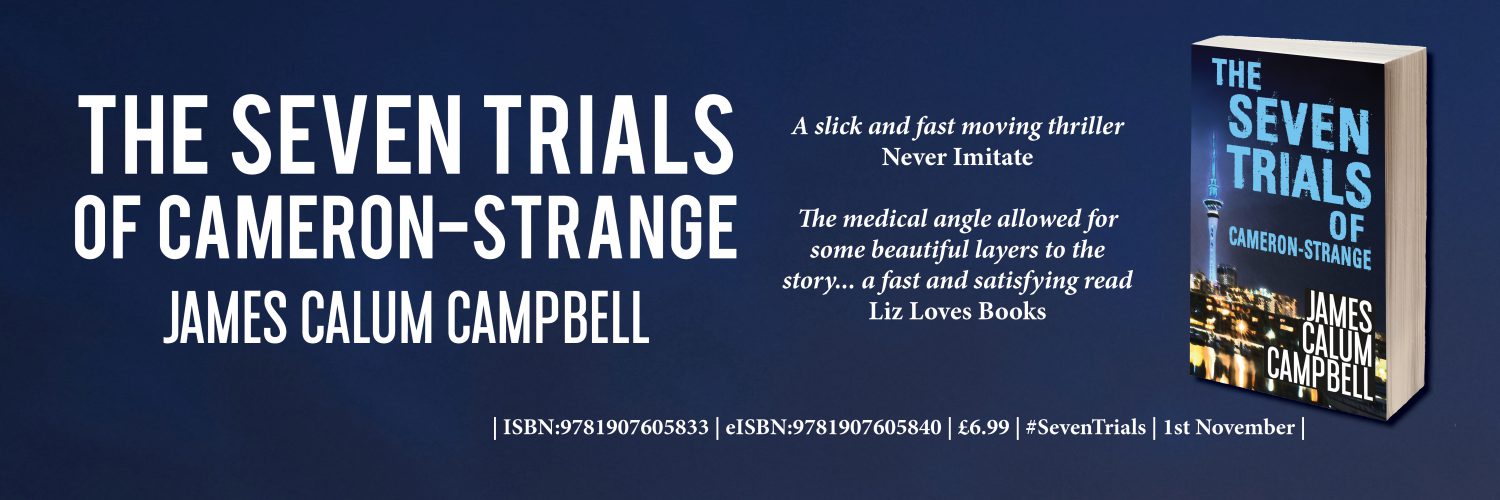
For myself, I don’t mind not being recognised as I move about the world. I concealed my name when I published my first book. At least, I lost it in translation. I did it, ostensibly, because I was still in practice at the time, my book contained a lot of medicine, and I did not wish my patients to suspect they were appearing in my book. Now I have published four books, and I have retained the habit of concealment, ostensibly, for continuity’s sake. Yet I suspect the real reason lies deeper. I crave neither fame nor notoriety. I highly prize the gift of being able to walk down the street unmolested.
Of course I would prefer that the books that have been printed be sold rather than pulped. I have no desire to be remaindered. But success and fame are not the same. I should like to observe any such success from a position of anonymity. I wish James Calum Campbell all the luck in the world.
 jamescalumcampbell