The Doomsday Clock Strikes Midnight

In these strange and troubled times, I have the great good fortune to live in a rural location and at the heart of a farming community.  I can purchase top quality local produce at my village store.  The farmers tell me that the pandemic has altered their lifestyle not one whit.  I already knew this, because I see them working in the fields every day.  They get up before dawn and milk the cows.  They alter their routine only according to the weather, and how much daylight there is.  Sometimes as I drive home I get stuck behind a slow moving tractor, and I follow on patiently, sending the farmer a telepathic expression of my gratitude that he is putting bread on my table.  I live in the beating heart of Scotland.     

Our refuse collectors are extremely reliable.  Our pick-up day is Saturday.  I have four bins, grey, brown, green, and blue, plus a blue box.  Grey for landfill, brown for garden and food waste, green for paper and cardboard, blue for cans and plastics, and a blue box for glass.  I try to put as little as possible into landfill.  And I worry about the plastics.  How much of it is recycled, how much put into landfill, and how much sent off to some distant land and some dubious mode of disposition?  The idea of sending garbage abroad seems very odd to me.  Should we not be responsible for our own detritus?

I don’t remember there being so much plastic around when I was a kid.  There were brown paper bags for fruit and veg, and grease-proof paper for meat and dairy products.  You could go into a confectioner and order a quarter pound of sweets which would be taken from a large glass container, measured on the scales, and put into a small paper poke.  There was hardly any pre-packaging.  You would ask for a quarter pound of butter, or cheese, and it would be cut from a huge slab, using a wire contraption resembling a garrotte, and then wrapped in paper.  There were no plastic bottles.  Milk came in glass bottles.  A pint would contain about three inches of thick cream at the top.  Bottled water was unheard of.  Now the supermarket shelves are crammed with commodities wrapped in plastic.  The packaging gives you data on the nutritional content and sell-by date of the produce, but does not tell you how to dispose of the wrapping. 

My local general practice is four miles away.  It’s very good.  They asked me to attend last Wednesday, at 11.06, for my first Covid vac.  In the event I got the jag at 11.03.  I was treated with kindness and courtesy and there were no glitches. 

Farmers, refuse collectors, and carers.  One of the thing this pandemic is teaching us, or should be teaching us, is what our priorities are.  Isn’t it extraordinary that the people upon whom we most rely for our very existence are often the people who are the least rewarded?  That should tell us something.

A little under a year ago, I seem to recall that the Prime Minister floated the idea that we avoid any form of societal lockdown and simply “take it on the chin”.  “Herd immunity” by attrition might be the way forward.  It was a callous thing to say and he got a lot of stick for it.  I dare say he was only thinking out loud, after the fashion of President Trump wondering if we should all swallow disinfectant.  I actually followed the presidential advice, though I admit my choice of disinfectant was only the best Islay single malt. 

But what if the world had decided to “take it on the chin”?  Where would we be?  How many would be dead by now?  100,000,000?  How much herd immunity would have been acquired?  Would it have protected us from the Kent variant, the South African variant, etc?  Nobody knows.  It occurred to me, in one of my darker moments, that Mother Nature has grown weary of us and our mission to rape, pillage and despoil her, and to exterminate every other one of her species.  She has decided to bump us off.  Who can blame her?

With this in mind, I did what I usually do when feeling apocalyptic, and reread Edgar Allan Poe’s The Masque of the Red Death.  I may have mentioned The Masque in this blog before, yet it is the quintessential story of our time, and therefore it deserves to be read and reread.  While the country is ravaged by the plague that is the Red Death, Prince Prospero, “happy and dauntless and sagacious”, holds a banquet for a thousand friends in his castellated abbey, cut off from the rest of the world and in defiance of the contagion.  There are seven apartments decorated and illuminated, from east to west, in lurid blue, purple, green, orange, white, violet, and, lastly, black.  The light illuminating the last apartment is scarlet.  At its westernmost side there is a clock, dolefully tolling the hour, periodically interrupting the masked revellers (it’s a bad taste fancy-dress party), the buffoons and improvisatori, the orchestra, and the dancing.  It is a doomsday clock.

One guest has dressed in particularly bad taste.  He is first noticed just as the ebony clock in the seventh apartment strikes midnight.  He is a mocked-up victim of the Red Death.  Prince Prospero is outraged and unmasks the guest by having his habiliments removed, only to find the disguise to be “untenanted by any tangible form”.  The Red Death had come like a thief in the night.  “And Darkness and Decay and the Red Death held illimitable dominion over all.”

I suppose every time we are confronted by a threat of this magnitude, we are inclined to interpret it in apocalyptic terms, as the Writing on the Wall.  Thou hast been weighed in the balance, and found wanting.  Yet surely the overarching existential question of our time, is how we can preserve and protect the only planet known to harbour life, and its fragile ecosystem of which we are – for the moment – a part. 

Yet some people are champing at the bit to “get back to normal”.  HS2.  Third runway at Heathrow.  New coal mine in Cumbria.

Buffoons and improvisatori. 
“The Of Scotland People”

Read the following sentence carefully:

Isn’t it time to abandon independence and concentrate much poorer and undermine our ability to improve society in the ways that the of Scotland people really want?

This was the final sentence in a letter which appeared on The Herald’s letter page on February 4th.  It was written by a Labour Councillor and it concerned a report from the London School of Economics Centre for Economic Performance, stating that Scottish Independence would leave Scots £2,800 a year worse off. 

Naturally I wrote to The Herald.

“Clearly, somewhere along the line between Councillor Gallagher’s pen and the printing press, Messrs Cut & Paste have fallen out…”

I wasn’t published.  That’s okay.  Sometimes I get published, sometimes not, and when I write, I cannot second-guess the outcome.  It no longer bothers me.  I am beyond harm.  But I’m still intrigued to know what happened.  Did Councillor Gallagher really write that?  If not, where, and how, did the words gets jumbled?  Did he fail to run a spell check? 

On the other hand, maybe the Councillor was being unusually candid.  Some people believe that the reason why Scottish Labour has been almost obliterated as a political force is that they became complacent in the stability of their once dominant hegemony and were content to keep their constituency in a state of docile subservience.  Sir Sean Connery once said, “Labour is fossilised.”  (Actually, he said, “Labour ish foshilijed.”)  Like it or not, the Councillor was urging the Scots to embrace small-mindedness, poverty of ambition, and fear, in the way a waif or street urchin might cling to a decrepit rag doll for comfort.       

On February 5th, when I was checking to see that I was not going to appear in print, I did notice there were a couple of letters written in response to Councillor Gallagher.  The contentious issue was whether or not the LSE report was valid.  Nobody mentioned his remarkable sentence.  Nor did The Herald see fit to offer an explanation as to how this bizarre utterance had come about.  What does this tell us?  Presumably it tells us that nobody noticed, or nobody cared, or both.    

This all seems to me to be symptomatic of some worrying trends in modern communication.  Messages are transmitted, and received, in broad brush strokes.  There is no attention to detail.  We are content to get the broad drift, to hear “where people are coming from”.  In politics, once we have identified the camp to which a correspondent belongs, we stop listening, either because we know we are in agreement, or we are in disagreement.  The possibility of a change of mind is hardly considered.  Lip service is paid to “nuance” in argument, but appreciation of nuance requires attention to detail, and that takes effort, in both the exposition and the apprehension of a case, political or otherwise.  Assertion is not enough; it must be backed up by argument. 

But questions and answers in contemporary communication are off-the-peg and not bespoke.  You encounter this phenomenon if you get in touch with a business enterprise or corporation with a specific query.  You are likely to be in communication with an automaton, and if the question you ask, and its answer, is not pre-packaged as a “FAQ”, your question will be ignored.  We are supposed to be “connected” as never before; all these lines of communication – from email to texting to SMS to WhatsApp to Snapchat and a million other platforms I’ve never heard of.  Such trafficking of information.  Yet do these services facilitate a meeting of minds?  Sometimes I feel like a pilot talking to the control tower:

“Golf Echo Charlie Kilo Oscar inbound request re-join instructions.”

“Oh Hi James, gorgeous day going forward.  It’s the gift that keeps on giving.  Please touch base any time.  Best!”  

People talk in clichés.  Lord Falconer described the pandemic as “the gift that keeps on giving” for the legal profession.  Did he mean Covid was a subject of professional interest, or a cash cow?  Or did he just thoughtlessly pull a cliché off the shelf?  Maybe he heard Craig Revel Horwood use it.  But fancy describing a virus that has by now killed 112,000 people in the UK as a “gift”.  (It reminded me of a remark passed by one Jo Moore, on 11/9/01: “A good day to bury bad news.”)  People seem to be content to speak in soundbites virtually devoid of meaning.   Messages on Twitter can be particularly puerile.  Politicians really ought to shut down their Twitter accounts.  Their posts can be full of cant and mawkish sentimentality.  “Truly sorry to hear of the passing of X.  So sad.” 

Talking in cliché is a consequence of restricting yourself solely to dialogue with those of like mind.  If you only converse with those in your own tribe, you don’t need to think of something new to say, because you have no desire to have somebody else see the world in a different light.  You abandon the effort to “reach across the aisle”, and all you ever hear is the reverberation within your own echo chamber.  Then somebody, like Councillor Gallagher, says something quite extraordinary, and nobody notices.        

A Tinkling Symbol

When the Prime Minister made his sojourn to Scotland last week (former First Minister Henry McLeish called it a “safari”), he inevitably commented on the possibility, or otherwise, of a second Scottish Independence referendum.  Some people think the sole purpose of the visit was to make such comment.  He said that wishing for a second referendum was like not caring what you eat, so long as you eat it with a spoon.

Aside from the spoon remark, Mr Johnson visited troops setting up a vaccination centre in Glasgow’s Castlemilk, and he went to Livingston to visit a pharmaceutical company preparing a new Covid vaccine.  The current First Minister was “not ecstatic” about the PM’s trip.  She might have reiterated the words often seen on billboards during the war: “Is your journey really necessary?”  In Castlemilk, the PM touched elbows with a soldier.  I am puzzled by this social nicety.  You can’t touch elbows and stay two metres apart.

I have been worrying over the spoon simile all week.  What could the PM possibly have meant?  What do the blind table d’hôte, and the choice of cutlery, signify?  Wondering if the analogy were some hackneyed cliché that has heretofore escaped my notice, I consulted the Millennium Edition of Brewer’s Dictionary of Phrase & Fable.  I looked up “spoon”.  Apparently a spoon is a simpleton, particularly one who is “spoony” in an amorous or sentimental way.  Perhaps Mr Johnson was implying that the Scots are sentimental about a culture, and nationhood, that no longer exists, if it ever existed at all, save on the lid of a shortbread tin, and that, left to their own devices, the Scots would open the tin, find it empty, and so they would have nothing to eat. 

On the other hand, you can be born – perhaps like Mr Johnson – with a silver spoon in your mouth.  This refers to the tradition of godparents gifting a silver spoon to a new-born child.  But there’s no point in having a silver spoon, if there’s nothing to eat.

There are various types of spoon.  There is the runcible spoon, and there is the wooden spoon.

They dined on mince and slices of quince

Which they ate with a runcible spoon.

The Owl and the Pussycat, Edward Lear (1871).

I gather from Chambers that quince is a globose, or pear-shaped fruit of the tree Cydonia oblonga, akin to the Japanese quince, Chaenomeles japonica, and somewhat different from Bengal quince, the bael-fruit of the tree Aegle marmelos.  Quince apparently makes good marmalade.  I have never knowingly tasted it.  “Runcible” is a nonsense word, but Chambers ventures to suggest a runcible spoon might be a sharp-edged, broad-pronged pickle fork.  But how useful would such an instrument be in the consumption of mince and quince? 

Then there is the wooden spoon – a booby prize, originally for the student who came last in the Cambridge mathematical tripos.  How cruel is that?  I sincerely hope the recipients ate their mince and quince with it, with pride.  The great Cambridge mathematician G. H. Hardy thought the competitive tripos system of cramming set back Cambridge mathematics by 150 years. 

Then there is the spoonerism, or metathesis.  One ludicrous juxtaposition comes to mind: pungent shafts of wit.  Mr Johnson has a reputation for passing remarks which some people find hilarious, others, deeply offensive.

Does any of this bring us any nearer to understanding Mr Johnson’s strange simile?  I think we must conclude that in this case the spoon assumes a kind of talismanic significance beyond its mundane utility, rather like the Stone of Scone, which is nothing more than a slab of rock; but because the Scottish monarchs were crowned upon it, it acquired mystic significance by virtue of what the Antiques Roadshow experts call “provenance”.  It was removed to Westminster, much as – some would say – the Elgin Marbles were removed to the British Museum.  (The stone plays a cameo role in a remarkable – almost Shakespearian – scene in the film The King’s Speech.)  Then in the early 50s an intrepid quartet of Scottish undergraduates removed it from Westminster Abbey and brought it home.  Currently (so far as we know) it is in Edinburgh Castle.  I have seen it, but I have also seen a replica in Scone Castle so who knows?  Maybe there are scores of stone slabs all over the British Isles claiming its identity.  “I’m Spartacus!”  Where were we?  Ah yes, the Spoon of Scone.  This runcible might also be compared with the Scottish Crown jewels, or Honours of Scotland.  After the Treaty of Union of 1707, the Scottish crown, sword of state and sceptre were seen as potent symbols of Scottish independence, and accordingly they were “disappeared”.  Sir Walter Scott was instrumental in rediscovering them, sequestered in a strongbox behind the locked doors of the Crown Room in Edinburgh Castle, where they are now on display, the oldest crown jewels in Europe.     

Mr Johnson’s spoon, it seems to me, is a kind of lampoon of a symbol of Scottish nationhood, which sentimental and gullible Scots will fall for, irrespective of the hard economic realities that will, or will not, put bread on the table.  When Oliver Twist, desperate with hunger after the pitifully inadequate serving of gruel, rose from his place and advanced to his master to ask for more, he had a basin and a spoon in his hand. 

I believe the spoon comment is Mr Johnson’s initial salvo marking his resolve to campaign for the Scottish Conservative and Unionist Party in the run-up to the Holyrood elections in May.  Whether his involvement will be welcomed by the party, whether his participation will be efficacious or detrimental to his cause, remains to be seen. 

But watch out for more spoonerisms.      

The Glasgow Factor

Shuggie Bain, by Douglas Stuart (Picador, 2020).

I received a copy of Shuggie Bain as a Christmas present, and I was particularly interested to read a first novel, set in Glasgow, written by a Glaswegian, that has won the 2020 Booker Prize.  “A novel of rare and lasting beauty”, said The Observer.  “A heartbreaking novel… both beautiful and brutal…  Tough, tender and beautifully sad”, said The Times.  There were further endorsements from the Booker Prize judges, and the New Statesman.  Already knowing that Shuggie Bain was all about Glasgow, addiction, and despair, I wondered about that.  Was this adulation from the middle classes a reflection of some kind of voyeurism?  Could a hedge fund manager from the City of London, or a teacher of creative writing at Yale, or even a privately-schooled lawyer residing in Glasgow G12, sitting in his conservatory perhaps reading one of these reviews while sipping a hazelnut latte, possibly empathise with the people in this book?  Would they not read it rather as an anthropologist might study a hitherto unknown tribe newly discovered in the Amazon?  These people would be entirely alien.  The Literati would read about them and discuss their way of life amongst themselves.  Isn’t that remarkable?  

But at the end of the day, I’m sure Shuggie Bain won the Booker because it really is a powerful and vivid depiction of the lives of people trapped in the cycle of poverty, addiction, and despair.  It’s a familiar scenario, and no doubt something similar could be encountered in any city in the world.  Of course Glasgow’s urban landscape, the wretched climate, and the dialect, all have their unique personality, but a reader in New York, or LA, or Sydney, or Auckland, will recognise the ubiquity of urban destitution, and the Glasgow “patter” will be no barrier; quite the contrary. 

The principal character in the book is not Shuggie, whose childhood life we follow for about a decade, but Shuggie’s mother Agnes, whose alcoholism is a kind of wrecking ball destroying everything it encounters.  The narrative is not entirely bleak.  Agnes has her better days.  There is Glasgow humour, but it is beyond dark; it is black.  I found myself caring for Agnes.  Was she going to get better?  Who knows, maybe she would have a kind of “Shawshank Redemption” and escape her prison.  I wanted her to, but I was always anxious for her, and I had a notion that everybody who cared for her would eventually up and leave.  In the end, does she stop drinking, or does she succumb, and lose everything and everybody?  I won’t say.  But I don’t think a spoiler alert is needed if I go so far as to say the last section of the book is cathartic.  I did indeed experience a kind of purgation of pity and terror.              

Shuggie Bain is beautifully written.  I was particularly struck by the originality of Douglas Stuart’s imagery.  Startling metaphysical juxtapositions.  I wonder why this Booker Prize winner has not received more fanfare in Scotland.  I suspect it might be because it is such a painful read.  Scotland’s First Minister Nicola Sturgeon, from Irvine in Ayrshire, herself a bibliophile, called it “A searing, brutal and deeply moving account of poverty, addiction, and childhood trauma”.  Searing and brutal, you may ask, like Shakespeare’s Macbeth, or Hardy’s Jude the Obscure?  Yes, all of that.  But, for me, much more.  You see, I come from Glasgow.  So when I first opened the book I thought to myself, I’m not sure I want to go through with this.  But I braced myself and I read it with an intense sense of familiarity and the sharp shock of recognition.  What a book to choose to read during lockdown!  I was depressed to my boots for about three days. 

Coincidentally, it came to light last week that in 2019 there were 1,264 drug-related deaths in Scotland.  This is the highest rate in Europe.  Nicola Sturgeon has called it a “national disgrace”.  Glasgow is the epicentre of this.  There is a district in Glasgow, just to the east of Glasgow Green, where the average life expectancy of a male is 54 years.  There is a hypothesis that there exists an unknown “Glasgow Factor” that contributes to the appalling morbidity and mortality statistics.  Perhaps it is multifactorial.  Maybe Shuggie Bain is a description of the Glasgow Factor.

Although the author denies that Shuggie Bain is autobiographical, he does admit he was very much writing from personal experience.  Douglas Stuart left Glasgow and went to the Royal College of Art in London.  Then he moved to New York.  He got out.

Does Shuggie get out?  You must read the book.  But brace yourself.        

The Longest Word in the English Language

Put my back out this week.  I gotta tell ya – my back is my Achilles heel.

How I did it was quite ridiculous.  I happened to read a letter in The Herald stating that “antidisestablishmentarianism”, 27 letters long, is the longest word in the English language.  “No it’s not!” I cried out loud. “It’s floccinaucinihilipilification!”  (28 letters).  And promptly wrote a Mr Know-it-all rejoinder to the paper.  I did make mention of “supercalifragilisticexpialidocious” (34 letters) just to pre-empt any “Dr Campbell needs to wake up and smell the coffee” retorts.  It didn’t work.  The word thrown in my face was pneumonoultramicroscopicsilicovolcanokoniosis (45 letters).  This is the sort of mindless banter we descend into for entertainment during lockdown.

I wish I hadn’t embarked on this wild goose chase.  I happen to have the Oxford English Dictionary, a vast tome and the last word in English usage, encapsulated in a single volume of considerable dimension and weight, which requires a magnifying glass to read (unless, as the daughter of a friend of mine demonstrated, you are 18 years old).  It was while I was manipulating this unwieldy volume that something in the lumbar region went twang.  Since then I’ve been wandering around like a half-clasped knife.

I did make a self-diagnosis – always a risky undertaking.  This was what we call a “mechanical back”.  Nothing to worry about.  All will be well.  I’ve lost count of the number of times I’ve experienced an episode like this.  I associate it with poor posture and overuse of the computer.  I experienced many such episodes during my career as a GP but I always managed to drag myself out of bed (supposing it took an hour) and crawl into work.  Our physiotherapist would glance at me and say, “It’s gone out again, hasn’t it?” and she would give me an instant treatment which was balsam, at least for as long as it lasted. 

In hospital, the orthopaedic surgeons hated getting patients with acute back pain referred from the emergency department, because, by and large, they weren’t going to investigate them or operate on them, but merely give them tender loving care.  They would end up blocking a bed.  Now you might say TLC is not part of the orthopaedic remit.  I couldn’t possibly comment.

But I was always very careful with patients with back pain, both in the emergency department and in general practice.  I would go over them with a fine tooth comb, looking out for the dreaded cauda equina syndrome, the missed diagnosis that appears with bleak and monotonous regularity in the pages of the medical defence journals.  99% of the patients had mechanical back pain.  I would lie prone on the surgery floor and demonstrate the exercises aimed at restoring the lumbar lordosis.  Physician, heal thyself.

I have a notion that we doctors don’t really understand back pain.  After all, if we did, we might be better at fixing it.  It’s a bit like dyspepsia.  We used to think we knew what caused gastric and duodenal ulcers, and we performed heroic procedures like vagotomies and pyloroplasties and Billroth 1 and 2 partial gastrectomies.  Then, remarkably recently, an Australian physician showed that the causative agent was Helicobacter pylori and all you really needed was a week’s course of antibiotic.  Now if John Buchan, Lord Tweedsmuir, had lived in the antibiotic age, he wouldn’t have had to endure a lifetime of tummy ache.  Then again, we wouldn’t have had his creation, the American magnate policing the world on a diet of white fish boiled in milk, John Scantlebury Blenkiron.

But to return to pneumonoultramicroscopicsilicovolcanokoniosis (an occupational lung disease, I presume, of volcanologists), it occurred to me to prolong the excruciating newspaper correspondence by coining a biochemical formula of the sort that can be more or less endless, like 2,3,dihyrdopolybenzoicethyleneglycolicorthopentocyclopentanobisblablabla….ene.  Or again, a German loan word.  The Germans have this great capacity for conjoining and amassing syllables.  They do it with numbers.  5,723,927 is fünf Millionen siebenhundertdreiundzwanzigtausendneunhundertsiebenundzwanzig.  Pithy.  But in the end, I let it go, maintained a dignified silence, shut down the computer, and went for a walk, which turned out to be far more therapeutic.

Now I read The Herald letters column and look out for the daily political diatribes from a well-known corpus of correspondents, guaranteed to make me splutter into my cornflakes.  The world is awash with anger.  Then my back starts aching again.  Maybe lumbago isn’t mechanical at all.  Maybe it’s all in the mind. 

It doesn’t do to splutter into one’s cornflakes.  Far better to read in an open-minded state of calm.  You never know; somebody might write so persuasively as to make one change one’s mind.  “I beseech you in the bowels of Christ,” said Oliver Cromwell, “consider that you might be wrong.”  But if not, and you are compelled to write back, better to do so respectfully, than to carp and snipe.  I saw a letter from a Diehard Remainer taunting the Brexiteers about the stinking fish on the lorries at Dover.  “Brexit going well?”

Ha!  That’s antidisestablishmentarianism’s floccinaucinihilipilification.

Time for another walk.          

Last Days

There is something positively biblical about the last days of the Trump presidency.  I imagine him, holed up in the Oval Office, the phones silent, sensing his power slipping away as even his staunchest allies seek to distance themselves from him.  Looking out on to Pennsylvania Avenue perhaps he can see the bare-chested men with big beards and Davie Crocket hats, touting enormous semi-automatic weapons, but he can’t reach them as his Twitter account has been suspended, permanently.  On this side of the pond, prominent establishment people who once fawned over him now openly condemn him.  He is yesterday’s man.  Now they court Mr Biden.

I wonder if Mr Trump seriously believes that he won the election.  I think so.  If you believe, not that the truth is out there, that is, that the truth is an external reality which your own sense of self cannot bend to your own will and wish-fulfilment; but if you believe that that which you desire to be so must ipso facto be the case, then you believe that you hold within you the power to define the truth.  Toddlers believe they can bend the universe according to their own will, until they bruise themselves on inanimate objects, and discover there are other beings in the universe who operate according to a different agenda.  “The terrible twos” is the expression of rage which marks the realisation that the toddler is not, after all, omnipotent.  Mr Trump’s refusal to attend Mr Biden’s inauguration is childish and petulant, the toddler’s expression of rage.        

Perhaps delusion goes hand in hand with enormous power.  Is this why King Canute enthroned himself on the beach and ordered the tide to stop coming in?  I have a notion that the members of any exclusive establishment or élite are to some extent deluded.  They begin to believe in their own sense of entitlement.  They can shape the world according to their own will.  Make America great again.  Over here, we will make the UK “world beaters” by wishing it to be so.  Mr Gove passed that infamous remark casting doubt on the value of experts.  Why let hard facts get in the way of a good narrative? 

I believe one of the chief reasons why New Zealand did so well in eradicating Covid-19 was that New Zealand society does not have an élite.  The New Zealand parliament does not have a second chamber, an upper house.  There is no establishment.  When Jacinda Ardern closed the border last March and locked the place down, everybody complied because everybody knew they belonged to a community.  Of course the economy was going to take a hit, but New Zealanders are extremely self-reliant people and they were never going to starve.  (I heard Ian Blackford, leader of the SNP at Westminster, on Any Questions on Friday, say that the number of food parcels being handed out by food banks in South Skye and Lochalsh had increased from 25 per month in January to 180 per week in December.)  But in their reaction to Covid, the Kiwis were nimble.  There was none of the obscurity and obfuscation so beloved of la crème de la crème.  “Well, yes, we might try that of course, but it’s going to be very, very difficult…”   

No doubt 2020 was difficult in NZ.  During the pandemic, Ms Ardern owned up to a sense of Impostor Syndrome.  But then she cast it aside and thought, “Just get on with it.”  Élites are not very good at just getting on with it.  They are too bogged down in their own vested self-interests. 

Meanwhile the Trump presidency – unless the 25th Amendment is invoked – has 9 days to run.  One thing we have learned in the last four years is that Mr Trump is a very unpredictable man.  I have a notion that he has one last trick up his sleeve, un coup de théâtre to unveil.  I wonder what it’s going to be.

I’m holding my breath.         

Sunrise to Moonrise

On Hogmanay in my local shop I was asked, “How are you bringing in the New Year?”

“Quietly.  A game of Scrabble, Horlicks, and bed by 9.30.”  In the event, I stayed up for the Bells, flicking between Jools Holland’s Hootenanny and Susan Calman’s show on BBC 1.  Sir Tom Jones is remarkable, as are Amy Macdonald and Hannah Rarity.  Hannah did not murder Auld Lang Syne.

Thence to bed.

At dawn on New Year’s Day I walked the two miles from my village to Flanders Moss, a nature reserve of great beauty, and tranquillity.  Me, the sheep, and the horses, we had the world to ourselves.  A beautiful winter’s morning.  There was a near full moon in the north-west, and I saw the sun rise over the Carron Hills in the south-east.  (Next time I saw the moon, in the evening, it was an enormous bright golden sphere rising in the east.)

Back home, I tuned in to the New Year’s Day concert from the Musikverein in Vienna.  Riccardo Muti was conducting the Vienna Philharmonic, before an empty hall.  That orchestra seems to be able to play the Viennese Waltz as nobody else can.  Before the traditional encore of The Blue Danube, Maestro Muti gave a speech, in English, reminding our world leaders of the healing power of music and the importance of nurturing culture.  Of his colleagues, he said, “We give flowers, not… things that kill people.”  Maestro Muti is in his eightieth year, though to see him you would hardly believe it.  When I was an LSO groupie I recall one of their first violinists saying to me, “Muti!  Bastard!  Absolute martinet!”  The spectre of Toscanini was summoned.  Yehudi Menuhin records in his memoirs that he rehearsed with Toscanini in his apartment at the Hotel Astor on Times Square, New York.  During the rehearsal, the phone rang – three times.  On the third ring, Toscanini rose from the piano, not to answer the phone but to disconnect it by heaving the electrical fitment off the wall in a tangle of wires, bits of wood, plaster, and dust.  This the sort of thing you can do if you are a Maestro.  

Well, I think Maestro Muti must have mellowed; his message was beautiful.  For the gig, he was put up in Vienna’s old Imperial Hotel which abuts the Musikverein.  He, and a handful of business men, had the place to themselves.  Muti said he felt like the hero in his own apocalyptic disaster movie. 

In Scotland, Saturday January 2nd was a sombre day, being the 50th anniversary of the Ibrox disaster.  2/1/71 was also a Saturday, and the traditional New Year Old Firm match took place at Rangers’ home ground.  It was by all reports a dull match played in dull and bitterly cold conditions.  It only came to life in the last two minutes, when Celtic scored, and then Rangers equalised more or less on the final whistle.  One all.  In high spirits but in good humour, a crowd of 80,000 dispersed. 

There was a crush on Stairway 13, a stairway at the north-east corner of the stadium leading down to Cairnlea Drive and thence to Copland Road, the nearest subway station, and in the space of just a few minutes 66 souls suffered death by asphyxiation or suffocation.  An early theory was that the excitement of the late goals had caused the departing crowd to turn back, but this theory was later discredited.  The event only took place after the final whistle had blown.

As with so many sombre events, the assassination of JFK, the murder of John Lennon, I remember where I was at the time.  I had been at Arlington Baths, and I had got on a bus on Woodlands Road, heading west – so a 10, a 10A, or a 59.  Somebody on the bus told me a major disaster was unfolding at Ibrox.  My father, being a policeman, was on duty at the ground.  It is a mark of my teenage zero emotional intelligence that I don’t recall thinking that this event would probably be the worst thing my father would ever have to deal with in his career.  I wish I’d had the gumption to express to him my sympathy and to offer what modicum of support I could.  But I guess I was just living on another planet. 

Die Wiener Philharmoniker, und ich, wünschen Ihnen… Prosit Neujahr!!! 

Cascade, Redux

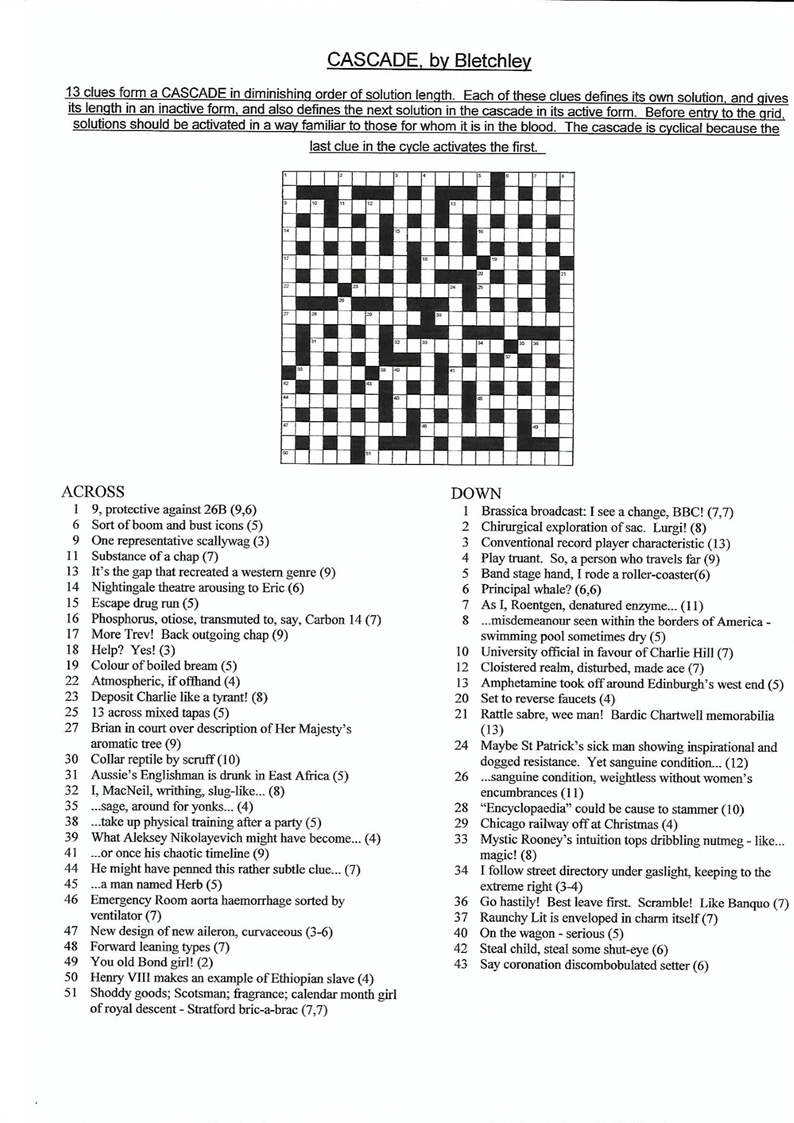
Last week I posted a particularly nerdish acrostic, and I was pleasantly surprised to be contacted by a couple of people anxious to have sight of the solution.  Ergo…    

Solution to Cascade

ACROSS

1 Christmas Factor

6 sonic

9 imp

11 reagent

13 spaghetti

14 erotica

15 elope

16 isotope

17 extravert

18 Aida

19 amber

22 airy

23 despotic

25 pasta

27 Britannica

30 turtleneck

31 pombe

32 limacine

35 ages

38 adopt

39 Tsar

41 isochrone

44 iambist

25 basil

46 aerator

47 non-linear

48 italics

49 yea

50 playa

51 Tatiana Romanova

DOWN

1 Chinese cabbage

2 surgical

3 stereotypical

4 astronaut

5 roadie

6 schoolmaster

7 nitrogenase

8 Crimea

10 proctor

12 academe

13 speed

20 spat

21 Shakespeariana

26 Haemophilia A

28 impedimenta

29 Noel

33 myristica

34 Neo-nazi

36 ghostly

37 charisma

40 sober

42 kidnap

43 street

The legend deciphered

The Cascade is based on the haematologist’s classical blood coagulation model, in which a series of molecules are sequentially activated, for example in response to trauma, to prevent blood loss by forming a clot.  Classically, 12 molecules were identified.  A thirteenth was later added.  They are activated in reverse order.  The initial trauma activates Factor 12.  Activated Factor 12 is Factor 12A.  12A activates Factor 11 to 11A which in turn activates Factor 10 to 10A, and so on.  (The current working model has become rather more complex.) 

To return to the legend:

13 clues form a CASCADE in diminishing order of solution length.  Each of these clues defines its own solution, and gives its length, in an inactive form…

These solutions are, in descending order:

Tatiana Romanov

Shakespearian

Churchillian

Haemophilia

Impediment

Britannic

Myristic

Charism

Erotic

Crime

Play

Aid

Ye

These solutions need to be “activated” before entry to the grid, by addition of the letter A.  Hence Tatiana Romanov becomes Tatiana Romanova, Shakespearian becomes Shakespeariana, and so on.  In addition, the clues defining these solutions also define the next solution in the cascade in its active form.  Hence, for example, the clue to erotic (14 across) must also define Crimea:

Nightingale theatre arousing to Eric (6).

The cascade is cyclical because the last clue in the cycle activates the first:

49 ac: You old Bond girl! (2)

“You old” is ye, activated to yea.  The Bond girl is from From Russia with Love.  Tatiana Romanova.

The most difficult two clues in Cascade are 1 across, and 26 down, because they require specialist knowledge.  Hack these, and you’ve hacked the whole thing.     

1 across:  9, protective against 26B (9,6)

Factor 9 in the clotting cascade is “Christmas Factor”.  If you lack Christmas Factor, you develop Christmas Disease, otherwise known as Haemophilia B.  Haemophilia A is Factor 8 deficiency.  “Weightless without women” is “eightless”.  “Encumbrances” defines the next solution in the cascade – Impedimenta.

I know what you’re thinking.  I need to get out more.   

Apologia

I must apologise to you, gentle reader, for Cascade, yesterday’s cruciverbalist’s overindulgence.  I am searching round for any extenuating circumstance that might mitigate this appalling lapse.  All I can say is that this is the season of overindulgence.  You consume an enormous turkey roast (in our case, pork – me and Nigella Lawson) and settle down to a Christmas crossword puzzle of gigantic proportions.  Have another mince pie, ho ho ho

I especially apologise that Cascade is not particularly legible.  I used a specific software package to construct the grid, but it and my blog site weren’t talking to one another.  I was minded to pack it in, but then I was on a mission, damn and blast, and determined to find a way.  Well I got there.  Bit of a Pyrrhic victory you might say.  I don’t seriously expect anybody to solve this acrostic.  Nonetheless I will post a solution – if I can figure out how – come the New Year.  Perhaps I will enlist the help of a teenager who will click the mouse on a few icons and say, “There you go.  It’s intuitive!”

Still, I’d rather occupy the twilit zone twixt Christmas and New Year doing a crossword than reading the 1243 pages of the EU-UK trade deal.  That’s longer than The Count of Monte Cristo!  And I imagine a lot less gripping.  I think I’ll stick with the executive summery. 

Christmas is traditionally a quiet day, and this year, with the travel restrictions, unusually so.  I walked up Callander Main St at dusk and it was entirely deserted.  I half expected to see tumbleweed wafting down the centre of the road.  Boxing Day brought Storm Bella.  Charlotte Bronte would have said, “There was no possibility of taking a walk that day”, but with the same stubbornness that made me post Cascade, I got happed up, went out, and got soaked to the skin.  Invigorating!  We had a light covering of snow on Sunday morning.  It was a beautiful winter’s day.      

So where are we?  Fourth Night, I think.  I always remember that come January 2nd, my mother would sigh with relief and say, “Thank goodness it’s over for another year.”  It’s traditionally a time of resolution, but who can now resolve to do anything, other than soldier on? 

An forward, tho I canna see,

I guess an fear!

But then while I was drying out and warming up after my encounter with Bella, I read, in one gulp, Viktor E. Frankl’s Yes to Life, In Spite of Everything (Penguin Random House, 2019).  Inspirational.  Dr Frankl makes a particularly powerful case against the idea of assisted suicide.  He speaks from a position of some authority.  He did after all survive Auschwitz.  Behind the wire, I don’t think I’d last a single day.  But who can tell?  We are taught to pray to be delivered from the trial.   

All you can do is that which you are supposed to carry on doing.  When I was a youngster I was full of resolutions, but now I only make one. Keep scribbling.