Hallucinations of Travel

On this winter solstice evening I will cast a glance – weather permitting – towards the western sky and try to catch sight of the predicted close alignment of Jupiter and Saturn, to form an apparent star of unusual luminescence, not seen for four hundred years.  Whatever chaos reigns on planet Earth, it is reassuring to know that the majestic clockwork still ticks along over our heads.  These planetary bodies are like the Mississippi; they just keep rolling along.  Maybe this is what the Magi saw.

I was thinking of the Magi on Sunday evening while attending a Zoom ceremony of lessons and carols.  Sometimes on these occasions – though not on this one – you hear a recitation of T. S. Eliot’s Journey of the Magi.  It is a remarkable poem, rich in imagery and symbolism.  But it is not a comfortable, far less a comforting poem.  On the contrary it is profoundly disturbing.  It closes with the expression of a death wish not unlike the death wish of another winter traveller, the protagonist of Schubert’s Winterreise, who pauses at a wayside inn, Das Wirtshaus, which is actually a graveyard.  The traveller enquires if there is any room in the inn.  Two songs later he observes a phenomenon of the heavens, much as the Magi may have observed Saturn-Jupiter.  Die Nebensonnen.  Ice crystals in the atmosphere refract the sun’s light to give an illusion that there are three suns – “mock suns” – aligned in the sky.  The traveller turns his back on them.

Im Dunkeln wird mir wohler sein.

I’d be better off in the dark.

Schubert’s forlorn lover travelled on foot, the Magi by camel.  We travel by Airbus A380 and we plan to travel by HS2.  The earth flashes by unseen.  It’s more a hallucination of travel, a kind of vertigo. 

Eliot’s poem seems to me to be the poem of this time, our time.  We can no longer be at ease in the old dispensation.  It has become clear even over the past twenty four hours that a vaccine is not likely to provide us with a quick fix for the predicament we are in.  The English Health Secretary Matt Hancock has said that the situation is out of control.  The Prime Minister’s bullish prediction earlier in the year that we would be back to normal by Christmas sounds more than ever like the predictions of August 1914 – Berlin this Christmas, then home.  In fact, if this thing only lasts for the duration of the Great War, we might count ourselves lucky. 

But surely the old dispensation is gone.  Surely we must not attempt to resume normal service.  Apparently not.  Last week the Supreme Court overruled the environmental objections to a third runway at Heathrow, and allowed planning to proceed.  HS2 is alive and well.  All roads lead to London.  Under the old dispensation, aeroplanes were taking off and landing at Heathrow every forty five seconds.  Why on earth would you want to cut this down to thirty seconds?  Why would you want to cut a swathe through the hedgerows of England just to get from Birmingham to London twenty minutes quicker, and make the journey sixteen times every hour?  I suppose it is because our beloved leaders are intent on making Britain great again.  London is a hub.  London is the centre of the world.  A “world leader”.  It does not seem to matter that casting an Airbus A380 into the air every minute is not compatible with the survival of the natural world, so long as we can get back to our old habits of conspicuous consumption.

There are these wonderful lines in Ben Jonson’s Volpone which exquisitely capture the death wish of the old dispensation:

…and could we get the Phoenix,

Though nature lost her kind, she were our dish.

Count me out. 

Special Measures

When a societal institution such as a school or a prison or a hospital is seen to be failing, the authorities, by which I mean the government, or a branch of government, or a government-appointed agency, moves in and places the institution under “special measures”.  The people running the show are either sacked or, perhaps more humiliatingly, rendered subordinate to a new dispensation.  (It’s like that scene in the movie Diehard in which the FBI descend upon the Nakatomi Plaza business tower block which has been taken over by the euro-gangster Alan Rickman.  The chief cop introduces himself to the Feds and says, “I’m in charge here.”  Special Agent Johnson (no relation to the PM) says, “Not any more.”)  So now the old guard need to do as they are told.  In the real world, the new directive from on high often takes the form a plethora of protocols under which the ousted and humiliated erstwhile seniority must cease to think creatively and merely carry out their allotted task by numbers.  They are required to stifle any initiative they may feel they have had, and function as cogs in a machine.  I say “plethora” deliberately, because the damning report that has come from the Royal Commission, or the independent judge-led report, may offer, and insist upon, a fantastic number, like three hundred and ninety six, or so, of recommendations.  

I wonder if the members of Her Majesty’s Government have any idea how close they are to being put into special measures.  It doesn’t matter whether you were a Brexiteer or a Remainer.  The idea of wrangling, for four and a half years, over the terms of the UK withdrawal from the EU, and at the end of that time coming up with nothing, is not merely unacceptable, or reprehensible, or damning, it borders on the absurd, the surreal, and the insane.

I think it was the F1 world champion Sir Jackie Stewart who once said that, while there are many people who can open a deal, there are very few who can close one.  In any walk of life, you need to be able to differentiate rehearsal and performance, training and racing, swotting for a test and sitting the test, debating and voting, coming to a decision, and enacting it.  The preparation is important.  In medicine, the doctor takes a careful history from the patient, carries out a physical examination, undertakes targeted investigations if necessary, collates data, reaches a diagnosis, considers how the diagnosis uniquely affects the patient, settles upon the proposed treatment, or management, of the patient’s illness, and then writes the prescription.  It has been a long and complex process, but in the end, the only thing that really matters is the prescription.  It doesn’t matter how elegant the consultation and diagnostic process has been; if you don’t decide on a treatment, and initiate it, the entire process has been futile. 

Of course doctors worry that their choice of treatment is misguided.  They may agonise over the decision.  They may confer with colleagues.  But in the end, that prescription still has to be signed off.  Failure to do so is an abnegation of responsibility and a tacit admission of utter failure, and defeat.

In terms of the current EU/UK negotiations, Michael Martin, Ireland’s Taoiseach, understands this.  He has said that an inability to get a deal over the line would be “an appalling failure of statecraft”.  But I do believe there are people in government who cannot discern the difference between process and progress. 

I don’t think the electorate will take kindly to the notion of a No Deal Brexit, not necessarily because World Trade Organisation rules are not the best, but because the government will have taken four and a half years to arrive at an arrangement which, in broad outline, could have been signed off, in 2016, on the back of a fag packet over morning coffee.  It is at that point that the electorate will send in Special Agent Johnson. 

What will he do?  Well, he will probably do all the things that governments do to failing schools, prisons, and hospitals.  He will introduce some stringent rules.  The diplomatic practice of “working through the night” at the last minute will have to stop.  Surgeons and airline pilots know they are dangerous people when they are tired.  Exhausted politicians or diplomats are not likely to make good decisions.  They need to manage their time better.  And the “working dinners” will have to stop.  Surgeons don’t munch a pie behind the sterile mask while removing an appendix, pilots don’t balance a Vindaloo on their knee while landing at Heathrow.  Of course, it goes without saying that the Palace of Westminster’s bars will have to close.  There are no bars in schools, prisons, or hospitals.  Special Agent Johnson will send in functionaries with clipboards who will perform time and motion studies.  Perhaps they will get the MPs to clock in.   

But much as the Schadenfreude of watching politicians squirm under the new austerity tempts me, I don’t really want them to don the straitjacket of three hundred and ninety six recommendations.  It always seems to me that, when a judge places an institution into special measures, the bigger the number of recommendations, the less likely it is that the judge has uncovered the real root of the institution’s problems.  He has not seen the wood for the trees.  Of course the devil is in the detail, but in any complex analysis, you need to be able to encapsulate the whole issue in terms that are simple whilst not simplistic, rather in the way that a theoretical physicist will study an immense number of apparently disparate phenomena, and come up with a unifying equation of great beauty and simplicity.  That sort of synthesis is not easy.  You need to be able to discern the fundamental structure of a problem, and then persuade your colleagues that the model you have created, and the solutions it generates, are correct.  The ability to model the world, and then convince colleagues of the model’s applicability, is what constitutes leadership.  That is as true of the problem of Brexit as it is of the problem of any ailing institution. 

Fishing rights, a level playing field, and rules of arbitration in disputes are said to constitute the barriers to a deal.  And yet the question of the Irish border remains.  It has always seemed to me that the Irish question is what has made a Brexit solution impossible.  At least it is impossible unless you are prepared to think the unthinkable, like Einstein, standing on a railway embankment watching a train being struck twice by lightning.  It’s impossible, unless you are prepared to think the unthinkable.

“The occasion is piled high with difficulty, and we must rise to the occasion.  As our case is new, so we must think anew and act anew.”  Where is Abe Lincoln when you need him?  I have a notion that if Abe Lincoln were Special Agent Johnson, he would advise us to revise these islands’ constitutional arrangements.       

A Long Time in Politics

MONDAY

As Christmas approaches, for the last 20 years or so I’ve been playing my viola in a ceremony of lessons and carols in Glasgow.  Each year, I take part in an elaborate gavotte of my own confection, in which I am asked to participate, and I assume an anguished air and say, “Oh I don’t know… I’m so rusty.”  Eyebrows are raised to the ceiling.  Then I agree to do it.  This theme had a variation this year as, understandably, the service will be virtual.  “Oh, I don’t know, you know, me and IT…”  Eyebrows are raised.  Then I said okay.  I had to watch the conductor and listen to the piano accompaniment, through earpieces, on one device, and record on another.  By some miracle it worked.  Greatly encouraged, I set about recording my contribution to an extended family birthday tribute to a cousin in the USA.  I was commissioned to recite a little Burns, and also to send a personal message.  I found myself quite unconsciously hamming up my Scottishness, raising a glass of particularly good Islay single malt, proposing a toast, and descending into some bastardised ancient highland patois. 

TUESDAY

Just when I thought I’d made peace with IT, I got an email from a financial institution with whom I do some business, to tell me that they had been hacked, and advising me to change all my passwords.  My first thought was, is this real?  I phoned them.  Yes, it was real.  I duly changed all my passwords, feeling a great nostalgia for the days of pen and ink, cheque books, high street banks with safes and vaults, and managers devoted to ideals of probity, confidentiality, and trust.  I’ve always thought that internet banking is a con.  The bank gets you to be your own bank teller, and so there is no need to employ one.  Everything is transacted online, so no need to have a High Street outlet.  The masters of the universe can sit back and watch the coffers swell. 

WEDNESDAY

Got home at dusk to see the multi-coloured flashing lights of two fire engines on the street, awfully near where I live.  But it wasn’t me.  It was a neighbour.  And it wasn’t a fire.  A carbon monoxide alarm had gone off.  It turned out to be a false alarm.  Now I don’t use gas, so I don’t have a carbon monoxide alarm.  But I wondered if I were being cavalier.  I do have a gas heater which I keep in reserve in case the electricity gets cut.  So I duly invested in a CO meter.  It came along with a heat detector.  At home, I have high ceilings.  I will spare you the excruciating description of my hapless attempts to install the heat detector.  I’m thinking of writing a series of tales about an inept antihero who barges through life leaving a wake of destruction behind him.  Captain Maladroit.  It will be largely autobiographical.  Up at the ceiling, I worked myself into a lather until I was overcome by a wave of intense nausea.  Maybe that was the effect of the carbon monoxide.  Whatever.  That’s it, with me and DIY.  Finito. 

THURSDAY

Got my overseas Xmas cards off.  It crossed my mind to include a Round Robin update that would be entirely confabulated.  “Elizabeth and Barbara are hugely enjoying life at Magdalen, and Gonville and Caius…”  I asked a fellow Glaswegian if he knew the nearest post office that would be open.  Have you noticed the way we Glaswegians have a habit of putting the accent of any denoting word on the second syllable?  “There’s a Post Office in Renfield Street.”

FRIDAY

On BBC Radio 3’s Composer of the Week, Donald Macleod reached the end of his year-long study, 250 years after the great man’s death, of Beethoven.  The week has been dominated by the late string quartets.  Somebody asked me to guess which Opus Mr Macleod would choose to end this huge project.  The end of the last quartet Opus 135?  I thought not.  Too quirky.  Muss es sein?  Es muss sein!  I went for the second movement of the last piano sonata, Op. 111, with its ethereal, other-worldly quality.  Music from beyond the grave.  In the end, Mr Macleod chose the last movement of the fifth symphony.  Good choice.  I will seize fate by the throat! 

SATURDAY

After Strictly (n my pnn, HRVY&Jntt r gng t wn), caught a snatch of The Wheel with Michael McIntyre.  It took me a while to figure it out, and I was reminded of Pointless, which took me forever to figure out because I’d flick on the telly to catch the six o’clock news and would only catch the dénouement.  Why would you want to score zero?  Pointless.  In The Wheel, helpful or sometimes helpless celebs orbit the contestant, one of three brought up from a dungeon, to choose one out of four answers in a series of multi-choice questions based on a variety of topics.  If the contestant gets the answer right, he or she lodges a considerable sum of money in the bank, and proceeds to the next question.  Get it wrong, and the contestant is sent back to the dungeon and the next contestant is selected at random (another revolving wheel).  Winner takes all, and can double the purse with a final question if not risk averse, or perhaps half it, or even leave with nothing.  Who devises these premises?  I’m sure if I’d heard the pitch on Dragons’ Den, I would have been like the man at Decca who turned the Beatles down, or the man in a hundred publishing houses who turned J. K. Rowling down.  “Let me get this straight.  You stick the contestants downstairs and may never see two of them at all?  That could cause resentment.  It’s like that Michael Caine movie The Prestige, in which an illusionist is despatched to an underworld and can only distantly here the appreciative applause of the audience.  I’m out!”

Yet I was gripped.  The man who eventually won £28,000 had a warm television personality.  He was devoted to his daughter, and also happened to be vertically challenged.  He had the audience vote, and their sympathy.  I was willing him to win.  Well, it wasn’t the Reith Lectures (Mark Carney this year I think).  Lord Reith must be spinning in his grave.                        

SUNDAY

It has been called “the last throw of the dice”.  David Frost still talks to Michel Barnier, and Boris Johnson still talks to Ursula von der Leyen, but they are running out of time, and Westminster is glooming us up that the UK and the EU may reach the end of the year without a deal.  If so it be, may I say I find this to be as utterly incomprehensible as it is utterly reprehensible.  Imagine taking four and a half years to do, precisely, nothing.  From the point of view of a medical practitioner, and especially an emergency physician, failure to make a decision is disgraceful.  That is not to say that in a given situation, doing nothing might not be the right option.  In medicine, this is called “masterly inactivity”.  I used to say to the anxious worried well, “Let’s hold our nerve, and keep a watching brief.”  You might even decide to stop doing something in order to do nothing.  An elderly patient on polypharmacy (is that a description of the UK, or the EU, or both?) is failing despite your best efforts, so you decide to withdraw all treatment to see what happens.  We call it “a trial of life”.  But making such a decision is not the same as indecision.  You have to make up your mind, and do so under the pressure of time constraint.  It seems to an emergency physician striving to make a difference within “the golden hour”, that to strive for four and a half years to do something, then fail to do anything, is to be weighed in the balance and found wanting.  That begs the question, whose fault is it?  “Ours”, or “theirs”?  I would say both.  It’s a collegiate failure, an inability to compromise, to find a way.  It’s a damning indictment of the ruling class.  Every day, refuse collectors pick up the refuse, nurses tend, carers care, teachers teach, midwives deliver, and undertakers bury, while government ministers shuttle diplomatically to and fro, and do, precisely, nothing. 

MONDAY

December 7th.  On this day, 79 years ago, “a day that will live in infamy”, the Japanese attacked Pearl Harbour.  And we all know how that ended.  So let us hope our politicians keep talking to our neighbours.  As Kate Bush said to Peter Gabriel, “Don’t give up.”              

Winter Journey

St Andrew’s Day.  “Official” winter starts tomorrow, but here in the heart of the Trossachs, yesterday was really a winter’s day.  1 degree Celsius.  The floods have receded in the Callander meadows, and I was able to walk by the banks of the River Teith, to the confluence of the two rivers that drain Loch Lubnaig and Loch Venachar, and then round Tullipan, a crescent of handsome villas nestling under the Callander Crags. The trim gardens border the road without fence or hedge, giving the neighbourhood a North American feel.  I could have been in Canada.  There wasn’t a breath of wind.  Nature is hunkering down.

Some people dread the winter, this one more than most, so full of uncertainty and anxiety as it is.  It’s not just Covid; there is the small matter of our departure into the mid-Atlantic in one month’s time, with as yet no sign of a deal with Brussels, and, more importantly, no convincing solution to the problem of a border between Northern Ireland and the Republic.  I admitted to somebody the other day that it had crossed my mind to buy in a few tins of sustenance just in case the supermarket shelves were suddenly laid bare.  I was asked, “How many tins?  Couple of hundred?”  The trouble is, if everybody does it, the shelves will be bare.  Hoarding is not good.  But maybe our angst is misplaced.  Do you remember the Millennium Bug?  At midnight on 31/12/99 aeroplanes were going to drop out of the sky.  The only excruciating thing that happened was that Tony Blair held the Queen’s hand to sing Auld Lang Syne.

I quite like winter, though I wish it didn’t last so long.  But I’m always struck by a sense of readiness for change as one season morphs into another.  Time to embark on the winter journey, wherever it will take us.  With this in mind, I got out my recording of Schubert’s Winterreise, sung by Jon Vickers, accompanied by Geoffrey Parsons, a rendition of great beauty and simplicity, with none of the portentous gravitas that is so often laid on with a trowel.

Fremd bin ich eingezogen,

Fremd zieh ich wieder aus. 

I came here as a stranger, and I will leave as a stranger.  It’s that Schubertian jilted lover again.  Sometimes I get impatient with him.  So she chucked you!  Get over it, mate.

Was soll ich länger weilen,

Daß man mich trieb’ hinaus?

Good question!  Why should I tarry here any longer, so that I can be thrown out?  In his Schubert’s Winter Journey, Anatomy of an Obsession (Faber & Faber 2015), Ian Bostridge translates weilen, to tarry, as “hang around”.  The last thing unrequited man ought to do is hang around.  Gute Nacht.

The trouble is, he never really gets over it.  What are we to make of Der Leiermann, the twenty fourth and last song in the cycle?  The Hurdy-Gurdy Man.  It’s so bleak. 

Talking of unfulfilled love, I happened to catch Brief Encounter on the telly the other night.  (And incidentally, talking of the telly, I couldn’t help noticing that BBC 1 put on Shakespeare’s Coriolanus at 12.50 last night.  I wonder what the viewing figures were.)  But back to Brief Encounter.  Trevor Howard and Celia Johnson fall for one another in a railway station tea room, embark, or nearly embark, on a furtive affair, and make one another thoroughly miserable.  Ms Johnson is married to a rather dull man who does crossword puzzles.  The Howard character, a GP with an interest in preventative medicine, finally departs on his own Winterreise, to Johannesburg.  At least he chose a good climate.  The soundtrack to Brief Encounter is, of course, Rachmaninoff’s Second Piano Concerto.  Rachmaninoff had suffered a nervous collapse because the composer Cui had written a vicious and damning criticism of his First Symphony at its première.  It might have finished Rachamaninoff for ever.  He went off on his own Winterreise, attended a therapist, recovered, and composed the second concerto.  Maybe this music explains why Yehudi Menuhin greatly admired Brief Encounter.  There is a story – perhaps apocryphal – that during the film’s first night, somebody addressed Trevor Howard from the back stalls.  “When are you going to **** her?”  I don’t think that would have been Lord Menuhin. 

Anyway, as we all embark on our Winterreise, we must make sure we don’t get down in the mouth.  But personally I think we should postpone Covid Christmas until we get a vaccine.  As King Lear said to Gloucester, “Thou must be patient.  We came crying hither.”        

Das Mobbing

Is Priti Patel a bully?

Sir Alex Allan, the Prime Minister’s independent advisor on ministerial standards, thinks so.  He found her conduct – shouting and swearing at civil servants – had broken the ministerial code.  The Prime Minister thought otherwise.  There was no need for the Home Secretary to resign.   In the end, it was Sir Alex who resigned.  And this has all occurred, ironically, during anti-bullying week.     

Does this mean that the Prime Minister does not think the Home Secretary is a bully, or does it mean that he does not think badly of her for being a bully?  The Prime Minister’s great hero is Winston Churchill, and there can be little doubt that Churchill could be a bully.  Clemmie wrote to him about it, gave him a sharp reprimand, and told him to stop being “Hunnish”.  He duly modified his behaviour; he probably wouldn’t have taken the advice from anybody else.          

What exactly is a bully?

Chambers:  bully n. a cruel oppressor of the weak: a blustering, noisy, overbearing fellow: a ruffian hired to beat or intimidate anyone…

Well, we’ve all met them.  I can remember a classmate of mine complaining to a teacher that he was being harassed by an older, bigger boy.  The teacher advised him to ignore it.  “Sticks and stones will break my bones, but names will never hurt me.”  That is manifestly untrue.  People have been driven to suicide by relentless name-calling.  The “sticks and stones” mantra lets the authorities off the hook.  It means they don’t have to intervene in the persecutions that occur in the school playground. 

Sink or swim.  I think that is what characterised all of my educational life.  School, the University Air Squadron, undergraduate medicine… indoctrination by humiliation and intimidation.  We were all pushed around. If you could stand the pressure and hold out, then after a while they would cut you some slack.  If you went under, well, too bad.  Does that mean we were all bullied?  No.  The essence of being bullied is not that you are in agony, but that you are alone. 

A handful of images from school, the RAF, and medicine:  I can remember a boy with a calliper, a great, rusting, clunking fetter – I guess he’d had polio.  He always stood alone in a remote corner of the playground.  We wouldn’t have considered playing with him.  It wasn’t that he was ostracised or sent to Coventry.  He was just invisible.  Occasionally, in the playground, a fight would break out.  A large, seething surging mob would surround the combatants.

“Ow – ow – ow –ow –ow…”

Then a teacher would wander out unhurriedly from the Old Building and break it up.

We were taught parsing and trigonometry but I don’t recall we were taught how to care for one another.

Towards the end of my two years in the University Air Squadron I spent two weeks at RAF Abingdon in Oxfordshire.  I got a lift down from Glasgow in an MGC sports car.  The journey took four and a half hours.  130 mph on the M1; when I think of it, my skin crawls.  I remember one morning attending a met briefing.  The expression “KAV-OK” came up.  At the end, the commanding officer said briskly, “Any questions?”  There were no questions.  Then he asked us, “What does KAV-OK mean?”  If memory serves me right, it means that visibility exceeds ten kilometres.  None of us knew.  We all got the traditional RAF bollocking.

I shared a room with a wide-eyed callow youth with floppy ears.  He was trying to jog my memory about something and asked, “Does that ring a ding-ding?”

What?”

I thought, you poor bastard.  I knew then that he was a member of what Graham Greene called “the torturable classes”.  Sure enough, one day half a dozen of the guys came in, pushed him around, trashed his gear, and completely soaked his bed with gallons of water.  The German for bullying is das Mobbing.  Well, this guy was well and truly mobbed.  I said to him, “You okay?” 

“Fine!”  He was on the verge of tears.  “Don’t worry.  Happens all the time.”  I helped him clear up and change his bedding.  It would never have occurred to me (nor I guess to him) to go to the Squadron Leader and seek help.  That would surely have shown a lack of moral fibre.  What would the CO have done? 

“At ease, gentlemen.  It has been brought to my attention that somebody is being picked on.  I don’t care what you think about this, one way or another.  But it will stop.  That’s all.”  I’m pretty sure that would have been it, because while we were at Abingdon a British European Airways jet crashed at Staines coming out of Heathrow.  Some of the guys drove up for a look.  There was a lot of bad feeling about it.  Was this mere professional interest, or ghoulish behaviour?  The CO dropped by.  We all stood up.

“I understand some of you chaps went up to Staines.  Now you may think that’s fine, or you may not.  Whatever you think, keep it to yourself.  There will be no more discussion of the matter.  Clear?”

“Yes, sir.”

My last sortie at Abingdon was an hour solo doing circuits and bumps.  I shared the circuit with a friend of mine, Craig.  Craig was crazy.  He would take a chipmunk and carry out verboten landings on disused wartime RAF airstrips.  I had to persuade him not to fly under the Severn Bridge.  Anyway there we were in the circuit.  I came round on to finals and Craig was on the runway.  He had called full-stop and he was dawdling.  I was at 300 feet.  Come on Craig, taxi left.  Expedite.  200 feet.  Get off the runway Craig.  100 feet.  Still not clear.  I was right down on the deck and he was still on the runway.  I applied full power, shimmied dead side, and “went round”, did another circuit, radioed “full stop complete”, and landed.  An instructor walked out to my plane as I shut it down, looking furious.

“What’s the minimum height to mandate a ‘go around’?”

“250 feet.”

“What height were you?”

I smirked and pouted, as if estimating heights and distances.  “Half an inch?”

He stared stonily at me and then suddenly burst out laughing, turned, and walked off. 

I worked for some crazy people in medicine – surgeons who would throw huge tantrums and cast instruments about the operating theatre, or have fits of apoplexy during a ward round because of some perceived minor mismanagement.  I remember as a medical student assisting an orthopod who was giving his anaesthetist, an attractive young lady, a hell of a time.  I thought, what’s going on?  In retrospect I think it must have been a kind of subliminal sexual abuse.  The consultant ward round could be an ordeal of terror for the medical students.  You would be summoned to the bedside to examine an abdomen and pronounce your diagnosis to a huge retinue.  Or a tricky question would be fired at you at random.

“What’s Foster Kennedy Syndrome?”

By some miracle I had read about it that morning.  “Optic atrophy in one eye, and papilloedema in the other, in patients with frontal lobe tumours.”  That particular consultant said nothing, but he never bothered me again.  In an entire career, I never once saw an instance of Foster Kennedy Syndrome.

The thing is, stress, pressure, and intimidation have been built into the structure and fabric of British society for as long as I can remember.  If things are changing, that must surely be for the better.  The events of last week suggest that the British Government are the last people to have noticed.       

How is your Situational Judgment?

There is currently a furious row ongoing in the undergraduate medical world about the Situational Judgment Test (SJT).  This is a test which medical students need to pass if they wish to undertake the first two years of postgraduate training (the foundation years) in the UK.  (That would be the case for most UK-trained medical students.)  They take the test towards the end of their undergraduate career.  The row has erupted because there seem to be insufficient places available in venues where you can sit the test.  For example, a medical student in Glasgow has had to book a slot in Harrogate (rail fare £300).  The issue of the wisdom or otherwise of travelling such a distance during the pandemic does not seem to have been addressed.  Students are exercised about all of this, the more so because if you fail the test, you can’t proceed with your career, you can’t resit for a year, and you can’t appeal. 

The SJT did not exist when I was a medical undergraduate.  Nor, for that matter, did the UKCAT test, a kind of cross between an IQ test and a daily newspaper’s puzzles page, which prospective medical students need to pass before they can even enter the undergraduate course.  I didn’t have to attend Edinburgh University for an interview, I didn’t have to forward a “personal statement”, I didn’t have to take a gap year caring for Venezuelan street kids, nor spend my summer in a drug rehab centre in Glasgow’s east end.  I just had to pass a few exams with semi-decent grades, and apply. 

So I was curious about the SJT.  I went online and researched it.  I found an online tutorial for prospective examinees.  It lasted about 90 minutes and, from the point of view of a student wishing to find out how to negotiate the test, I would say it was very good. 

The Situational Judgment Test does not assess clinical knowledge or skill, but ethical awareness, and more intangible aspects of being a doctor – the medical schools used to call them “attitudes” – such as empathy and kindness.  The test takes 2 hours and 20 minutes and is time-pressured.  There are broadly three kinds of questions, which I will exemplify. 

A small point: timing is everything.  I wonder if it as appropriate (appropriate – remember that word) to subject a young person to five or six years of rigorous training, and then, only then, almost as an afterthought, to enquire as to whether they are fit, morally fit, to undertake the duties for which they have been trained.  But that’s just a small point. 

All of the questions are based on a scenario.  I guess I could recount the scenarios put forward in the tutorial but I thought it would be more interesting to forward my own – not, note, scenarios I have made up, but scenarios that I actually experienced during my career.

In the emergency department you are asked to see a 12 year old girl who appears to be hyperventilating.  A staff nurse is coaxing her to breathe into a paper bag.  The girl’s highly exasperated mother says “Don’t encourage her by doing any tests.  Just tell her to pull herself together.”

You say to the patient, “Pull yourself together!”

A appropriate

B somewhat appropriate

C somewhat inappropriate

D inappropriate

Next option:

You say to the mother, “Do you mind if I have a chat with your daughter first?”

A appropriate

B somewhat appropriate

C somewhat inappropriate

D inappropriate

You say to the mother, “Don’t tell me how to do my job!”

A appropriate

B somewhat appropriate

C somewhat inappropriate

D inappropriate

You say to both patient and mother, “Do you mind if I carry out a brief examination?”

A appropriate

B somewhat appropriate

C somewhat inappropriate

D inappropriate

You say to both patient and mother, “I think there might be a medical problem here.  Do you mind if I take a blood sample?”

A appropriate

B somewhat appropriate

C somewhat inappropriate

D inappropriate

Next up, you are given a scenario, and then a list of five possible responses which you are asked to put in order of merit, from best to worst:

You are a newly qualified doctor working on a general medical ward.  A local GP sends in a 17 year old girl suspected of having glomerulonephritis.  She has hypertension, and protein in her urine.  While examining her, you find the patient to be pregnant, and, you estimate, at term.  She instructs you not to divulge this information to her family. 

A  You say to the girl, “Don’t be silly.  A thing like this cannot be hidden.  I must tell your parents.”

B   You say to the girl, “Do you get on well with your parents?  If so, would you consider telling them yourself?”

C  You arrange urgent transfer to a nearby obstetric hospital.

D  The patient’s father rings you to enquire after the health of his daughter.  You say, “It’s confidential.  I can’t tell you anything.”

E  You say to the father, “I can’t give you an up-to-date report, but I can tell you we have transferred your daughter to St Elsewhere Maternity Pavilion.  Here is the contact number.”

And finally, you are given a scenario, and then a list of eight possible responses from which you must choose the three most appropriate:

You are working in the emergency department and a staff nurse informs you that an attending junior doctor is ordering narcotic analgesia for his patients, and insisting he himself administer the injections.  The staff nurse has reason to suspect the doctor is injecting himself.

A  You tell the staff nurse just to get on with her own work.

B  You ask the nurse to explain the grounds for her suspicion.

C  You inform the senior Charge Nurse on the floor, and discuss the situation.

D  You ask the doctor’s patient if he has been given an injection.

E  You confront the doctor, and demand that he confirm or deny the accusation.

F  You set up a sting operation in which an actor posing as a patient asks the doctor for pain relief and you install a hidden camera to record the result of the sting.

G  You contact the police.

H  You inform the doctor’s clinical supervisor (consultant) of the nurse’s suspicions.

How did you get on? 

My responses for the first scenario, the hyperventilating girl with the paper bag, were D A D A A.  I have a notion that the UK Foundation Programme Office (UKFPO) would have gone for D A C A A.  After all, there is some merit in pointing out to the mother that you really need to practise medicine conscientiously, as you have been taught.  But “Don’t tell me how to do my job” sounds very abrupt, and is likely to antagonise.  There is nothing to be gained by it, and an awful lot to lose.  Generally, I would tend not to use the “somewhat” options.  Medical decisions of all types had best be clear-cut.  A clinical sign is present, or it is not.  A clinical diagnosis is accurate, or it is not.  You cannot be somewhat septic. 

But by and large I don’t think many medical students would struggle with this question, even if they might struggle with the scenario in real life.  A far more interesting question (this is one for medical students) would be this:

If you could only do one test, you would measure:

A  Full blood count

B  Urea and electrolytes

C  C reactive protein

D  Blood glucose

E  Arterial blood gases

I went with E.  Second best option is D.  That would have told me that the patient had diabetes.  The gases told me she was profoundly sick, probably due to diabetic ketoacidosis.  Now you may say this would not be a fair question to appear in a Situational Judgment Test.  But you can see that the division between clinical acumen and a good bedside manner is entirely artificial.  You are always thinking to yourself, “How can I achieve the best diagnostic and therapeutic outcome while carrying the patient and her loved ones along with me?”

Second scenario:  the occult teenage pregnancy.  Put the 5 responses in order from best to worst.  My answer was C B E D A.

Note that these responses are in order of merit, not order of chronology.  This patient has preeclampsia, therefore the overriding clinical consideration is to deliver her to the right location, and deliver her at the right location.  C comes first.  D is an interesting response.  I don’t think a doctor would land in trouble for telling the father nothing.  After all, that is what the patient has requested.  But I put E ahead of it.  Sometimes, in the interests of humanity, you need a little wriggle room.

Third scenario: the doctor addicted to opiates; best 3 responses out of 8.  Mine were B C and H.  I would still opt for these, but I’m not sure the end result was satisfactory.  The consultant blew his stack, came down on to the floor, confronted his junior, gave him a tremendous bollocking, and suspended him.  But then the junior went to his lawyers and then the whole thing went sub judice and dragged on for years. 

Well, it’s all good fun and certainly instructive to ponder ethical issues and approaches to sensitive areas of human communication.  But I have to say I think the Situational Judgment Test is an absurdity.  You can’t separate out human kindness from clinical professionalism.  Cum Scientia, Caritas, as the Royal College of General Practice has it.  And the idea of reducing Caritas to a series of tick boxes is grotesque.  As you might predict, the marking system for the SJT is absurdly complex.  The SJT is an ivory tower, a ziggurat of burgeoning buttresses and ramparts designed by a remote conclave of academics to ensure its own perpetuity.  They should demolish it, roll up their sleeves, and see a few patients.

Of course most medical students will just shrug and sit the test.  They’ve spent their whole lives leaping hurdles.  You could ask a medical student to index the telephone book by ascending order of the phone number rather than alphabetical order of the names, and they would just get on with it.  Perhaps it is only later in life that you develop a nose for these occasions when you are being asked to paint coal.  Jobs for the boys.  I have a horrible feeling that if now I were sent from Glasgow to Harrogate to sit the test, I would screw the exam paper up into a ball, throw it at the invigilator, and say, “You can stuff your SJT.”           

The Cull

I ran into my good friend Dr Alastair Cameron-Strange the other day in Edinburgh’s New Club and we stopped for a right good blether.  He told me about this strange dream he’d had.  It was a dream about his last day at work as an emergency physician, putatively thirty-five years hence.  “Actually, Jimmy, it was more of a nightmare” – and he described it at some length.  I’ve tried to reconstruct the narrative as best as my memory will allow.        

Midsummer’s Night saw the close of the last day in harness for Emeritus Professor Lord Cameron-Strange, of Trotternish and Te Paki, OM, CH.  As increasingly had become his custom, he had taken a stroll from his highland fastness to a remote copse – the magnificent carpet of bluebells had wilted by now – and the remains of an ancient broch of the Iron Age.  Here within the dilapidated rubble of the double stone walls he would sit; here he would forget for a time the cares of the world, count his blessings, and mutter a prayer of thankfulness for that which he had.  Ich habe genug.  Sometimes, if he forgot to switch off his mobile, he would get a call.

“Alastair where are you?”

“I am at broch.”

And his colleagues would know, save in dire emergency, not to disturb him.  Well, it was twenty minutes to midnight.  Surely they wouldn’t call him now.  He leaned back against the antiquated, mossy dyke, and glanced up at the green canopy over his head.  It was warm and close.  There was a sultry heaviness in the air.  From a distance, he imagined he heard a low rumble of thunder.  Soon there would be a deluge.  He glanced now at his phone – a new one, very smart – and he reflected on the events of this his last day, a day which had turned out be so unusual.

He had hoped to spend the morning in the emergency department at Little France, clearing his desk, prior to a convivial luncheon, courtesy of Boeringer Ingelheim, during which friends and colleagues, and perhaps a few enemies, would slap his back, say a few kind words,  and wish him, hopefully, a long and happy retirement.  But it was not to be.  He got the call from Whitehall, and after all, up until midnight he was still N-MASS, the National Medical Advisor to the Security Services.  He said, with frank irritation, “Can’t the next guy deal with it, whatever it is?  Can’t it wait?”

Apparently, it couldn’t wait.

Abject apologies to his colleagues, a wistful glance at the white table cloth, bedecked with finger-foods, sandwiches and sausage rolls, then another hair-raising ride on HS3, gazing morosely out at the green blur of Lincolnshire.  What did they want of him?  Probably nothing at all.  It would just be another manifestation of the profoundly British obsession with form and process.  The Ship of State was becalmed in the doldrums, and happy to be so.  It was only when the Ship of State felt herself to be under threat, that she could be seen to mobilise with frightening rapidity.

Three hours later he was in the committee room of the anonymous building off Storey’s Gate, staring resentfully at the other twelve members of the Witanagemot.  It occurred to him that none of the original members of this committee, as it was constituted when he had first been seconded, still sat.  He had seen them all out.  And he had never been a committee man.  Fancy that! 

Syrinx, in the chair, called the meeting to order.  “Professor!  Thank you for your prompt attendance.  Another chance for us to wish you well, now that you are hanging up the stethoscope.  We have had a long and fruitful association, have we not?”

“Roller coaster ride for us both I think.”

“How will you spend your time?”

“Lots of aviation, for as long as the eyesight and hearing hold out.”

“Where will you base yourself?”

“Waipapakauri.”

“Ah!  Of course.  Your southern bolthole.  Well I’m sure we all envy you that.”

“Syrinx.  You haven’t summoned me here just to give me another golden handshake.”

“Of course you are right.  We would like you to undertake one final task on behalf of HMG.  It is not an onerous task, and it certainly won’t be time-consuming.  Actually it’s largely ceremonial.  It will only take a second.  Literally.  A leap second.  You are aware that the masters of the universe are adding an extra second on at midnight?  Something to do with the music of the spheres.  Don’t ask me.  I did Greats at Oxford.  But I gather we need to keep the majestic clockwork in kilter.”

“I think I saw something in the papers.”

“Splendid!  Anyway, that is when we would like you to carry out the ceremony.”

“What ceremony?”

“First we must set the scene.  Serendip?”

The Permanent Undersecretary, a slim young man with aquiline features and rimless spectacles, cleared his throat and clasped his hands on the table.  He spoke fluently, without notes.

“So.  The world is facing a combination of challenges that increasingly look to be insurmountable.  We are all aware of them.  For at least forty years the international community has been cognisant of half a dozen disparate threats, and has done its best to combat them.  What we have perhaps been slow to recognise is the synergistic effects of these threats one upon another.  The entire threat to humanity is greater – logarithmically greater – than the sum of the parts.  All the indications are that we have reached a tipping point, un point d’appui if you will, beyond which further attempts to ameliorate a deteriorating situation are, frankly, futile.  This inescapable fact has been brought into sharp relief this morning by the news that the Secretary General of the United Nations, Ms Thunberg, has resigned.”  

“I’m very sorry to hear that.”

“It need hardly surprise you that the critical factor for her, inter alia, has been the sustained rise in average global temperatures by four degrees Celsius.  The opening up of Antarctica to mining and other industrial activity, combined with the exploitation of the North-West passage by shipping, has made it a mathematical certainty that the entire ice pack of Antarctica and Greenland will calve, migrate, and then melt, resulting in a global rise in sea level of approximately 100 metres.  The map of the world will be redrawn, and it will be unrecognisable.   

“This will of necessity lead to our next challenge – the mass migrations of peoples.  A generation ago we were concerned about attempts by, perhaps, one hundred people daily, to cross from North Africa and the Middle East to Europe.  We now face the prospect of hundreds of millions of people on the move in search of higher ground.  It is hardly surprising that there has been a hardening in attitude, even, or perhaps especially, in the liberal democracies of the west toward both economic migrants and seekers of asylum.  Barriers are going up.  Walls are being built.

“With the emphasis on defence and security, the attempt to rid the world of nuclear weapons has long been abandoned.  The nuclear club, which for a considerable period of time was an exclusive club of nine, now has fifty six members.  The nuclear stockpile has quadrupled, and the hardware has become more sophisticated, and deadlier.

“Now that the Amazonian rain forest has ceased to exist, the systematic extermination by Homo sapiens of every other species on the planet has caused crucial disruptions in the food chain which means that food security for even the wealthiest nations can no longer be guaranteed.  The oceans are acidic, and fish stocks are rapidly dwindling.

“The deficit loss in the phenomenon of photosynthesis has now become measurable.  The partial pressure of oxygen in the atmosphere at sea level has fallen below 150 mmHg, and the content of carbon dioxide has risen to 0.05%, which may sound low, but has resulted in a measurable increase in the respiratory rate for all of us. 

“The regular appearance of new viruses with which our immune systems cannot cope, and their equally regular and sometimes rampant evolution to combat our attempts to find effective vaccines, is an ever increasing threat.  In addition, bacteria have rediscovered the virulence they enjoyed during the middle ages, and there is no longer any antibiotic molecule on the market which does not encounter fierce resistance. 

“So… Syrinx, have I left anything out?”

“Serendip, you have left out the elephant in the room, the mastodon in the auditorium.”

“Being?”

“Overpopulation.  We have topped the twelve billion mark.  Gentlemen, we just cannot go on like this.  You see where this is going.  Professor?”

“Spell it out for me.”

“You must know that there is going to be a cull.”

“…”

“Professor.  You know, don’t you, that there is going to be a cull.”

“Yes.”

“The critical point to apprehend is that all of the crises enumerated, all of them, are man-made.  Therefore if we are to find a solution to the predicament in which we find ourselves, we must look to ourselves.  In short, gentlemen, we are the problem.  That is why we have taken the executive decision to diminish the human population of the world through an humane and beneficent agency, rather than passively sit back and await the inevitable carnage that must result from inertia and inactivity.  When the deed is done, the Prime Minister will address the nation from the podium outside No 10, and she will explain that difficult decisions have had to be taken.”

Alastair Cameron-Strange asked, “This cull, how is it to be brought about?” 

“Hmm.  Covid45 afforded us a great opportunity.  Here was a resurgence of the Black Death.  Who would not wish to be protected?  When a viable vaccine became available, who would not wish to avail himself of it?  The mass vaccination programme organised by the WHO and financed by some of the world’s great philanthropists brought about an uptake that far exceeded the projections of our scientific advisors.  It gave us the opportunity to implant CHERF into specified subclasses of the human organism.”

“CHERF?”

“Compound haptoglobin euthanasia receptor factor.  A switch, as it were, which, when activated, will bring about a peaceful and painless demise.”

“Specified subclasses?  You have preordained the cull population.  I wonder, what were your criteria?”

“We used an Australian points system.  Points for, points against.  We used SPLURGE.  It’s a very sophisticated algorithm.  What does the world need?  Esprit de corps.  Zealotry of the highest mould.  What must the world delete?  Feeblemindedness, lack of moral fibre.”

“How is CHERF activated?”

“There is an App.”

“Normally, I find invocation of the spectre of the Führer seldom to be helpful in contemporary public and political discourse, but I must say, Herr Hitler would have been proud of you.”

“Now look here, Professor, there’s no point in being sentimental about this.  If we don’t act now, we have to face the possibility that the planet will become such a toxic and inhospitable environment, that our species might not even survive this century.  We risk extinction.”

“How many people do you propose to cull?”

“1.2 billion.”

“10% of the population.”

“In the first tranche.”

“You envisage further tranches.”

“Computer models have indicated an optimal world population.”

“What is this optimum?”

“Again, 1.2 billion. “

“You intend to exterminate 90% of us.”

“I think exterminate is rather an emotive word.”

“It certainly is.  Why are you telling me this?”

“Because, Lord Cameron-Strange, you are to be afforded a rare and signal honour.  We wish you to activate the App.”

“I see.  Why me?”

“Because it is very important that politicians, and the military, be seen to be removed from the process.  The Cull is not an act of aggression.  On the contrary, the Cull is a public health initiative.  Its implementation must be seen to be firmly in the hands of the medics.  You, Lord Cameron-Strange, if I may make so bold, are now recognised – at least by those with access to the corridors of power – as the greatest medico on the planet.  Oh no – no false modesty, please.  It is simply a fact.  People will accept the necessity to carry this out, if it comes from you.”

“Have you run this by the legislatures of the world’s 209 states?”

“That has not been deemed necessary.  Of course the Security Council of the UN is fully apprised.  But the logistics of this undertaking have been largely taken on by Big Pharma and the Great Tech Giants.  They greatly value your input.”

“I am like the athlete who carries the Olympic flag.”

“Just so.”

“Or perhaps, who lights the eternal Olympic flame.”

“Even more apposite.”

“And how do I carry out this task?”

“Very simply.  Here is a mobile phone.”

It slithered across the mahogany board room table. 

“And here is a telephone number.”  Written on something resembling a credit card.  “You send a text to the number.  ‘Activate CHERF’.  And press ‘send’ precisely at midnight, which will be the inauguration of the leap second.  Simple!”

At this point, the thought processes of Alastair Cameron-Strange were moving rapidly.  Look squeamish, declare any scruples now, and I will never leave this building alive.  Buy time.

“I have a return train ticket this evening to Bella Caledonia.  May I perform this duty from home?”

“Actually we would prefer it.  Go up to Scotland by all means.  We would prefer this initiative not to emanate from London.  Too much colonial baggage.”

“I see.  Well, gentlemen, that seems clear enough.  Thank you for such a frank briefing.”

“That’s the spirit.  We knew we could count on you.  A long and happy retirement!”

And now, here he was, at broch.  It was 11.45, yet, despite the growing heaviness of the atmosphere, not yet completely dark.  There was another grumble of thunder, nearer this time. The torrential downpour could only be minutes away, and the leafy canopy overhanging the ancient Iron Age dwelling afforded scant shelter.  Still, he was glad to be here, at the end of the world. 

He took out his newly acquired phone.  Well, it was a phone, like any other phone.  Why not make a call?  He tapped in the number.

“Hi!”

“Caitlin.  Where are you?”

“KL.”

“Kuala Lumpur?”

“Yes Ally, that KL.”

“What are you doing there?”

“Lying on a beach.  But not for long.  Back to the airport this afternoon.  And back in London tomorrow.  The LSO beckons.  Where are you?”

“I am at broch.”

“You’re always at broch.”

“Caitlin listen to me.  Will you do something for me without asking me why?  Don’t fly to London.  Are you carrying your NZ passport?”    

“Always.”

“Get on the first plane to Auckland.  When you get there, hire a car and drive up to Ninety Mile Beach.  Don’t stop on the way.  Stay in the bach.  If you need to quarantine, the Whanau will keep you in supplies.  Got it?”

“Something’s come up, then?”

“I’ll explain.”

“Are you coming too?”

“As soon as I can.”

“When will that be?”

“Soon.”

“You’re not coming, are you?”

“Caitlin, I can’t explain.  But promise me you will do this thing.”

“I promise.”  That was the great thing about Caitlin.  She was every bit as crazy as ACS.

“Love you.”  He quit the call. 

Five minutes to midnight.  Alastair Cameron Strange carefully removed the SIM card from the mobile.  He dug a hole in the soft loam and buried it deep.  Then he sat back against the stones of the broch’s inner wall and watched as the digital display of the phone crept towards midnight. There was a loud crack of thunder directly overhead.  And the first few heavy drops of rain.  Impassively, he watched the clock.

Five four three two one

Precisely at midnight the pulse of lightning was as brief as the flash of a camera.  In that split second he saw them.  The bronzed, woded, men, women and children, half naked, in tattered scraps of animal skin, sat with him in a circle round the confines of the broch, watching, waiting.        

Bread and Circuses

All Saints Day.  60 years ago today, at the Old Bailey, a jury of nine men and three women found Penguin Books not guilty of offences under the Obscene Publications Act.

I was covertly reading Lady C – the wives and servants edition – under my desk, when I became aware of the diminutive form, at my elbow, in the tired, faded blue pinstripe suit.  Wee Peem glanced at the Penguin on my lap, raised a quizzical eyebrow, and held out his hand.  I bit my lip and handed over the book, thinking, this is the end of the world as I know it.  I will be reported to the highest authority.  The headmaster will come on the blower and announce to the school that I am a filthy fellow.  I will be placed on some kind of register. 

There was a long and electric silence.  The entire class held its breath.  Peem opened the book at random and thoughtfully read a paragraph.  He then intoned:

“…burning out the shames, the deepest, oldest shames, in the most secret places… the same on the Greek vases… the deep, organic shame…”

Peem closed the book, and handed it back.   

A silver lining to the Covid cloud – the cancellation of Halloween.  Actually it was such a foul night that I doubt if anybody would have gone tricking or treating even at the best of times.  (Earlier in the day I had walked up Dumyat at the western end of the Ochils and been nearly blown off my feet.  It certainly blew away a few cobwebs.)  And now, with any luck, Guy Fawkes will also turn out to be a damp squib.  I haven’t yet heard any whizz bangs in my neighbourhood. 

Then Remembrance Sunday promises to be a low-key affair.  And already the politicians and the scientists are united in glooming us up for a blue blue Christmas.  It’s all sheer balsam for the curmudgeon.  So long as there’s bread, never mind the circuses.  I suppose people will do their best to have some kind of virtual midwinter festival.  I’ve frequently heard it said that Covid has allowed the digital world to come into its own and show its worth.  But it seems to the curmudgeon in me that quite the opposite is true.  It is as if Mother Nature has said to us, “So you think it is better to exist virtually than to be living breathing flesh and blood in a living world?  So let it be…”  And then we were inflicted with a pestilence.  We are all castaways on our own arid desert island, of radius two metres, listening to our desert island discs, on Spotify. 

I was driving my car on Halloween when BBC Radio 4 announced the death of Sir Sean Connery.  I confess I had to pull over.  It’s not that long since I raised a glass to him, on his ninetieth birthday on August 25th.  And now he is gone.  Unaccountably I recalled another sombre car radio announcement from forty years ago.  As a medical student in 1980 I was driving from Edinburgh through to Monklands Hospital in Lanarkshire (it was a paediatric attachment) and I paused in the Meadows to pick up my friend Thor.  As Thor got into the car the radio announced that John Lennon had been murdered.  Now why should I connect the quiet culmination of a long and rich life with the sudden and violent demise of a man of peace who, it seems increasingly to me, had an awful lot still to give to the world? 

The answer lies in the 1960s.  The fact is that the two great phenomena of popular culture in 1960s Britain were Bond, and the Beatles.  That in itself is strange.  Bond’s creator, Ian Fleming, was born in 1908, and the Beatles were all born during the Second World War.  They were a generation apart.  Bond was really a creation of the 1950s.  It’s true that Bond books sold well from the start – Fleming wrote one a year – and each successive novel drew increased attention, to the extent that From Russia with Love was one of President Kennedy’s professed ten favourite books.  But it was really the Bond movie franchise that brought Fleming to the world’s attention, and brought his creation global fame.  And this started in 1962 with Dr No, starring Sean Connery.  Ian Fleming was initially dubious about the choice of Connery for the role, but he increasingly came to admire Connery’s interpretation.  He certainly admired the box office success.  It has always struck me that Fleming’s swiftly deteriorating health in the 1960s must have been all the more bitter for him, with the realisation that his literary creation was about to make him a phenomenally rich man.  

Dr No was released on the same day as Love Me Do.  There is nothing in the Bond canon that in any way presages or reflects the Beatles.  The only reference to British pop music comes in Thunderball when Bond takes a taxi ride from a young man who Bond imagines to be a beatnik who admires Tommy Steel.  Bond treats the young man with courtesy but there is no denying the sense of class distinction.  Bond, like his creator, was an old Etonian, albeit briefly.  I rather imagine that that taxi driver would turn out to be wild for the Beatles, but that the Beatles would largely pass James Bond by.  And now Bond 25 (or is it 26?  I confuse it with COP 26) is on ice.  Maybe it will end up going “straight to video”. 

President Trump has called Sean Connery “a great actor and an even greater man.”  He says Sir Sean helped him get planning permission for a “big development” in Scotland.  Something to do with golf, I think.  Trump, Connery, Fleming, Bond, Goldfinger.  All golfers.  Who knows where truth ends and fiction begins?  I wouldn’t like to make a confident prediction of the outcome of the US Presidential election, except to say there will be some kind of muddying of the waters, a hanging chad.    

Disparate thoughts on Margate sands.  “Only connect.”                                            

Hirsute! The Autobiography

But my brother Esau is an hairy man –

But I, am a smooth man.

2nd Kings, 1, 14.

Actually, it isn’t the first verse of the fourteenth chapter of the second book of Kings, except in the immortal Alan Bennett sketch in Beyond the Fringe, in which Bennett mocks the hackneyed tropes and cadences of an Anglican vicar.  I have the original LP, which might be something of a collector’s item, except that the vinyl (shellac?) is so scratched as to make it virtually unplayable.    

Anyway, for the record, I am an hairy man.  I grew my first beard as soon as I left school.  It took a fortnight.  It was the fortnight of the Glasgow Schools First Orchestra’s summer course.  Nobody seemed to mind that this increasingly disreputable-looking vagrant occupied a desk in the viola section.  I think I shaved it off on the eve of the concert performance (Tchaikovsky’s Fantasy Overture Romeo and Juliet, the Bruch G minor Violin Concerto, and Brahms 4). 

I grew it again in the summer following First MB at Edinburgh Med School.  I was staying in a croft in Benbecula on the Outer Hebrides, building a fence, helping the farmer next door to bury dead sheep, and walking Jet, our beloved family dog, along a vast and beautiful west coast beach.  Why would you bother to shave?  I was a composite of Charles Darwin, James Clerk-Maxwell, and Brahms.  I don’t wonder that eighteenth century gentlemen allowed their beards to burgeon so exuberantly.  Mind you, you would have thought the gentler sex might have objected.  Maybe this is why Brahms and Clara Schumann never got together.  “Johannes!  Last night’s dinner’s buried somewhere in there!  Wo ist deine Rasierklinge?”  I dare say Gillette, Wilkinson, et al, were yet to perfect an adequate blade.  Indeed, I can remember as a youth frequently shaving of a morning and then coming down to breakfast, my face a mosaic of bloodied Kleenex fragments.  The best a man can get.  Fortunately, blade technology has moved on.          

My Benbecula beard took me through medical school.  In these days, medical students were kept away from patients until they had absorbed, and regurgitated, a great splurge of factual material relating to the medical sciences.  Then we were awarded a BSc.  So it was perfectly possible for medical students only to find during the fourth year of the course that they didn’t actually like patients.  Most medical schools around the world now offer an “integrated” course in which students are exposed early on to the reality of clinical life, but I still have a notion that Edinburgh, conservative as she is, retains much of the old model.  As it happens, the medical faculty made some radical changes to the undergraduate curriculum while I was in the thick of it.  I wrote a piece for the Royal Medical Society rag, Res Medica, arguing that the changes were cosmetic and that nothing of significance had changed at all.  A sub-Dean took me aside and remarked, with apparent good humour, “Campbell, you will go far, so long as you don’t go too far.”  And as I was about to start pacing the wards, and looked like Rasputin, I was also gently prompted to shave the beard off.  I think I compromised and acquired an efficient beard trimmer such that, rather than Rasputin, I looked like an international terrorist.  I went off on my medical elective to Papua New Guinea and the beard flourished once more.  I have a picture of myself climbing up a Pandanus tree dressed only in shorts, looking so hirsute as to be, well, really quite at home in that environment. 

For graduating MB ChB, I decided to shave.  One evening I announced to the occupants of the Royal Medical Society library that I was retiring to the rest room to carry out the act.  When I returned, clean-shaven, everybody screamed and clutched their throat as if they’d been confronted by a monster – perhaps they were – and collapsed to the floor. 

I can’t quite remember when the beard returned, but it was certainly there for the fifteen years, give or take, I spent in the Antipodes.  I was bearded during the 11 years I spent in Middlemore Hospital Emergency Department, South Auckland.  Incidentally, there is currently a move afoot to rename the Emergency Department Te Tari Rongoaa Ohorere.

The Place of Sudden Medicine.

Isn’t that beautiful?

One morning, I woke up and realised I needed to go home.  I was Senior Lecturer in Emergency Medicine in the University of Auckland Medical School, I had a circle of good friends, I loved to fly light aircraft out of Ardmore just south of Auckland, and I lived in Devonport on Auckland’s beautiful north shore.  Why would I want to give any of that up?  I didn’t know why then, and I don’t know why now. 

But now here’s the thing.  I flew from Auckland to London via Singapore.  I stopped off at the Sheraton Towers, 39 Scott Road, Singapore, and I shaved my beard off.  The man who left Scott Road was unrecognisable – a reincarnation of Doctor Who.  I can dress it up as a kind of compulsion for reinvention, but I know it is symbolic of something that is at heart destructive.  For some reason, the idea of building a coherent life has been utterly alien to me. 

The beard has not since reappeared.  And yet I can sense it is just there.  Personally, I blame Covid.  Every morning I get up and go to my local shop for the newspapers.  I wear a mask, so, no need to shave.  By the same token, nobody can cross my door, so why bother to vacuum?  Standards are slipping.  And for sure, the hirsutism threatens to be ever more rampant.  Why is it that there is no effective and viable nasal hair trimmer on the market?  The ears get ever hairier.  Interestingly enough, aside from the assignation of male gender, the hairy ear is the only other piece of genetic information the Y chromosome carries.  What is that all about? 

And the stubble is getting ever stubblier.  Stubble encroaches so close to one’s mouth that I dread I will soon need to shave my lips.   Then there are the malars – the cheek bones.     

I’m turning into a werewolf.        

The Rewilding of JCC

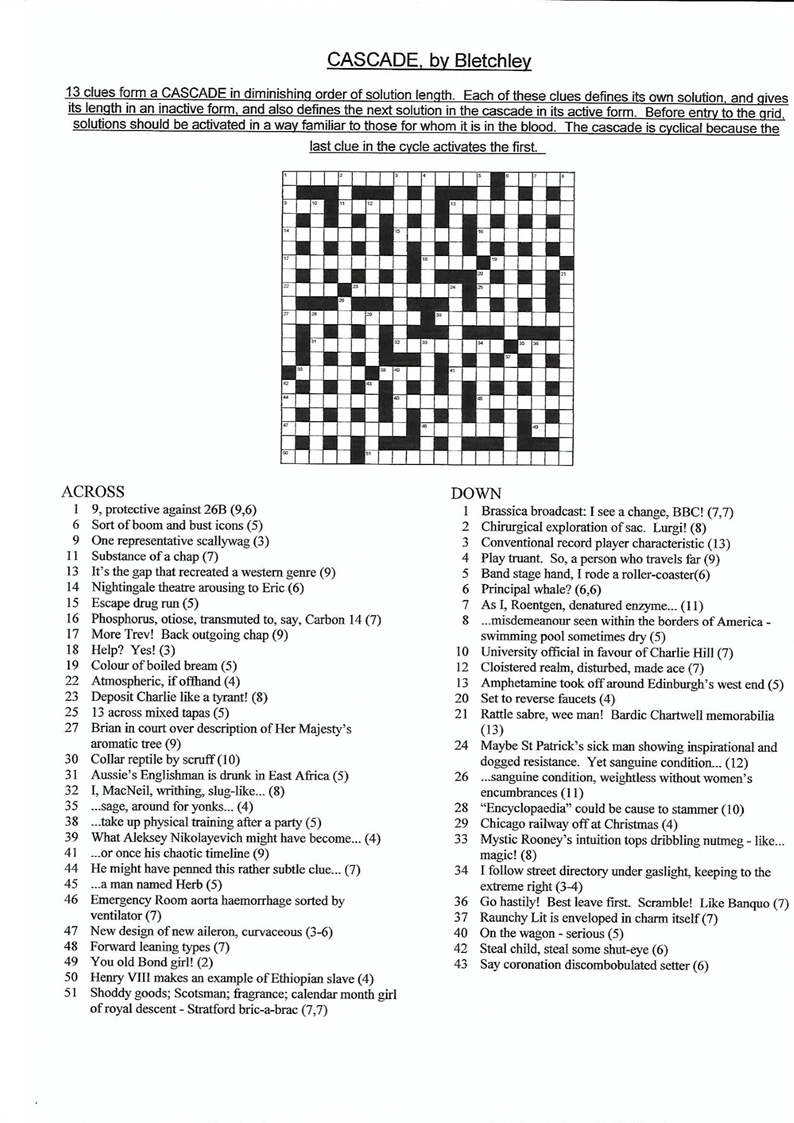
In A Tale of Two Cities, when, in 1789, the world was going to hell in a hand cart – or a tumbril – Lucy Manette’s father grew distractible, turned his back on the world, and returned to his cobbler’s last.  Having just finished David Attenborough’s sobering A Life on Our Planet (Witness Books, 2020), simultaneous with Ian McEwan’s dystopian novella The Cockroach (Jonathan Cape, 2019) a barely disguised critique of the current Westminster government cast as a Kafkaesque Die Verwandlung in reverse, I fear we are once again living in interesting times, and feel inclined to turn to my own version of the cobbler’s last, crosswords.  I am like King Lear, unable to perceive or prevent an impending tragedy, saying to Cordelia,

So we’ll live,

And pray, and sing, and tell old tales, and laugh

At gilded butterflies, and hear poor rogues

Talk of court news, and we’ll talk with them too –

Who loses and who wins, who’s in, who’s out…

I will be like a prisoner in a concentration camp who gives up bartering to survive, and starts to smoke his own cigarettes. 

Atop Ben Gullipen, on a day of great stillness, the Trossachs were radiant in their golden autumn livery.  I said to my companion, Harpoonata Venture (not her real name), from New York, “Let me pose you a ‘found’ clue.”

“What is a ‘found’ clue?”

“It is a clue that is discovered rather than invented.  Normally the cruciverbalist has the solution and composes a clue.  In the case of a ‘found’ clue, the clue already exists, and the cruciverbalist, like the puzzle solver, must seek the solution to it.”

“I’m not sure I follow, but go ahead.”

“Short back and sides, and a little off the top (8).”

“Bouffant.”

“Nope.”

“Crew cut.”

“Not enough letters.  Incidentally, the crew cut was what wrecked Elvis’ career.  The draft was Delilah to his Samson.  By the time he touched down at Prestwick, on his way back from Germany, Beatlemania was just round the corner, and he was yesterday’s man.”     

“Semi-crew.”

“Not semi-crew.  You won’t remember the ‘semi crew and friction’.  You came out of the barber’s looking as if you’d seen a ghost, or suffered an electric shock.”

 “Mullet.”

“Mullet is the antithesis to a short back and sides.”

“Beehive.”

“Get off the hair-do theme and think laterally.”

“’Hair-do’?  Is that what you have when you get a new ‘outfit’?  I give in.”

“Pinnacle.”

What?”

“Pinnacle.  You see, ‘top’ is the definition.  ‘Short back’ is pin.  A short is a dram, or a nip.  Nip back is pin.  NACL is ‘sides’.”

“Why?”

“Sides as in teams.  National Australian Cricket League.”

“Oh, come on!”

“Oh yes.  The Big Bash League.  The Adelaide Strikers, Brisbane Heat, Hobart Hurricanes, Melbourne Renegades, Perth Scorchers, Sydney Sixers…”

“These household names.”

“And to finish, ‘a little off the’ is e.  Ergo, Pinnacle.”

“That’s really terrible.  Your pinnacle is inaccessible.  Do you lie awake at night dreaming this stuff up?”

“Better than contemplating the fact that Homo sapiens is systematically exterminating every other species on the planet.”

“Deliberately?”

“I think the word was ‘systematically’.  Mr Johnson and Monsieur Barnier carry on squabbling – or worse, have given up squabbling – about fish, while the fish are suffocating under a trillion tonnes of plastic.  Talk about rearranging the deckchairs.  I saw Greta on the telly the other night.  She looked really tired.  She said, ‘I should be at school.  I shouldn’t have to be doing this stuff.’  If Greta gives up, we’re all doomed.”

“If Greta gives up, and starts doing crossword puzzles like you?  I don’t think Sir David has given up.  I seem to recall the subtitle to his books is, ‘My witness statement and a vision for the future.’”

“True.  He thinks biodiversity is key.  We must rewild the planet.”

“There you go.  Get rewilding.  Take heart.  After all, Jacinda has just won a landslide.  Aren’t the colors (sic) of the Fall stunning?” 

Autumn is the most poignant of the seasons.  It makes me think of Kurt Weill singing “Sing low”, accompanying himself on the piano.  Everything ends, too soon!  Or his September Song.  September… November…  Or of Eva Cassidy singing Autumn Leaves.  There is a vulnerability in her voice which seems – albeit with hindsight – to be an intimation of mortality.  Feuilles Mortes.  Debussy’s second prelude from the second book.  Or Robert Donat reciting Keats’ Ode to Autumn.  That note of wistfulness in his voice –

And gathering swallows twitter in the skies.