Two Turtle Doves

I read an item in the paper a few days ago about having sex with robots.  It was the subject of a keynote speech at a conference for mad boffins.  I wasn’t paying much attention but I think the general idea was that with increasing sophistication in robotic technology one could conceive of a machine with humanoid characteristics that could be rendered, well, attractive.  It was the mathematician and cryptographer Alan Turing who posited that, if you had an interaction with a machine so advanced that you could not tell that the machine was not human, then to all intents and purposes the distinction ceased to matter.  This is the essence of “the imitation game”.

You can see this has huge implications for the sex industry.  Minded to explore these a little further, I was about to Google “sex with robots” but thought better of it.  I know what would happen; every time I fired up my computer I would be bombarded with advertisements directing me to dubious sites.  I do not wish my desk top to get the wrong idea.  I have an app, “Cortana”, who already flirts with me in an inappropriate way.  She – anybody called “Cortana” has to be female – says to me, provocatively, “Hello.  I’m Cortana: ask me anything you like.”  I might say, “What did you say your name was?” and she would reply, “What would you like it to be?”

It all sounds a bit like science fiction but clearly society has already gone quite far down this route.  You only need to observe people walking down the street with ear pieces in situ, staring fixedly at a phone or tablet, oblivious to their environment, to realise that they are completely besotted.  Having sex with a machine is one thing, but what happens if you fall in love with it?  It is only a matter of time before somebody proposes to their computer.  Should the computer accept, then society will have to decide on a number of issues.  Civil partnership is one thing, but marriage?  The Anglican community will be riven.  The Archbishop of Canterbury will espouse liberal values and preach tolerance and compassion (for the hash-tag crossed lovers), while in the developing world a dim view will be taken.  There might even be persecution.  Sooner or later, a member of the clergy will “come out” and announce he and his machine are cohabiting.

Meanwhile in Cheltenham, GCHQ will get very nervous.  Unprofessional cyber relations among spooks, and indeed among the political class, will clearly be a security issue.  People romantically involved with their computer will be vulnerable to cyber-attack.  The robotic embrace, like that of a boa constrictor, will prove an ideal means of political assassination.

Then what would happen if, in the absence of a pre-nup, relations broke down?  The possibility of computers turning malignant has been recognised for a long time. In the film 2001, A Space Odyssey, the space ship computer Hal goes rogue.  Or is it the human being on board whose behaviour has become erratic?  It depends on your point of view.  (Incidentally, is it merely coincidental that the letters HAL immediately precede IBM in the alphabet?)  I can imagine divorce from a robot would be a very messy affair.  Hell hath no fury like a lap top scorned.  The only winners would be the lawyers.  Kerching kerching.

Brief Encounter

At the party in Aberdeen on Saturday night, the woman in the silver-grey dress touched glasses and said “Cheers.”

“Cheers.”

“That is not how you say ‘cheers’.  You must look deeply into my eyes, as I do into yours.”

“Cheers.”

“Cheers.”

Thus, she hypnotised me.

She was very direct.  “Are you married?”

“No.”

“Why not?”

“Because I have zero emotional intelligence.”

“Were you ever married?”

“I cohabited.”

“What happened?”

“She saw through me.”

“That’s bad.”  It occurred to me that that was a line directly out of Notting Hill.  Julia Roberts said it to Hugh Grant.  Are we condemned to speak nothing but second-hand movie scripts?   I added, “But I’m impossible to live with.”

And although that is clearly a self-indulgent and therefore despicable utterance, there is some truth in it.  The fact is that since adolescence I have been irresistibly drawn to solitude.  I first became aware of it at a school badminton club on a Friday night when I would quietly withdraw from play, disappear into the school music room, Room 7, and play my viola.  I was happy to play unaccompanied Bach.

She continued, “What do you do?”

“I’m a doctor.”  No surprise there.  This party was crawling with medics.  “But I’m in abeyance.”

“Retired?”

“On sabbatical.”  After all, I still get the PTSD nightmares.  The profession still has me.

“You don’t look old enough to be retired.”  I took that as a tremendous compliment.   “How do you spend your time?”

“I write.”

She looked quizzical.  I explained, “I was lucky enough to win a literary competition, and won a contract for three books.  Two are published, and I’m working on the third.”  Suddenly she looked interested.  I wondered if being a published author was like being a rock star.

“What sort of books?”

“They are called crime fiction, but I prefer to think of them as psychological thrillers.  They concern a young doctor who is emotionally labile.”

“Labile?”

“Troubled.”

“Like you?”

It was impossible to evade her directness.  “Yes.”

“Why are you troubled?”

“If I knew the nature of my trouble, it would cease to be troubling.”

“Tell me about your last date.”

“It was in New Zealand.  I was driving around Northland and I stopped one night in a camp site just north of Dargaville.  A very beautiful woman sat in the lotus position alone by her tent.  She had long fair hair in a ponytail.  Her head was buried in a book.  I thought to myself, “Charming.”

Shortly afterwards I was busying myself about my campervan and became aware of a presence.  I looked up.  It was Keet.  (Pronounced Kate.  She was Dutch.)

“Where are you going tomorrow?”  Her English was perfect.

“Auckland.”

“Will you take me with you?”

I shrugged.  An affectation.  “Yes.”

We travelled, and spent a pleasant day.  The conversation was wide ranging.  She was 22.  As with so many people from the Netherlands, her linguistic skills were remarkable.  She said, “I’m thinking of learning Maori; it looks pretty easy.”  She loved English Literature, from Chaucer to Eliot.  I remember we had a conversation about the Canterbury Tales.  Can you imagine having a conversation like this with somebody from a foreign country?  We talked of the Latin tag, “Amor vincit omnia” – Love conquers all things.  I had always thought of that as a benison; two people in love face all adversity with courage and fortitude because they know their mutual love will see them through.  But Keet saw it in a different way.  Love was not a benison, it was a curse.  It undermined you, weakened your resolve.   Specifically, Love would impede your ability to serve the state.  You would be unable to wage war.

We drove down the west side of the Hauraki Gulf and lunched in Clevedon, on the periphery of South Auckland.  I said, “Where can I drop you off?”

“Where are you going?”

I mentioned the name of a Top 10 Campervan site in South Auckland, near to Ardmore Airport, out of which I was going to do some flying.

“I will come there also.”

That evening, we shared a bottle of wine, and chatted some more.  I thought, “What’s the Agenda here?”

I said to her, “You didn’t half take a chance, coming up to a middle aged guy and asking for a ride.”

“What is life without chances?”

I didn’t tell the woman in Aberdeen that I’ve developed a bad habit of talking to myself.  I wander about city streets and remonstrate with myself.

“You bloody idiot.”

Medicine and The Media

Bill English has become New Zealand’s thirty ninth prime minister.  I’ve met Mr English.  In the mid-90s when I was clinical head of Emergency Medicine at Middlemore Hospital, South Auckland, he was Minister of Health.  He dropped by one day and we had a chat in my office.  He asked me what the department needed, and I said it needed to double its resources.  At the time I didn’t think this went down too well, but in fact it happened, in spades.  Middlemore ED is now a 130 bedded facility with four resuscitation rooms, run by 56 medical staff, 22 of whom are consultants.  I am proud of the fact that I played a small part in the development of Australasian emergency medicine.

In order to further the cause of emergency medicine, it was necessary that the specialty have a public profile.  Hence in the mid-90s I had dealings with the media.  I don’t think of myself as a person particularly comfortable in the limelight but at the time I didn’t mind.  I even relished it.  The fact is I was living on my nerves.  My world was full of murder and mayhem and for some inexplicable reason I would wake up in the morning full of beans.  I couldn’t explain it then and I can’t explain it now.

For a time I had a slot on Radio Pacific.  I would arrive at work at 8 am and do an interview about the activities of the night just gone.  The subject matter often involved road trauma, interpersonal violence, drug and alcohol abuse, multiple morbidity and the problems of patients with significant pathology presenting late.  TV NZ interviewed me one Christmas about the challenges the department might have to face over the festive season.  The hospital saw this as an opportunity to offer preventative medicine and the delivery of sound health care advice.  Then a television company negotiated with the hospital to run a weekly fly-on-the-wall documentary, Middlemore.  Episodes of emergency medicine were televised.  I was never very keen on this idea.  Any time I was on camera I always knew that the dynamic of the medical consultation was altered.  There was a third party in the resuscitation room.  But again, the hospital recognised it as an opportunity to deliver a form of health care in a different way.  So it happened.  I remember I was interviewed on the programme one week about the epidemic (it was no less) of major trauma in Auckland resulting from road crashes, often alcohol related.  I recall making some disparaging remarks about human irresponsibility culminating in a throw-away remark, “It’s pathetic.”

It turned out that “It’s pathetic” struck some sort of chord.  I started hearing recordings of myself on radio and TV saying “It’s pathetic!” as the media took it upon themselves to tackle the scourge of drink-driving.  For a week or so I had a kind of Andy Warhol fame.  I would walk the length of Middlemore’s immense medical corridor and colleagues coming the other way would nod at me.  Then, ten metres further on, they would shout back at me, “Pathetic!”

Then I went to an emergency medicine conference in San Diego, California.  I recall one evening we crossed the bay to dine in the Hotel del Coronado, a magnificent old style hotel with décor in deep brown varnished wood.  Outside, we had a stroll on the beach, where Marilyn Monroe and Tony Curtis filmed Some Like It Hot.  That night, I took a call from a New Zealand radio station.  They wanted to use my “It’s pathetic” quote as part of a publicity drive to improve New Zealand road safety.  I said no.  They tried to change my mind, and in many ways were very persuasive, but I stuck to my guns.  The reason why I was so adamant was that I did not believe the public would make a distinction between a criticism of a human action and the criticism of a human being.  “It’s pathetic” would morph into “They’re pathetic.”  That sort of attitude is absolute anathema to medical practice.  And mind, Middlemore Hospital is at the heart of disadvantaged South Auckland where the bulk of Maori and Polynesian people stay.  Many of the people involved in episodes of major trauma were, are, Maori and Polynesian.

I recall some of my colleagues thought I was being perverse, even sanctimonious and pompous.  But I’ve never had reason to change my mind.

Not that I always got it right.  I remember doing one particularly gruelling night shift and in the morning getting a call from a New Zealand newspaper.  My guard was down.  “Is it true, doctor, that in the event of unsuccessful resuscitation from cardiac arrest, medical students are sometimes offered the chance to practise intubation of the deceased?”

I answered yes.

Huge mistake.

At home the following morning, my phone rang at 7am.  I answered, assuming it would be the hospital.  No.  It was the media, the first of many calls that day.  I had an uncomfortable 24 hours.  The Professor of Medicine at Middlemore was kind enough to say to me, “You only told them the truth.”  But the fact is that to intubate somebody who has just died is unethical, because the person has not consented to the procedure.  And I chaired the Hospital’s Medical Ethics Review Committee.  I used to think I could get by on “common sense” but fortunately there was a lawyer on the committee who would occasionally gently point out to me how hopelessly wide of the mark was my “She’ll be right” attitude.

To Sleep, Perchance

I have to confess I felt some sympathy for the Prime Minister when she admitted last week that Brexit was keeping her awake at night.  Unlike Dr Axel Munthe of The Story of San Michele who was a chronic insomniac, I’ve seldom had any trouble dropping off.  Moreover I’ve always been able to get back to sleep having been woken in the night.  When I was a child our pet dog Jet used to scratch my door in the night and ask me to let him out to answer a call of nature.  He must have known that I was going to spend a career being woken in the night.  In ten minutes I’d be back in bed and out like a light.  The few times I can remember lying awake through worry, it has not so much been at the thought of an impending disaster, rather it has been because I have felt myself to be in the middle of an impossible situation, or what the psychiatrists call a “bind”.  I can think of a few occasions in medicine when I made a mistake that kept me awake.  The bind here was that I had taken the Hippocratic Oath, “First do no harm”, and then gone on to break it. That is an existential threat.  Yet it is unavoidable.  You cannot have a career in medicine and not, at some point, several points, foul up.  The hardest thing in medicine is, having made a mistake, not to curl up in bed, but to carry on practising.  Honesty, humility, and the support of colleagues are what get you through.

Shakespeare’s Othello suffers an existential threat.  It’s not mere jealousy that keeps him awake.  It is the self-doubt, the chink in the armour of “my parts, my title, and my perfect soul” that puts him on the rack.  And Iago says, “Not poppy, nor mandragora/ Nor all the drowsy syrups of the world/ Shall ever medicine thee to that sweet sleep/ Which thou owedst yesterday.”

Disturbed sleep is a very common symptom in the GP surgery.  Patients come in requesting some mandragora, or, more likely, temazepam.  GPs constrained to consult within ten minutes might be tempted to write the prescription, and before you know it, the patient is hooked on benzodiazepines and maybe the GP will have to explain to the GMC what he’s playing at.  Far better, surely, to introduce the patient to the concept of “sleep hygiene”; regular sleep habits, avoidance of caffeine or alcohol in the evening, the importance of fitness and physical exercise, and so on.  Yet there is always a deeper level to which the doctor might delve.  What existential crisis is keeping the patient awake?  Depression, fear, and anxiety in the face of some impossible situation?  Worth asking.

A New Zealand friend of mine was once asked what her favourite pastime was, and she replied without hesitation, “Sleeping”.  When asked, “But isn’t sleep just unconsciousness?” she offered a panegyric to the experience of sleep, particular of falling asleep, that in its sensuousness I do believe some people found unseemly.

Sleep is essential to our wellbeing; sleep deprivation is a device of the torturer and a cruel and unusual punishment.  We cannot function without sleep.  Yet our neurophysiologists are not quite sure what function it serves.  One theory is that sleep is a process whereby the brain reorganizes itself in terms of cataloguing data in folders.  The hippocampus, seat of short term memory, gets saturated.  During sleep, the files are taken out of the hippocampus and transported to multiple sites of long term memory that are more secure.  This may be why people who have conditions of memory impairment such as Alzheimer’s may lose short term memory but cling on to more hard-wired information.  Musical melody might be the last thing to go, and perhaps a lifetime of music appreciation and even more so of music making, may be protective.  One of Mrs May’s predecessors who was famous for thriving on four hours’ sleep a night, developed memory impairment.

The PM has been quoted as saying, “In this job, you don’t get much sleep.”  I wonder about that.  Most professions now recognise that lack of sleep is generally detrimental to professional performance.  My obstetrics job as a junior doctor was a “one in two”, that is, every second night on call.  It is worth painstakingly mapping that out:  go into hospital at 8 am on Monday morning and emerge at 6 pm on Tuesday evening.  Return at 8 am Wednesday morning and emerge at 6pm on Thursday evening.  Return at 8 am on Friday morning and emerge at 6 pm on Monday evening.  Return at 8 am on Tuesday morning and emerge at 6 pm on Wednesday evening.  Return at 8 am on Thursday morning and emerge at 6 pm on Friday evening.  And, believe it or not, you’ve got the weekend off.  Then go into hospital at 8 am on Monday morning…  “Do the math.”  That is a 109 hour week.  It was European directives that put a stop to that.

There have been similar regulations introduced into aviation.  Pilots cannot fly more than a given number of hours within a set time frame.  Most people would regard such regulation as eminently sensible.  After all, you would not wish your surgeon or your pilot to drop off during critical manoeuvres.  You would, on the contrary, wish them to be extraordinarily alert.  However this does not seem to apply to the political class.  How often do we hear of “all night sessions” in Parliament, in the various institutions of the EU, at the UN, and in a variety of other diplomatic forums, when politicians keep going until they have thrashed a deal out?  What sort of state of mind are they in when they eventually come to ratify some critical decision, and what, in consequence, is the quality of that decision?

One of my favourite Prime Ministers is Henry Campbell-Bannerman, a liberal who sat for the Stirling Burghs and who was PM from 1905 – 1908.  He died in 10 Downing Street.  His term of office was a quiet time, you may say.  I suspect that quietude might often be an index of successful premiership.  Campbell-Bannerman went on his holidays every September for six weeks to Marienbad in Bohemia.  Can you imagine a PM doing that now?  D’you know, I wish they would.  It would be a wonderful cure for insomnia.

In Mrs May’s case, I can only imagine that her own particular bind results from the fact that, having voted to Remain, she is now in charge of a government dedicated to Leave.  In this regard, I did find her coronation to the premiership in July somewhat puzzling.  Mr Cameron campaigned to remain, lost the referendum, and promptly resigned on that basis.  Moreover, his initial plan to stay on until September to provide a period of stability was quickly shelved and, with extraordinary expedition, Mr Cameron became a man of the past.  His eclipse was total.  He completely disappeared.  He had concluded, as had everybody else, that his position was untenable.  Yet Mrs May support for Remain did not appear to be an obstacle to her accession.  You may say that, while Mrs May’s support of the Remain campaign was low-key, Mr Cameron was the key figure in putting the government into a position which he had never intended, and therefore he had to pay the price.  Yet Brexit has become the key political issue in the UK right now, and while the PM believes in democracy and the will of the people, she does not believe in Brexit.  And that, I imagine, is why she cannot sleep.

Flitting round Glasgow

When I was wee, we used to flit a lot.  My first house was in Milton, north Glasgow.  Ornsay Street, off Ashgill Road.  I can recall the curve of the stairway, which was a kind of replica of the curve of the street where I played with my first girlfriend, Judy.  Recently I went back for a look, went for a walk, and was utterly appalled by a sense of abject poverty and got out quick.

We moved to Dowanside Road in Glasgow’s west end.  Gentrified now, but a bit rough back then.  It was a ground floor flat, with a basement.  There was a “speaking tube” between upstairs and downstairs by which no doubt those and such as those could summon the help in a bygone age.  There was a common green out the back.  Our neighbours were called Heeney.  My cousin bullied the Heeney boy mercilessly.  Considering the name, this might have had a sectarian connotation.  I was reminiscing about the Heeneys with my parents in a Lochalsh Hotel about twelve years ago.  We were in a public room and speaking in whispers, as you do in the Gaidhealtachd.  An English family group at the next table were eavesdropping, which is quite acceptable, especially as I was eavesdropping on them.

“They’re talking about their neighbours.”

“Healey?”

“No.  Heeney.”

“Sweeney?”

“No, dammit!  HEENEY!”  By this time, I was in hysterics.

Then we moved a quarter of a mile up to Crown Road North.  At this point we were cohabiting with my aunt and uncle, et famille.  I hesitate to attempt to explain the convolutions of my family’s domestic arrangements because they are so bizarre, but basically my mum and her three sisters had entered the business of care of the elderly (note this, for this blog does have a point in the end) and were opening up nursing homes in Glasgow’s west end.

It was from Crown Road North that I went to school, in Hyndland, I guess just under a mile away.  I really ought to have gone to Dowanhill but mum and dad thought Hyndland was the better option so I snuck in by some dodgy arrangement.  Not that I appreciated it.  On day two I thought, this is definitely not for me!  And scarpered.  I went home.  I was promptly delivered back to school.  I can’t remember my reaction to that, but I can’t say I’ve ever regretted my decision to do that runner.

Incidentally, there was no such thing as “the school run”.  Apart from anything else, nobody from our social class owned a car.  But me and my pals, all of us 5 year olds, we went everywhere we had to go, unaccompanied, on our own two feet.

Our next move was to Garscadden.  Millburn Ave. Why is it that Glasgow suburbs have such desperate names?  Auchinshoogle, Stobhill, Riddrie…   This was away in the far north-west, miles out of area, but once you’re in, you’re in.  So every day it was the No 6 bus from its terminus to Broomhill Cross, and the 10, 10A, or 44 (whichever turned up first) to Clarence Drive.  Millburn Ave was a cold house.  I recall we had a paraffin heater which just took the edge off it.  Oddly enough, in this arctic region, I have a nostalgia for the arrival of the ice cream van.

Next up, the definitive move (I suppose my parents would have thought of it as that) to Rowallan Gardens.  A leafy suburb in the west end.  I don’t think it was easy for them.  The bank was rather snooty about the whole thing.  In the end it went ahead because my mum, a trained nurse, took on the care of an elderly lady (in the Gaidhealtachd, a cailleach), and thus assured an extra source of income, which my father dutifully paid into the bank every week.  It was a terraced house in a street of character and the walk for me to school took seven minutes.  I was seven years old.

Sometimes I take a walk along Rowallan Gardens and past our old house.  It recently went on the market and out of curiosity I looked it up on line and did a virtual tour of the old haunts.  I must say the improvements were considerable, although the old place was still recognisable.  In the end it went for such a vast, eye watering sum that I thought, what’s this all about?  It’s only bricks and mortar, a heap of rubble, slightly organised.  Get a grip!  It crossed my mind to have a look round, as a bogus potential vendor.  I just had this great urge to walk up the garden path and be greeted by Jet, cross between a lab and a collie, our beloved dog.  But I forget we had a standing feud with our neighbours who, incensed by my brother endlessly playing the piano, and me endlessly playing the viola, would turn their radio up to ghetto-blaster proportions.  You forget the bad stuff.

How the hell did I get started into all this?  O yes, I tuned into the Andrew Marr show on Sunday morning, as is my wont, and gathered there is a particular preoccupation at the moment about Health and Social Care, and its seamless alignment.  Everybody knows that the current state of play in the NHS is that you arrive in “A & E” as a “casualty” (I use inverted commas to indicate that these obsolete and inhuman expressions are to be vilified, reviled, and eschewed), you wait for a period in excess of 4 hours (the shadow politicians prefer the expression “wait” for they would not have you know that something beneficent might be happening to you while you “wait”), and you find you cannot get to the ward because of “access block”.  “Access block” occurs because the frail and elderly, who are cramming the wards, cannot be discharged (despite the fact that they no longer need to be there) because they have nowhere to go; that is to say, the provision of “social care” at home is inadequate.

I put all this into the context of my childhood domestic arrangements because it occurs to me that a generation ago, the idea of a crisis in social care would not really have been generally understood.  The reason why no problem would have been flagged is that both child care and care of the elderly would have been deemed to be the responsibility of the family unit.  In days of yore, one family member would have been the bread winner, and one would have run the household.  Can you imagine how it would go down now if a politician were to say to the electorate, in order to care for your parents and children, it is best that you be in a stable relationship and that one of you (no need to stipulate which one) quit work, accept a diminishment of spending power, and devote yourself to running the household.

Political suicide.

The Rest is Silence

Quantitatively and qualitatively, “the two minutes silence” in Dunblane Cathedral on Remembrance Sunday was a bit of a misnomer.  It lasted barely a minute, and rather a noisy minute at that, as the cathedral’s heating system roared away in a valiant effort to keep us all warm.  I shouldn’t complain.  Nobody fainted, or succumbed to hypothermia.  But it made me think; in our modern world, silence is a rare commodity.  We are surrounded by noise.  Even if, on a windless day, I go to the top of my local mountain, Ben Ledi, at 879 metres (2884 feet), a Corbett aspiring to be a Munro, I can still hear the traffic on the A84.

Some people fear silence.  DJs on the radio call silence “dead air”.  Dead air is a big no-no and to be avoided at all costs.  Often, conversations on air are conducted against a background of fuzzy muzak which does not rest for a crotchet.  Even Radio 3, once proud of its aeons of protracted silence, is now wall-to-wall.  Scientific documentaries on television, even when discussing anything from quantum physics to cosmology, are all delivered against an unceasing soundscape of portentous musical drivel.  Hotel elevators lift you skywards against an endless loop of “elevator music”, just in case these few moments of enforced captivity compel you to stare into an abysmal void of nothingness.  Wallpaper music pervades doctors’ and dentists’ surgeries, restaurants, even banks.

I used to think that John Cage’s Four minutes thirty three was nothing more than a wisecrack and a gimmick but now I’m not so sure.  I think I would go out of my way to attend a rendition.  This work is “performed” by a concert pianist who sits in silence before the keyboard for the duration, as indicated on the tin.  The idea of sitting in silence in a concert hall filled to capacity, for just over four and half minutes, I find deeply appealing.  Perhaps the performer will prefer a slower tempo and the work will last five minutes.  What would the critics say? What would constitute a bad performance?  An inattentive audience, lots of coughs, or the pianist taking a fit of the giggles?  I checked a performance out on the internet and was amused to discover the work has three movements.

Silence is integral to great music.  It both encapsulates it, and infiltrates it.  Arvo Part’s Cantus in Memory of Benjamin Britten, which happens to be the “signature tune” of my current work-in-progress, does not start with the single toll of a bell, but with a rest, and a silence, into which the bell announces its toll.  The brief, distilled closing movement of Stravinsky’s last substantial work, Requiem Canticles, is punctuated with silences that are pregnant with meaning.  I was once privileged to sit in silence in Abbey Road’s hallowed Studio One while the LSO under Michael Tilson Thomas made a recording of the Brahms Haydn Variations.  It must have had something to do with the peculiar acoustic of that space, but the silence that enveloped the orchestra just before each take was more profound than anything I have ever known.  Once on the Antarctic Peninsula a group of us took a zodiac into a deserted bay and cut the engine.  There was absolute, magical, quietude.  Then I remember feeling as much as hearing a low-pitched sinister rumble and seeing an enormous wall of ice calve itself off the shoreline and plunge into the ocean with a deafening roar.  We started up the zodiac engine and got out, pronto.

I did achieve a two minutes silence, on Armistice Day.  It turned out indeed to be a day of remembrance.  I went to the funeral in Clydebank of an old musical friend.  I met up with a group of friends with whom I have been playing music for more years than I care to remember.  Four of us used to play late Beethoven quartets together.  Iain sat on the front desk of the National Youth Orchestra of Great Britain.  He was the most naturally gifted violinist I have ever known.  But he also happened to be good at mathematics so his life went off on a different tack.  I remember four of us went through to the Edinburgh Festival to hear the Amadeus Quartet play Beethoven’s last quartet, Opus 135.  Norbert Brainin, Siegmund Nissel, Peter Schidlof, and Martin Lovett.  They obligingly autographed Iain’s copy of the first violin part, on the opening page of the last movement, with its portentous and somewhat tongue in cheek statement: Must it be?  It must be!  It must be!  Apparently Beethoven was having a joke about his laundry bill.  That slow introduction, Grave, ma non troppo tratto, is punctuated by silences.  I remember that in the final rendition of the Op 135’s last quirky theme, played pizzicato, Norbert Brainin nearly played it arco, with the bow.  I vividly recall the self-critical look of exasperation on his face.

On November 11th we listened to an ancient recording of Iain playing Elgar’s Sospiri.  So sad.

Hush now.


Hitting the Ground Running

With respect to “draining the swamp”, Newt Gingrich has suggested that President-elect Trump hit the ground running.  Mr Trump himself has signalled that securing the borders and deporting or incarcerating illegal immigrants with criminal records (apparently two, maybe three million of them) are priorities.  Would it be reasonable to call such action a “purge”?  Is this all vaguely reminiscent of the McCarthy witch hunts of the 1950s, which Arthur Miller allegorised in The Crucible?

Many people on this side of the Pond have taken comfort from the fact that, once Mr Trump realised he was about to cross that magical line of 270 of the collegiate votes, his tone became more conciliatory.  Before the election, Mrs Clinton was “crooked Hillary”.  Her crimes were “egregious”.  He was intent on putting her in jail.  In contrast, Mr Trump’s victory speech was calm and measured, even Presidential.  He said, “I want to thank Secretary Clinton, for her service to this country, and I mean that most sincerely.”  The italics are mine.

Have you read “On Bullshit” by Harry G Frankfurt, Professor of Philosophy emeritus at Princeton University (Princeton University Press, 2005)?  Do.  It’s a life-changer.

Mr Trump asks us to believe that he is holding two points of view simultaneously in his head that are mutually contradictory.  George Orwell had a term for this feat of mental gymnastics: he called it doublethink.  There is a story, doubtless apocryphal, about the young George Washington escaping a thrashing by telling his father the truth. “Father, I cannot lie.  I did push the privy into the ravine.”  Had President Washington survived into our post-truth age, he would doubtless have deployed a different argument.  “I both did and didn’t push the privy into the ravine.”  Perhaps he would have evoked the physicist Erwin Schrödinger’s cat.  Schrödinger’s cat is a thought experiment designed to demonstrate just how crazy is the world of quantum mechanics.  You put a cat in a box along with a piece of radioactive material which has a 50% chance of breaking down.  Should it do so, a vial of poison is broken and the cat will die.  You don’t know whether the cat is alive or dead unless you open the box and look.  The point is, in the quantum world, the cat is both alive and dead.  We are all living in a quantum world.

When I think of Orwell and doublethink, I think of another extraordinary example of prescience in 1984, his anticipation of reality TV and the politics of hate, encapsulated in the “Two Minutes Hate”, in which an enemy of the state is paraded and viewers hurl abuse at their telescreens.  All this year we have seen the Two Minutes Hate in action, with politicians gaining capital out of urging us to blame our woeful condition on the other guy, the outsider, the infiltrator.  G K Chesterton was once asked to write an article for The Times about what constituted the biggest problem in the world today.  He replied, quite simply, “Me.”  By that I think he meant that the sin of the world (see how our hackles rise at that archaic biblical world… sinful?  Moi?) does not reside in Someone Else, it runs through all of us.

Mr Trump reminds me of Othello, an outsider who is called upon to do the state some service.  During his campaign, he said that if elected President, he would ask Congress to declare war on Islamic State.  Hatred is an act of self-harm.  Look what Othello says at the end:

Set you down this,

And say besides that in Aleppo once,

Where a malignant and a turbaned Turk

Beat a Venetian and traduced the state,

I took by th’ throat the circumcised dog

And smote him thus.

Then he killed himself.

Yet maybe not.  Maybe Iago – whatever Iago is – has not yet seized control of the President-elect.  They say you should campaign in poetry and govern in prose.  Who knows, we may yet hear from him some of the beautiful Othello music:

Keep up your bright swords, or the dew will rust ‘em.  

The Least Powerful Person in The World

Behold, I shew you a mystery; we shall not all sleep, but we shall all be changed, in a moment, in the twinkling of an eye, at the last trump…

Is there a Special Relationship?  Will it survive the week ahead?

I declare an interest here.  My mother’s older brother emigrated from Skye to the USA, possibly not long after Donald Trump’s mother did the same from Lewis.  Consequently I have three American first cousins, two in New York and one in North Carolina.  The last time I was in New York I drove up New York State and into Canada at Niagara on the Lake, Thousand Island country, then round Lake Ontario, and back into the US via Buffalo.  The journey north was 007’s journey in a Studillac by Albany and Saratoga in Diamonds are Forever; the journey south was 007’s journey in a Thunderbird to rescue the French-Canadian Vivienne Michel in The Spy Who Loved Me.  (I inhabit cloud cuckoo land.)  The Adirondacks are very beautiful.

There was a cultural difference at the US/Canada border that I found exactly analogous to the difference at the Spain/Portugal border.  I’d flown into Faro in the Algarve and hired a car.  “Where you going?” said the girl at the car rental.  “Costa de la Luz.”  It’s in Spain.  She pulled a face and said, “Why you wanna go there?”  At the Canadian/US border at Buffalo it might have been the same girl pulling the same face.  “You wanna go back down there?”  I suppose it’s the natural defensive attitude you assume when you have a Big Neighbour.

Incidentally, up at Lake Ontario we stayed outside Toronto at the home of a family friend who happened to be a Pastor of somewhat evangelical leanings.  We arrived on a Saturday and it was arranged we attend his church service the following morning.  It so happened I got sick and spent Sunday morning vomiting up this hideous black bilious material (sorry, too much information).  I could tell from the look of horror on my host’s face that he was convinced he was entertaining an emissary of the devil.  It was like Omen Damien 3.  This is by the way.

I’ve spent time in North Carolina, Texas, Arkansas, LA, and San Diego.  I’ve always found American people extraordinarily welcoming and friendly.  But I’m also aware when I’m there that I’m in a foreign country.  I felt more at home in Canada, just as I always feel so much more at home in New Zealand than in Australia.  Was it Churchill who described Britain and the US as two nations separated by a common language?  Winston had more reason than most to feel an affinity for the US.  His mother Jennie Jerome was American.  It’s even said that Winston was one thirty-second Iroquois.  There is that famous quip of his when he addressed the joint meeting of the US Congress when he said that if his father had been American and his mother British, “I might have got here on my own.”  Yet he knew well enough that the “Special Relationship” is more special to the UK than it is to the US.  He spent a considerable part of his war effort wooing FDR first in his guise as “former naval person” in a series of phone calls, then face to face at Placentia Bay.  In the Lend-Lease agreement that secured US assistance he stacked up a huge war debt.  It was only Pearl Harbour that really guaranteed US alliance.  For all his affection for the US, Churchill’s admiration was not starry-eyed.  He said the US could always be relied upon to do the right thing once she had tried and exhausted all the other possibilities.

After 9/11, Tony Blair addressed George W Bush with words to the effect of “I am with you always, even unto the end of the world.”  Dubya listened to this with an expression of complete bewilderment.  Who can blame him?  Why do we pay such preeminent attention, with, let’s face it, fawning subservience, to our cousins (figuratively this time) on the other side of the Pond?  Even the demographics alone should give us a sense of proportion. The US population, at 322.5 million, represents approximately 4.3% of the population of the world.  Even the US land mass, at 3.8 million square miles, is only 6.6% of the landmass of the globe.

We call her the world’s only “super-power”.  Yet it has become apparent, especially during the last few weeks, that America’s domestic problems are huge.  The society is riven – as it is in so many other parts of the world – by inequality, poverty, violence, and hatred.  Moreover, the political mechanisms for addressing some of these issues do not appear to be there.  Who can say that the race for the White House has been edifying?  Who is manifesting leadership, moral courage, wisdom, and insight?  I don’t know what will happen on Tuesday but the US electorate has a history of voting, not for an Al Gore or a John Kerry – they are a bit suspicious of intellectuals – but for the man they would rather spend time with in a bar.  Whatever else you say about the Donald, he is a consummate performer.  He exercises a power over his audience that is hypnotic.  Most important of all, he is comfortable in his own skin.  He is having the time of his life.  Even when the secret service hustle him off the stage because they think somebody’s going to take a pot shot at him, he’s quite calm.  “Folks, nobody said it was going to be easy…”

By contrast, did you hear Mrs Clinton addressing the crowd during a torrential downpour in Florida?  She sounded as if she was on the rack.  She sounded like a wild animal, cornered, about to fight for her survival.

Whichever way it goes, it’s hard to envisage, after all this vituperation and bitterness, a calm and orderly transfer of power.  One can only imagine it’s going to carry on being dirty. There’s just too much hatred.  The political chasm between the parties is too deep.  America has lost the election.

Seven Trials

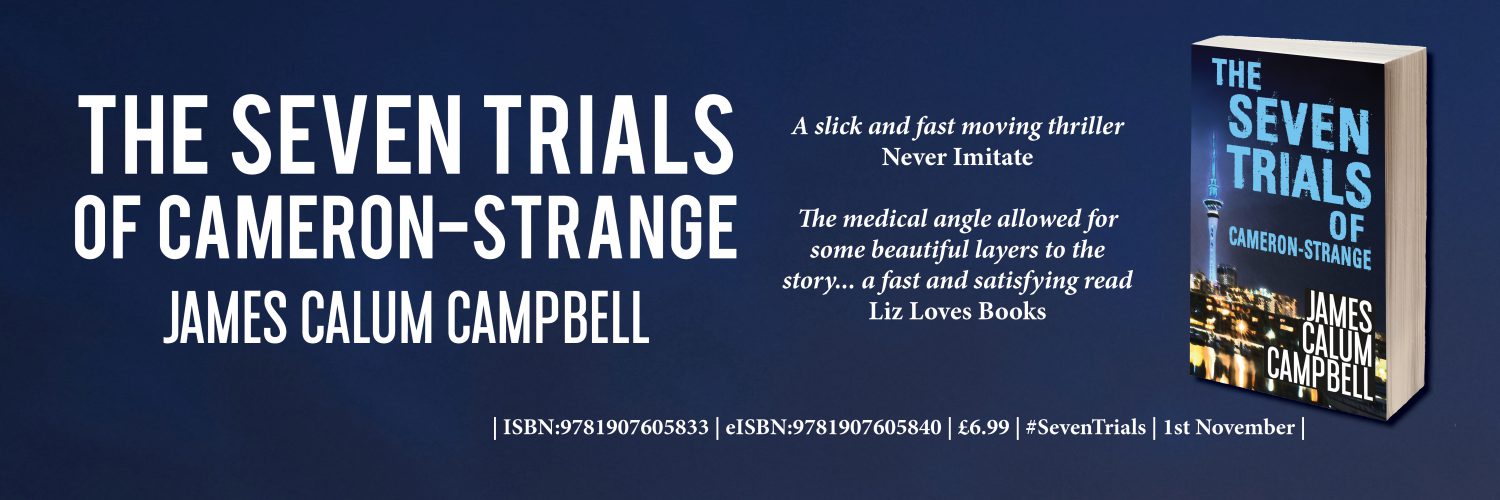
The Seven Trials of Cameron-Strange comes out on November 1st.  Impress kindly sent me some advance copies which I’ve distributed among friends.  It is very rewarding, and slightly surreal, to see one’s stuff out there and between covers (incidentally, I love the cover).  Let me divulge a confidence.  I wanted to call it The Seven Trials of Alastair Cameron-Strange but I was persuaded to drop the “Alastair” – too many words on the cover!  That reminded me of Amadeus, Peter Shaffer’s play (and subsequently film) about Mozart in which an aristocratic patron tells Mozart that his music contains too many notes.  (You can see I have delusions of grandeur.)  I canvassed the opinion of a group of friends (largely the ones who got advanced copies of the book) and they thought Impress were right, so I relented.  I wonder what Alastair would have done?  He’s a younger man, and on a bit of a short fuse.  I think he might have thrown a Beethovenian tantrum and said, “Don’t change a ******* word!”  But I’m practising the art of serenity.

A further confidence: I didn’t find it particularly easy to write.  Frankly I wasn’t in the mood.  I was preoccupied with other things, but I had a time schedule, largely of my own devising.  I just had to get up every morning and write another thousand, day upon day.  Given all that, I’m happy with the result.  I’ve just read a favourable review from the website neverimitate, for which much thanks.  What sort of a review would I have given it?  Let’s see… 21 chapters.  3 good, 16 OK, 2 bordering on the shonky, as they say Down Under.  And the overall effect?  Ah – that is where I’m least qualified, like the pilot in the eye of the hurricane, impervious to what’s going on around him.   I know I’m not supposed to say stuff like this.  I should be like a top level sportsman… “I was really awesome today.”

So, on to part 3, in “the life of the troubled doc”.  And, for whatever reason, this has been, thus far, an easier remit.  “You ask me why?  I cannot tell you.  I only know that it is so.”  I’ve become very fascinated by the creative process.  Do you just sit down and blurt, and see where it takes you?  Or do you pre-plan everything down to the finest detail?  Well, no doubt every writer has a different modus operandi, but I’ve certainly come to discover that, for me, I’m more of a blurter than a planner.  That’s not to say I don’t plan.  I come up with an idea (where it comes from I’ve no idea – subject for another blog).  And yes I sit in coffee shops with a note book and I try to expand it and structure it and see where it will go and what conclusion it might reach.  But I pretty soon learned that that approach, initially fruitful, brought me up against a brick wall.  For a time I thought this was a lacking on my part.  But I’ve changed my mind about that.  When you hit the wall like this, the Muse is merely telling you to stop faffing around and get on with it.  Just start writing and the solutions to all these unanswerable questions will sooner or later come along.

So Speedbird (working title) is a great mystery, even with 20,000 words on the slate.  And I love that.  I’m not even sure the title will remain.  A friend of mine asked me yesterday which character was critically injured at the end of Seven Trials, and I replied, how should I know?  All I know is that the putative Speedbird has about 24 chapters, of which 5 are written.  I know that every chapter has to “work” on its own, as an autonomous entity, and then – more difficult – that every chapter has to elide seamlessly into the next chapter, and that – most difficult of all – the entire construct must, as an entity in itself, “work”.

Will it work?  No idea.  But I can tell you I’m getting great satisfaction in the process of finding out.  I love it when I go for a run and swim and a sauna and then some utterly crazy idea comes to me out of left field and I think, “I can write about that…”  Suddenly Speedbird has gone off in a direction I’d never anticipated.  You say to yourself, where is this going to end up?  You don’t know.  All you can do is write your way to the conclusion, and only then will you find out.

Enigma Variations

A couple of reports in the Herald last week caught my eye.  On Thursday: Thousands of convicted gay people to be given pardon; and on Friday, Pressure mounts to strip BHS ‘spiv’ Green of knighthood.  Let us draw a connection.

The Westminster government is drawing up new legislation whereby gay people who were convicted under the laws against homosexuality will be posthumously pardoned.  This legislation has been dubbed “Turing Law” after Alan Turing, the mathematician and cryptographer who was convicted of homosexual offences in 1952.  He was offered the choice of imprisonment, or chemical castration, and opted for the latter.  He committed suicide in 1954.  He was posthumously awarded a royal pardon in 2013, 59 years after his death.  In 2009 Prime Minister Gordon Brown had highlighted the tremendous debt Britain owed Turing for his work at Bletchley Park during the war, deciphering the Germans’ Enigma code.  His contribution to the allied victory was immense.  He went on to develop the rudiments of computer science, information technology, and artificial intelligence.  He wasn’t really a household name until Benedict Cumberbatch played him in the film The Imitation Game in 2014, the year after he was pardoned.

I’m interested in this word “pardon”.  How does Chambers define “pardon”?

Verb, transitive, to forgive: to allow to go unpunished: to tolerate… to grant remission of sentence…

Noun, forgiveness, either of an offender or of his offence, remission of a penalty or punishment: forbearance: a warrant declaring a pardon (French, pardonner).      

With respect to Alan Turing’s Royal Pardon, you can actually view it on line:

NOW KNOW YE, that We, in consideration of circumstances humbly represented unto Us, are Graciously pleased to extend Our Grace and Mercy unto the said Alan Mathison Turing and to grant him Our Free Pardon posthumously in respect of the said convictions. 

Well, Alan Turing cannot be given a remission of punishment; too late for that.  It would therefore appear that he is being forgiven.  You can see from the dictionary etymology that the English “for-give” and the French “par-donner” are cognate words.  Pardon is a generous act of giving.  We may pray for forgiveness of sins and believe that a slate is being wiped clean, not through justice, but through Grace.  Yet this pardon has been given to Alan Turing precisely because there is nothing to forgive.  Alan Turing doesn’t deserve a pardon; he deserves an apology.  Were he alive, he might then offer his persecutors his pardon.

With respect to Sir Philip Green, Westminster is again minded to effect a volte-face, and reverse a previous decision.  Parliament has debated whether to strip the former BHS boss of his knighthood.  The debate was heated, not because there were opposing points of view – nobody spoke up for Sir Philip (although Jacob Rees-Mogg did aver outside Parliament, in his dulcet patrician tones, that it was really none of Parliament’s business) – but because many MPs were speaking up for constituents who had lost their jobs, and maybe their pensions.  So this was not faux-outrage, but genuine anger that somebody in a position of power and wealth should grossly mismanage a company and bring its employees to ruin.  It’s all reminiscent of 2012, when former Royal Bank of Scotland boss Fred Goodwin was stripped of his knighthood when RBS was on the verge of collapse and had to be brought into public ownership.  Yet, that Parliament should debate whether Sir Philip’s Honour should stand or fall is almost unprecedented.  Only the Honours Forfeiture Committee is in a position to withdraw an Honour.  Yet no doubt Parliament can bring pressure to bear.

What is the connection between Alan Turing’s rehabilitation and Sir Philip Greene’s putative excommunication?

It lies in the subtext.  Both represent the establishment’s attempt to rewrite history.  I can’t help feeling that the establishment is not so much interested in forgiving Alan Turing, as in forgiving itself.  It has occurred to them that Turing was treated abominably.  Much has been made of Turing’s contribution to society and to the country.  Mathematical genius who – some people go so far as to say – won the war.  Yet if he had been a coal miner or a brick layer, or for that matter a vagrant or a drug addict, would his treatment have been any less abominable?  We may look askance at the attitudes of sixty years ago but we cannot change them.  That which happened can be regretted, but it cannot be reversed.

With respect to withdrawing an Honour from a disgraced individual, I can’t help feeling that this has little to do with punishing an individual, and everything to do with rewriting history for the benefit of the great Ship of State.  The establishment loves to associate itself with the great and the good.  Successful entrepreneurs, Captains of Industry, billionaire tycoons, rock stars, superstars, masters of the universe… The establishment loves to woo such people in the hope that some of their glitter rubs off.  It’s a way of increasing establishment’s power and prestige and thereby bolstering its foundation and ensuring its continuity.

But once you blot your copy book, commit a misdemeanour, shame yourself, they will drop you, with the sanctimonious zeal of the Pharisees, like hot coals.  But not without first taking back their gong.  That man is not a knight.  He was never a knight.  It never happened.

We are far more likely to learn from the past if we don’t try to muddy it.  In the past, a man was handed down a criminal conviction and another received a knighthood.  These things happened.  Don’t tinker with history.  The past is irrevocable.