My Castaway This Week…

This week I happened to come across an ancient recording of Ian Fleming being interviewed by Roy Plomley on Desert Island Discs.  In a voice-over, Kirsty Young said that the ten minute extract was the only recording the BBC had of the programme, and it contained none of the music Fleming chose.

I actually remember the programme.  As a kid, I was an inveterate fan.  He kept choosing records by The Ink Spots.  All The Ink Spots records sounded the same to me.  There was a laid back pam-pa-ram-pa intro with a tinkle of ivories and then a high pitched tenor voice which for some unaccountable reason reminded me of Lord Haw-Haw came crooning in mostly with a tale of forlorn love told in perfect anachronistic diction.  Then a very sad black man mused in spoken prose.  And it was always the same.  It never varied.  Don’ you go blabbin’ to dem trees.  Oh yes you did!  I suppose it was all vaguely Caribbean.

Plomley asked Fleming about the critics’ adverse reaction to the sex and sadism in his books.  Of the sadism, Fleming defended it on the grounds of verisimilitude, saying specifically it was no good trying to depict the world as John Buchan depicted it.  It set me wondering about the relationship between John Buchan and Ian Fleming.  You can think of the James Bond canon as a series of Mickey Spillane novels translated into old Etonian, but I think the accent is more Scottish than that.

Ian Fleming loved the set piece, usually in the form of a contest: baccarat, bridge, chemin-de-fer.  If there was nothing else to hand, Bond would even play scissors-cut-paper.  Perhaps the great set piece in the Bond canon is the game of golf with Goldfinger.  Bond’s task is doubly hard in that Goldfinger is a cheat, just as Moonraker’s Sir Hugo Drax was a cheat.  Drax is really a dry run, a rehearsal, for Goldfinger.  Both men are immensely wealthy, powerful, and physically repugnant.  Both are megalomaniacs whose Grand Designs are conceived on a cosmic scale of indiscriminate destruction and personal aggrandisement.

John Buchan shows the same fascination for the set piece at the close of The Three Hostages.  Again, we witness a sporting contest between the protagonist and the great foe.  But where Fleming used the set piece as a preliminary skirmish, Buchan chooses to culminate the Richard Hannay tetralogy with an elemental struggle between Dick, and Dominick Medina, on the deer stalk at Machray.  It is the culmination of the whole Richard Hannay saga.  (Although The Island of Sheep is a fifth Hannay adventure, the focus by now is shifting to the next generation, to Peter John, with his goshawk.  Eyass or passage-hawk, he asks Archie Roylance, when Archie offers to get him a peregrine, tassel-gentle or falcon-gentle.  Buchan, like Fleming, was fascinated by worlds, by misteries.)

Dominick Medina is not unlike Drax and Goldfinger, with his head as round as a football.  He too is a megalomaniac, whose vanity has been cut to the quick, since Dick has outwitted him.  He challenges Dick to a duel somewhere in the Pyrenees, and Dick wires him and tells him not to be a fool.  Sooner or later these two men need to have it out.

Bond would not have been comfortable on a grouse moor.  He occupies a different world.  Part of his broad appeal is that he is rather a classless individual.  Dick admits to being quite at home with the upper echelons, just as his creator was.  Buchan wrote a book on the huntin’ fishin’ shootin’ world in which the protagonist bags a “Macnab” – a salmon, a grouse, and a deer, all on the same day.  The ultimate set piece.  James would not have been interested, although he might have looked twice at a “Royal Macnab” – all of the above, with Himself’s daughter thrown in.  Buchan would have found that notion unconscionable.

It was a good clean fight, out on the hill, hardly a fight at all, when Dick realises that like a fool he has brought the wrong cartridges.  After that, it’s a hunt.  And when Medina gets into difficulty on a cliff face Dick offers to help him.  That Medina accepts his help is the greatest compliment Dick ever received.  I can’t see Bond showing the same magnanimity to Red Grant, or Goldfinger, or Ernst Stavro Blofeld.

I wonder how much of Richard Hannay there is in James Bond.  If Fleming is Buchanesque, yet the one great disparity between the two canons is the way the authors, and their protagonists, treated sex.  Not that Hannay’s world is devoid of sex.  He clearly fancies Mary from day one when he espies her in her V.A.D. uniform.  But the carnality of it all is subsumed in his overflowing love for her.  “I didn’t even think of her as pretty, any more than a man thinks of the good looks of the friend he worships.”  When Dick and Mary finally get it together in the Picardy Chateau the description is not exactly like James and Vesper in a French hotel, or James and Solitaire on the train.  In Memory Hold the Door Buchan described a bizarre occasion when he and Henry James found themselves examining a collection of literary erotica.  “Nauseating, perhaps,” was Henry James’ comment, “but how quite inexpressibly significant.”  One imagines Buchan might have said as much about Bond’s sexual excursions.

Just as Buchan shied from being sexually explicit, Fleming clearly has an aversion to exploring emotional feeling too deeply.  I suppose it’s the Anglo-Saxon litotes tradition of the stiff upper lip.  Throughout the canon, from the Vesper days, Bond buries his emotions.  Later on, spontaneously, he composed for Tiger Tanaka a haiku of extraordinary emotional power.  But when Tanaka tries to probe beneath its surface, James is very offhand, and changes the subject.

So Dick is rather priggish and James is rather cold, and yet you have the feeling that they are both pulling it off with a big effort.  I wonder what they would have made of one another, if M and Sir Walter Bullivant had put their heads together and come up with an assignment for them.  Maybe they are more alike than they seem.  In Mr Standfast, When Dick and Lancelot Wake find themselves alone after the ladies have withdrawn from dinner at Fosse, Dick says, “I stood up with my back against the mantelpiece for as long as a man may smoke a cigarette, and I let him yarn at me, while I looked steadily at his face.”  That sounds like Bond.  There is something cold and steely about that.  Just occasionally, Buchan anticipates Fleming.  “Odd,” said Sir Walter Bullivant (in the midst of muffins and marmalade) to Dick in The Thirty-nine Steps, “that the code word for a Sous-chef d’Etat Major-General should be ‘Porker’.”  M en pantouffles might have said just that.  The intelligence worlds Hannay and Bond occupied were essentially the same, only about forty years apart.

Buchan and Fleming both had a curious preoccupation with androgyny.  As soon as Dick saw Mary walking across the lawn, he said, “She moved with the free grace of an athletic boy.”   And when Bond first espied Honeychile Rider on the beach at Crab Key, Fleming compared the firm contour of her behind to that of a boy.  Noel Coward took Fleming to task about that, one night at Goldeneye.  “Dear boy, what were you thinking of?”

Sexual ambivalence was thematic for both authors.  In Goldfinger, Tilly Masterton, Pussy Galore, and Pussy’s all female flying circus, are all lesbian.  In Buchan’s Greenmantle, Stumm, the big bruising Teutonic “back-number”, is homosexual.  As for Sandy Arbuthnot’s relationship with Hilda von Einem, it’s definitely a bit weird.  Buchan might easily have described it as queer.

Maestoso Glasgow

To the Glasgow Royal Concert Hall on Saturday evening, to hear the Royal Scottish National Orchestra play Prokofiev’s Piano Concerto No 2 (soloist Nikolai Lugansky), and Shostakovich Symphony No 8.  I’m not a huge fan of Soviet music, but isn’t it strange how you can attend a concert of music you love with high expectations and be disappointed, and then again attend a programme you had not thought simpatico, and be moved?  Such was the case on Saturday, partly I have no doubt because of the phenomenal musicianship of a virtuoso pianist and, it has to be said, a virtuoso orchestra.  Glasgow is blessed with an abundance of top quality orchestras, but the RSNO is surely the jewel in the crown.

These two composers have very different characters; Prokofiev, urbane, sophisticated, melodic; and Shostakovich, introverted, sardonic, tortured, sometimes striving after a mode of expression almost beyond the capacity of music itself.  What is to be made of the last movement of the fifth symphony?  Is it, frankly, sarcastic?  Sometimes I listen to Shostakovich and think, this is what music would sound like, if it were being composed by the inmate of a lunatic asylum.  I suppose that is essentially what it is.

I had some acquaintance with Shostakovich 8 from a CD but I can’t say I’d reached any conclusion about what the symphony “means”.  Saturday’s performance was a revelation.  I hadn’t realised the extent to which it is a show piece for the orchestra.  Almost all the principal players, from the piccolo to the cor anglais, have extended and important solos.  They were all played beautifully, but what really struck me on Saturday was the power, the depth of tone, and the sheer committed conviction of the string playing.  It is extraordinary to me that you can stroll up to the top of Buchanan Street on a Saturday evening, walk into a hall, and hear musical performance of such quality.  I’m still not sure what Shostakovich 8 is all about.  It was composed in 1943 and it certainly has martial qualities.  But what of its serene ending?  Is it serene?  Is it merely holding bated breath?  At any rate the audience held its collective breath and you could have heard a pin drop.

Which brings me to the crux of this blog.  This is not really meant to be a crit of a classical concert.  It’s more a crit of various aspects of Glasgow.  In all the myriad facets of community life in a big city, there has to be a generally accepted convention as to modes of behaviour.  In the concert hall this sense of how to behave becomes refined to an extent that some people would regard as rather precious.  So the musicians wear attire of the nineteenth century, the house lights dim and the assistant leader of the orchestra stands as a cue to the principal oboe to sound an A.  The orchestra tune.  The leader of the orchestra enters to applause.  Now any latecomers will have to wait at least to the end of the first movement.   Now the soloist and conductor arrive.  Prior to the upbeat, there are moments of complete silence.  We have entered a sound world.  Each member of the audience has become part of the performance.  A cough, an aside, an electronic device, will become part of the soundscape.  The contribution of the audience to the performance lies in its attentiveness.

Flashback an hour and I was walking from the Clyde up a thronging Buchanan Street.  I could tell from a vague sense of anarchy and a heavy police presence that there must have been trouble at the Scottish Cup Final.  This indeed was the case.  A late goal – the collective police heart must have sunk – and a pitch invasion.  Rangers v Hibs – the old sectarian divide, and Glasgow v Edinburgh, a double whammy.  I saw the behaviour of the fans was described in the Sunday papers as “exuberant”.

Well it’s not exuberant.  It’s criminal.  It’s the violent and disruptive behaviour of people who don’t know how to control their emotions.  Over the moon – sick as a parrot – it’s all too much.  A plague on both their houses.

The Politics of Fear

I don’t know about you, but I haven’t made up my mind yet how to vote on June 23rd.  I hopefully await some decisive game-changer to turn up in the debate.  I have this horrible feeling I’ll still be swithering as I enter the polling booth.  Yet on one thing I’m clear.  I’m becoming increasingly irritated by the corporate international harbingers of doom the Remain Campaign enlist to gloom us up with an apocalyptic vision of the consequences of leaving the EU.  President Obama said that if the UK left, it would join “the back of the queue” in terms of negotiating a trade deal with the USA.  Now I can’t stand that.  It reminds me – I’ve said this before – of the time the Archbishop of Canterbury said to King George VI, on his request that his speech therapist Lionel Logue be accommodated in the Royal Box, “Well of course I’ll see what I can do, but it will be very, very difficult.”  Humbug.  If there’s a political will, the broad outlines of an agreement can be drafted on the back of an envelope in ten minutes.  Christine Lagarde of the IMF said the economic consequences of leaving would be “somewhere between bad and very very bad”, Mark Carney of the Bank of England suggested leaving would create a recession.

It’s all uncannily reminiscent of the build-up to the referendum on Scottish Independence in 2014.  On that occasion, the apparatchiks of doom even gave an official name to the glooming-up process – Project Fear.  On that occasion, the fear that was being disseminated was that if Scotland left the UK she would become overnight an economic basket case.  This time round, over and above the economic threat is the security threat.  If the UK leaves the EU, both will be weakened, to the delight of President Putin, Middle East extremism, and an unpredictable and isolationist potential US President.

There is no doubt that in the settlement of any dispute Fear is a very powerful weapon.  That is why it is deployed.  In the contest between “He who hesitates is lost” and “Look before you leap”, the latter aphorism wins out. Better the devil you know.  It is salutary to consider the extent to which Fear dominates our lives.  Trident is the ultimate exemplar of the lengths a nation will go to when dominated by Fear.  Every second of every minute of every day, twenty four seven, a nuclear submarine is on patrol ready to unleash Armageddon at a moment’s notice.  Why?  Because of fear of attack.  Fear penetrates into every corner of our lives.  This week, the father of a child won a legal argument that justified his taking his child out of school during term time to go on a holiday.  The government response has been to change the law in order to close this loop hole.  But why do they want to do this?  It’s Fear.  It’s fear that if the next generation is out-performed by the Chinese, the UK will be demoted from a principal to a bit player on “the world’s stage”.  Hence they subject our children to an endless series of grotesque, stultifying, non-creative SATs tests that can only result in PTSD, para suicide, and bed-wetting.

My own generation was brought up on a diet of Fear.  Fear was utilised by the education system.  Of course corporal punishment was utilised as a means of maintaining discipline.  Only the most independent-minded, the most self-confident, and the most courageous among us dared challenge that system.  I recently had a conversation with a longstanding friend of mine who had frequently been chastised at school.  He was offering an apologia for the old days.  “I got the belt more times than I had hot dinners!  Never did me any harm!”  Poor soul.  He had no idea of the extent to which he was damaged.

The trouble with Fear as a political modus operandi is that it may appear to resolve a situation, but it can never settle a dispute for the long term.  The dispute does not go away.  The Scottish referendum demonstrated this.  I wouldn’t be surprised if the EU referendum result does something similar.  I can imagine the Remain Campaign winning by a significant but not overwhelming majority – say 55% to 45%.  Then UKIP start to get more support and middle England, whose motto is said to be “Mustn’t grumble”, carry on grumbling. There will be a call for another referendum when “a material change in circumstances” suggest that Brexit would be “the settled will of the people.”  Meanwhile we carry on exasperating mainland Europe with vetoes and opt-outs just the way you would expect an island race to be.  Detached.

Quel d’Hondt!

Now that the dust is settling on Thursday’s election to Holyrood, I thought I’d have another go at comprehending the involutions and convolutions of the Scottish Parliament electoral system.  We have two votes.  The first is for a named constituency MSP.  There are 73 Scottish constituencies and members achieve seats by a first-past-the-post system (FPTP).  The second vote is for a political party (or conceivably for somebody standing as an independent).  This is the regional vote.  Scotland has eight regions, and seven MSPs are elected for each region, by a system of proportional representation known as the Additional Member System (AMS).  Therefore 56 additional members drawn from party lists make up the total of 129 seats.  The system is designed to ensure that people who backed a candidate who didn’t pass the post first still have a voice in Parliament.  A political party’s share of the vote is roughly represented by the number of seats the party gains.

It is when these two systems – FPTP and AMS – are linked, that it becomes convoluted.  In the d’Hondt system, seats are allocated to a given party by dividing the number of regional votes gained by the party by the number of seats already held by that party, plus one.  You allocate a seat to the party with the highest quotient and then reiterate the process until all the seats are filled.  Follow?  I had a look at the Glasgow results to see if it worked.  Serendipitously, if you work with percentages rather than absolute numbers, the quotients are not too messy.

The Glasgow region has eight constituencies.  In the constituency vote, the SNP picked up the lot.  In 1999, when the Scottish Parliament was reconvened, such a result would have been utterly unbelievable.  In the regional vote, the percentage vote was roughly: SNP 45%, Labour 24%, Conservative 12%, Greens 9%.  So by FPTP, the SNP have 8 seats, and the other parties, none.  Now apply d’Hondt.  Divide the percentages by the number of seats already won, plus one.

Step One:  SNP 5, Labour 24, Conservative 12, Greens 9.  You take the highest number: Labour 24.  You allocate Labour a seat.  Then you repeat the process.

Step Two:  SNP 5, Labour 12, Conservative 12, Greens 9.  Labour and Conservative each gain a seat.  (I’m probably fudging it a bit there because, using absolute numbers of votes, rather than rounded percentages, there wouldn’t have been a dead heat, but I think the end result would be the same.)

Step Three:  SNP 5, Labour 8, Conservative 6, Greens 9.  The Greens gain a seat.

Step Four:  SNP 5, Labour 8, Conservative 6, Greens 4.5.  Labour gain another seat.

Step Five:  SNP 5, Labour 6, Conservatives 6, Greens 4.5.  Another seat each to Labour and Conservative.  All the list seats are now occupied.

End result:  the allocation of regional seats is 4 to Labour, 2 to Conservative, and 1 to the Greens.

That is indeed how it panned out.

I asked a family member, who happens to be a statistician (it’s very handy to have a statistician in the family), what percentage of the electorate he reckoned would be conversant with the d’Hondt method.  He mused, “Academics, political pundits, nerdish anoraks… let’s be generous… 2.5%?”

It set me thinking; if the vast majority of the electorate are not familiar with the system by which their representatives are elected, is that a good thing?

In a Parliament of 129 seats, a party must win 65 seats in order to command an absolute majority.  The fact that the SNP won 69 seats in 2011 under this system, is extraordinary.  In 2016, the SNP won 63 seats.  But it is interesting to imagine what the new parliament would have looked like if it had comprised 73 MSPs all elected by first-past-the-post.  SNP – 59, Conservative – 7, Lib Dem – 4, Labour – 3.  The SNP would have occupied 81% of the chamber.

Designer Grunge

A picture in Saturday’s Herald Magazine has just made me guffaw with laughter.  It’s in the fashion section, and it is of a beautiful woman modelling a white cotton voile tunic, a pair of jeans, and a pair of grey leather ballet pumps.  The jeans look like a remnant of clothing worn by someone who has spent a weekend at home doing slapdash DIY painting, or who has just survived the detonation of a bomb in a confined space.

“Painted and frayed denims – £175.”

I rather admire the style of young women who wear trousers lacerated across the knees.  It’s a young person’s statement.  Somebody of my age, on the other hand, adopting such a fashion, would not look like a chic waif, but rather a homeless vagrant.  Not a pretend tramp; a real one.  Mind you, I still think such a look might be preferable to that of some chaps I know, contemporaries of mine who, for reasons best known to themselves, think it a good idea to swan around the countryside wearing bright orange corduroys.  Then there’s the rural aristocracy.  They actually do allow their corduroys to degenerate into something not unlike the fragment on the girl from Colours Agency.  But they would never dream of expending money to acquire such a look.

The three biggest rip-offs in the modern world are to be found in the worlds of food and wine, fashion, and real estate.  You can usually tell if something is being marketed at a fantastically inflated price because the language of the pitch becomes hyperbolic.  Prosciutto of lamb sweetbreads pitchblended in an emblazoned béarnaise swamp showered in a crouton farce…. £75 supplement…  A rare acquisition opportunity: a truly delightful one bedroom mews garden flat (ie basement) with many period features, in need of some renovation, in the Georgian heart of Edinburgh’s New Town… offers over £1.5m…     Mind your wallet.

It was a very long time ago, in Primary School, that I first became aware of the truth, that, with the right pitch, it is possible to get somebody to swallow, literally, anything.  Sam, in the class ahead of me, was big, placid and gentle.  He was a hypnotist.  In the playground sheds, before a small audience, he hypnotised Wally, using a watch on a gold chain.  The watch swung to and fro and Sam addressed Wally in an undertone.  An occasional snigger from the crowd would quickly be silenced.  After a time Sam asked Wally to raise his hand in the air.  He appeared satisfied that he had achieved in Wally a state of trance.  He took a large safety pin from his blazer lapel, unclipped it, and took Wally’s hand.  He told Wally what he was going to do, and that he would feel no pain.  He pushed the pin into the fold of skin between Wally’s thumb and forefinger, right up to the hilt.  Wally never flinched.  Sam went on with his monotonous dirge.  He took the pin out and stuck it back in his lapel.  There was no bleeding.  Then he told Wally he was going to wake him up, by counting backwards.

Five four three two one

Wally blinked once and looked uncertainly around him.

Someone asked, “Won’t he get lockjaw?”

Sam said, “No,” with absolute confidence.  The crowd dispersed.  I lingered.  What happened next, the show’s aftermath, was much more interesting than the show itself.  Sam took a crumpled white paper bag out of his pocket and tore it open to reveal a slab of very dark brown stuff, stuck down on the paper.  He broke a piece off, prized it off the paper, and put it in his mouth.  He gestured the bag towards me.

“Piece?”

I shook my head.

“Wally?”

“What is it?”

“It’s s****.”

“What?”

“S****.”

He crunched with relish.  “It’s okay.  It’s been specially treated.  It tastes good.”  He snapped off another piece and proffered it.  Wally took it and put it in his mouth.  That was when I realised that, with the right pitch, you could persuade anybody of anything, sell anybody anything, get anybody to swallow anything.

And why should I be surprised?  Were we not the first generation rediffusion kids?

Amarsadayhelpsyouworkrestandplaytreatsthechocolatesthatmeltinyourmouthnotinyourhandmaltezersthechocolateswiththelessfatteningcentremilkywaythesweetyoucaneatbetweenmealswithoutruiningyourappetitethemilkybarkidistoughandstrongnestlesmilkybardon’tforgetthefruitgumsmum

Primum Non Nocere

What a catastrophe that the “junior doctors” (sic) in England are going on all-out strike on Tuesday and Wednesday this week.  Even emergency cover is being withdrawn.

I’ve had experience of an all-out strike of doctors in training, twice, in New Zealand.  At the time, I was Clinical Head of the Department of Emergency Medicine in Middlemore Hospital, Auckland.  I can’t remember what the issue at stake was – pay, conditions, whatever.  What I remember was the experience of working in that environment, when there was a skeleton staff made up entirely of consultants.

It was intensely interesting.  The consultants’ modus operandi was entirely different from that of the doctors in training.  There was no sense that any of the doctors were trying to satisfy somebody else’s agenda, whether it be their boss, Management, or the General Medical Council.  Instead, the consultants met their acutely unwell patients at “the coal face” (an unusual experience for many of them) and practised medicine from first principles.  They thought pathophysiologically.  First they took a very careful History.  Actually, almost everything they subsequently did was predicated on the History.  The physical examination was focused on the relevant systems, and any investigations were parsimonious, designed to answer specific questions, and extremely focused.  It was fabulous.

That’s not to say the situation was ideal.  There had been a very high profile appeal to the public beforehand, not to attend the emergency department unless it was absolutely necessary. For better or for worse, this had an effect.  Therefore the consultants, whether they knew it or not, experienced a light work burden.  Even so, by the end of a long haul, most of them had had enough.  I remember trying to refer somebody to one of them towards the end of a shift; he said, “I can’t think straight.  Can you sort it out?”  I put the patient into our short stay ward and looked after him.

This upcoming strike in England really is a catastrophe.  It bespeaks a failure on all sides. What I think it really tells us is that the relationship in England between doctors and politicians is profoundly toxic.  Isn’t there a discernible pattern here?  Mrs May got off-side with the police; Mr Gove got off-side with the teachers; now Mr Hunt is off-side with the doctors.  The pattern is archetypically British.  In the antipodes in the 1980s, I recall the doctors went to the politicians and said, “This is what we need.”  In England this decade, the politicians went to the doctors and said, “This is what you will do.”

This impasse raises the whole issue of what the role of a Health Minister should be.  Do we need one at all?  What expertise does he bring to the table?  Of course it is clear that democratically elected MPs should be responsible for the hypothecation of taxes towards a specific human endeavour, and it is also clear that such elected officials should be empowered to deliver the substance of their election manifesto.  Obamacare would be an ideal example of this.  But at what point does party policy descend into micromanagement?  Should politicians really be fixing waiting times for patients who have a cancer diagnosis?  Or the target that 95% of all emergency department patients should be discharged within 4 hours?  Should they really be organising the rosters of doctors in training?

If I were Health Minister I like to think that I would outline a policy direction in broad brushstrokes, then hand the budget over to the doctors and nurses, tell them to get on with it, and put my trust in them.  I wouldn’t wish to browbeat them and I certainly wouldn’t wish to make them miserable.

Yet the medical profession has made itself vulnerable to this sort of treatment by lack of cohesion and lack of leadership.  If only the ancient Royal Colleges could bury all the historical hatchets, stop being so tribal, and come up with a real sense of unity of purpose, the medical profession could be one of the most influential bodies in England, and across the UK generally.  If they were truly proactive, and spoke with one voice, and said, like the Aussies back around 1989, “This is what we need to do”, the politicians, even in this authoritarian land, would have to listen.

As it is, you have the prospect of 48 dangerous hours commencing tomorrow morning.  I’m writing this at 8 am on Monday morning.  You would think that the Health Minister and the Chairman of the BMA could shut themselves in a room, bang their own heads together, and come up with some sort of compromise, no matter how ramshackle and interim, that would avert a strike.  Instead, we see this perilous display of brinkmanship.  Both of them are waiting for the other guy to blink first.

Something will happen.  It doesn’t even have to be as a result of the strike; bad things happen anyway, and it will not be difficult to point to a cause-effect relationship between lack of staff and an adverse outcome.  At that point, doctors in training will begin to lose popular support.

This is really bad medicine.  It breaks the first law of medical practice: first, do no harm.

The Poignancy of a New England Fall

In Waterstones Perth I picked up a copy of The Opposite of Loneliness, essays and stories by Marina Keegan (Simon & Schuster UK 2014).

And couldn’t put it down.

Marina Keegan read English at Yale.  She was an author, poet, playwright, actor, and political activist.  Five days after her graduation magna cum laude from Yale in 2012, she was killed in a car crash.  The Opposite of Loneliness, her last essay for the Yale Daily News, went viral.

What is the opposite of loneliness?  Gregariousness?  Fellowship?  Togetherness?  Ms Keegan said there was no word for it; but she depicted it as something she experienced during her time at Yale, something that she was anxious not to lose.  So The Opposite of Loneliness is an exhortation to her fellow graduates not to look back with regret, but to look forward with hope.  The best is yet to come.  She reminds them that they are after all only 22 years old.  There is a bitter poignancy in that.  They have all the time in the world.

Her work is represented by eighteen pieces, half of them fiction, and half, including the title piece, non-fiction.  Her themes are Love, Transience, and Death.  In Cold Pastoral, the narrator gives a eulogy at the funeral of a boyfriend who has died prematurely.  In Challenger Deep, the occupants of a submarine trapped in total darkness and at great depth debate whether to await the inevitable, or leave early.  There are essays about a man who kills vermin for a living; about a school of whales thrown up by the tide and dying on the beach; and one about the death of the sun.  In Against the Grain, she even mocks her own demise, fantasising about a huge gluten-rich meal she would consume on her death bed.  (She had coeliac disease.)  It sounds like the sort of last meal sometimes ordered by people on Death Row.  If this all sounds a little dark, still there is humour and vitality and linguistic virtuosity.  And there is idealism.  You get a sense of it in Even Artichokes Have Doubts, in which she looks askance at the astonishing statistic, that 25% of Yale graduates take jobs in the financial sector.  That bothers her.  She doesn’t pretend to understand how the world works, but she just knows this isn’t right.  She expresses this with great warmth and humanity.  You will get a sense of it if you go on to theoppositeofloneliness.com and go into “Performances” and watch “I don’t know about Art…”  What a Life Force.

With Marina Keegan, you have a sense that a jealous god snatched her away precisely because she was so extraordinary.  She said, “…everything is so beautiful and so short.”  She has a sense of urgency.  She wants to leave her mark in the universe before she’s gone.  She might have shared a sentiment with Keats, who died when he was twenty five –

When I have fears that I may cease to be

Before my pen has gleaned my teeming brain…

Of course, she is a 22 year old writing as a 22 year old, in an unmistakable eastern seaboard US accent.  I suppose there is a tradition of mawkish sentimentality about Ivy League doomed youth that goes back to Ryan O’Neal and Ali MacGraw in Love Story, and indeed a surprising amount of the comment on line on The Opposite of Loneliness is negative and hypercritical in suggesting that, had Marina Keegan lived (as if her death was some kind of slick career move) her book would not have seen the light of day.  I think this is both unfair and untrue.  Ms Keegan said she was liable to bouts of jealousy; maybe she didn’t know she could stir that detestable emotion in others, who mistook for naivety the greatest gifts a writer can have – directness and simplicity.

She reminds me of Eva Cassidy, another artist who died prematurely.  Listen to her sing Autumn Leaves.  There’s something in the tone of voice that bespeaks a prescience of mortality.  The tone of voice of Marina Keegan is Eva Cassidy singing Feuilles mortes.


A Man, a Plan, a Canal… Panama!

Whichever way you look at it, the Prime Minister was going to have a rough week.  Unless something further comes to light, I’ll stick my neck out and hazard a guess that, unlike his counterpart in Iceland, he will survive.  I don’t even think he’ll sustain much political damage.  There’s a weary resignation in Britain when it comes to the systematic rip-off of the poor by the rich.  People will shrug and say, “It is what it is.”  I recall that when the Archbishop of Canterbury expressed criticism of Pay Day Loan Companies he rather shot himself in the foot because it turned out that The Church of England had shares in one such company.  Well, you can’t necessarily be held personally responsible for a shady inheritance.

Somebody asked me yesterday what I understood by the term “money laundering”, and I was reminded of the time I put my jeans through the washing machine with a £20 note in the hip pocket.  I was left wondering if the bank would honour its promise, now faded to illegibility, to pay the bearer on demand.  At medical school, the psychiatrists taught us that the inability to think in metaphor was indicative of various mental health issues.  You say to the patient, “What do you understand by the expression, ‘A stitch in time saves nine’?” and he replies, “If your clothes get frayed, it’s better to darn immediately, otherwise the job will get much bigger.”  You ask, “Could it mean anything else?” and the patient will look at you suspiciously, and say, “No.”  He will not extrapolate to the abstract and tell you that the entropy of the universe is always increasing and that it takes less energy to reverse a little disorder, than to reverse complete breakdown and chaos.

I’m on the side of the man in the psychiatrist’s chair.  Keep it simple; keep it concrete.  Once a metaphor turns into an epigram it begins to lose its meaning much as a bank note in the Hotpoint fades and loses its value.  But I gave “money laundering” my best shot.  You take some money that is “dirty” because it is ill-gotten or, to be frank, stolen, and you put it through some sort of process that renders it “clean”.  Therefore it no longer has the appearance of being stolen.  You have effectively hidden its mode of acquisition.

I checked that out with the last arbiter, the OED:

Launder: to transfer funds of illegal or dubious origin, usu. to a foreign country and then later to recover them from what seem to be “clean” (ie legitimate) sources.

Interestingly, OED cites the first use of the term in this sense to have occurred during Watergate in 1973 when Republican campaign funds (suitcases stuffed with $200,000) were allegedly “laundered” in Mexico.

Any metaphor that slips into common usage begins to function below par, degenerate into cliché, and finally become meaningless.  Far from being an act of hygienic purification, any financial scam, or white collar theft, is a deliberate muddying of tracks.  You take somebody else’s hard-earned cash (clean money, if you will) and sully it by burying it in an impenetrable quagmire of deceit and obfuscation.  No doubt the digital age has made the possibilities for manipulation of smoke and mirrors endless.  It is easier to transfer money in silica than in a suitcase.

Now that we are eschewing banknotes in favour of tapping our debit cards on the screen at the supermarket checkout, we need to revisit the question of what money actually is.  The stock answer is that money is a system devised for the exchange of goods and services, that is less cumbersome than barter.  This sounds too democratic, collegiate, and sensible to be true.  I’ve heard another explanation for the origin of money that has the horrible ring of truth about it.  An absolute ruler invented money in order to pay his army.  He constructed a mint, and paid his army in coin.  If he needed more money, he produced more. (We might call it quantitative easing – a licence to print money; he was just coining it.)  The army then used the money to pay the populace of the country it occupied in return for food and provisions.  The populace then did indeed use the money as a substitute for barter.   You might call this the real economy.  Additionally, and regularly, the absolute ruler got some of the money back, through taxation.   This was for defence procurement.  Thus the populace was financing the army.  You might call it a protection racket.

It’s a dark view.  It suggests that money, and even taxation, are scams organised by the rich and powerful for their own benefit.  It suggests that the quality that invests money with value is neither confidence nor trust, but fear.

The Dodgy Syllogism

A week ago I bought a copy of The Sunday Times.  I don’t normally take The Sunday Times, but I saw it on the news stand, and an article, “We are in denial about Islam”, by Tony Blair, caught my eye.  This followed the attacks in Belgium, and I was curious to know the ex-Prime Minister’s opinion.  I have been mulling over the article for a week now, wondering if I’ve really understood its drift.  I will try to precis Mr Blair’s argument:

We are at war with extremist Islamism.  The conflict is going to be long.  The attacks on us are going to become more frequent and more severe.  We need to tackle the problem at its root, which is an ideology shared not by thousands, but by many millions of people.  This ideology – “Islamism” – is a perversion of an honourable and peaceful faith.  “Islamism” begets Islamic extremism.  Islamism even in its more moderate and non-violent form has a way of thinking that is inconsistent with a pluralist and open-minded view of the world.  Islamism seeks dominance.  It cannot be contained; it has to be defeated.

We need to improve intelligence cooperation across Europe and elsewhere, removing all obstacles of bureaucracy and, in some cases, normal legal processes.  Isis has to be crushed.  We must confront and defeat terrorists where they try to hold territory.  Ground forces are necessary to win this fight and ours are the most capable.  Prejudice needs to be rooted out of education systems globally.  In Europe, Britain should take the lead in this struggle which is similar to that against revolutionary communism, and fascism.  The entire body politic needs to “rediscover its muscularity”.  We’ve been here before.      

Well, today I took The Sunday Times again, confident there would be some reaction in the Letters column.  There were six short letters.  The first blamed Tony Blair and George W Bush for the rise of Isis.  The second despaired of any coherent global strategy as the members of the UN Security Council are only acting out of self-interest.  The third drew attention to the corrupt and sectarian nature of the Iraqi state, which sprang from the invasion.  The fourth sees Mr Blair as responsible, and asks to be spared the sermon.  The fifth supports Mr Blair’s view.  The sixth calls upon European nations to tackle deprivation in their Muslim communities.

I confess I was disappointed with the standard of debate, on all sides.  Granted the printed version of Mr Blair’s essay was an extract of a longer piece available on line; and I suspect the readers’ correspondence similarly were extracts of longer letters.  But we have to evaluate the arguments, as they have been presented.  The letters for the most part amounted to a hand-wringing exercise, dominated by a predictable ad hominem attack on Mr Blair.  I had much rather that any riposte had taken the form of literary criticism, that is, an analysis of what Mr Blair has to say, and – if justified – a demolition of it on its own terms.

It seems to me that Mr Blair’s argument takes the form of a dodgy syllogism.  Recall that a syllogism is a logical argument consisting of two premises leading inescapably to a conclusion. A sound syllogism would be: All men are mortal; Sophocles was a man; ergo Sophocles was mortal.  A dodgy syllogism would be: Sophocles was mortal; Sophocles was a man; ergo all men are mortal.  Mr Blair’s syllogism takes the form of the latter: We are at war with extremist Islamism; “Islamism” begets extremist Islamism; ergo we are at war with Islamism.  If you propound an axiom concerning all the members of a large class of entities you are entitled to apply it to any subgroup within the class.  If on the other hand you propound an axiom concerning a subgroup within a class, you are not logically entitled to apply the axiom to the whole class.  This conflation, almost by a sleight of hand, of “Islamism” with “Islamic extremism” creates an enemy for us, of many millions of people.  Corollaries to this follow thick and fast.  Because “Islamism” seeks dominance, and cannot be contained, it has to be defeated, militarily.  This involves not merely intelligence gathering, but combat, that is, troops on the ground.  The UK must be involved and must take a lead role.  This is a call to arms, on a vast scale.

But Mr Blair’s first premise, “We are at war with Islamist extremism” (the first sentence of Mr Blair’s essay) is already suspect.  Currently the UK is not, as far as I know, at war with anybody.  Now you can certainly wage war against extremists, but is it possible to wage war against an ideology?  You may be able to “crush” (sic) Isis, but can you crush an ideology in the same way? Can you really kill off an idea with a drone strike?  Reading Mr Blair’s essay reminded me of an extraordinary passage in Michael Ondaatje’s The English Patient, a description of an army incensed by a wind coming off the desert.  The army declares war on the wind, puts on combat gear, takes up arms, and goes out to the desert to confront the wind.  The army is completely engulfed in a sand storm and never seen again.

Any conflict of ideas is virtual; it takes place not on a battlefield, but in the hearts and minds of people.  We seldom talk about the origin of hatred, or try to understand why it is there.  At Eastertide, would we not do well to remember Jesus’ advice to “love your enemies, do good to those who hate you”?  Most people think that is impossibly sentimental, and – well – just impossible.  Yet to think so is to fail to understand the hard core of pragmatism underlying this teaching.  Love undermines hatred.  It leaves hatred with nowhere to go.


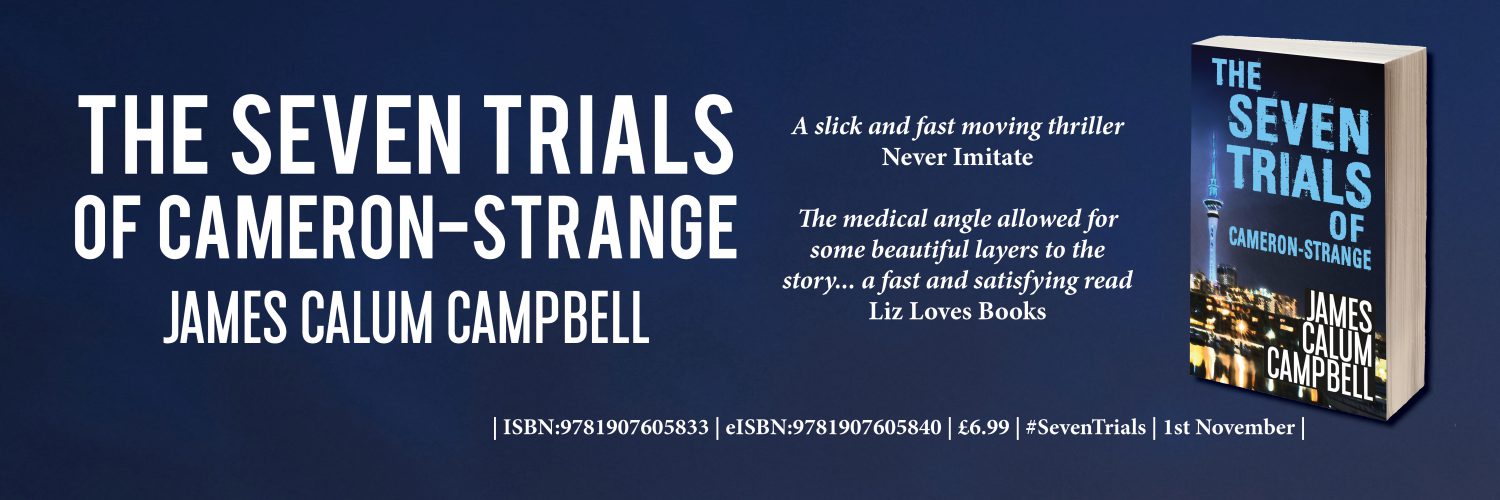
The Seven Trials of Cameron-Strange

God bless Impress Books.  They gave me a prize and published Click, Double-Click and then, even more generously, asked me for two more episodes in the life of the troubled doc.   Though I was preoccupied with literary forms non-fictional, I readily agreed.  Who would look a gift horse in the mouth?  This was last September.  Impress asked, when will episode 2 be ready?  I replied, perhaps cavalierly, by the end of the year.

Would it become an albatross round my neck?  Maybe, but I made it.  I sent the draft off and shortly afterwards disappeared to New Zealand.

Actually the seven trials, Alastair’s ordeals, take place in New Zealand.  I took the tome with me, on a laptop, with a back-up memory stick.

Never looked at it.  Too many places to visit, too many people to see, too many precious acquaintances to renew.

Moreover, even when I came back, I still could barely revisit it.  I’m not sure if writers aspiring to recognition are supposed to say this, but I would cast an eye over the tome, and say to myself, what a load of utter tosh!

Then I buckled down.  This is the essence of being a writer, the need to buckle down.  Remember the immortal words of Shelley in Prometheus Unbound

To suffer woes, which hope thinks infinite,

To forgive wrongs darker than death or night,

To defy power which seems omnipotent

Neither to change, nor falter, nor repent:

This… is to be

Good, great and joyous, beautiful and free,

This is alone life, joy, empire and victory.

I don’t in the least regret the fact that while I was in NZ I never once looked at my tome.  The best possible thing you can do with a draft, once completed, is, like a good wine, to put it down.  It sounds self-indulgent and pretentious to say that you are allowing time for your unconscious mind to work on it, but that is perfectly true.  Something mysterious happens to your creation while you conscientiously leave it alone.

The great spur for me, particularly over the last week, has been that I have revisited The Seven Trials with a sense of joy.  I’ve had a couple of creative ideas.  I saw a way of reorganising the architecture of the book in such a way as to signpost for the reader the journey he is about to undertake, even if more often than not he ends up far from the destination he might have anticipated.

Secondly, I’ve found a way of fitting some material into that architecture in a way that seems to solve several problems at once.  I suspect this only happens to a writer whose engagement with his material has become slightly obsessive.

I’m writing this on March 27th.  From tomorrow I’ve got four working days to meet my deadline, and if I’m spared I think I might just make it.  The extraordinary thing is, I relish the challenge.

What is the most important attribute a writer can have?

Inspiration?  Readability? Eloquence?  Message?

No.

Sheer bloody-mindedness.