Designer Grunge

A picture in Saturday’s Herald Magazine has just made me guffaw with laughter.  It’s in the fashion section, and it is of a beautiful woman modelling a white cotton voile tunic, a pair of jeans, and a pair of grey leather ballet pumps.  The jeans look like a remnant of clothing worn by someone who has spent a weekend at home doing slapdash DIY painting, or who has just survived the detonation of a bomb in a confined space.

“Painted and frayed denims – £175.”

I rather admire the style of young women who wear trousers lacerated across the knees.  It’s a young person’s statement.  Somebody of my age, on the other hand, adopting such a fashion, would not look like a chic waif, but rather a homeless vagrant.  Not a pretend tramp; a real one.  Mind you, I still think such a look might be preferable to that of some chaps I know, contemporaries of mine who, for reasons best known to themselves, think it a good idea to swan around the countryside wearing bright orange corduroys.  Then there’s the rural aristocracy.  They actually do allow their corduroys to degenerate into something not unlike the fragment on the girl from Colours Agency.  But they would never dream of expending money to acquire such a look.

The three biggest rip-offs in the modern world are to be found in the worlds of food and wine, fashion, and real estate.  You can usually tell if something is being marketed at a fantastically inflated price because the language of the pitch becomes hyperbolic.  Prosciutto of lamb sweetbreads pitchblended in an emblazoned béarnaise swamp showered in a crouton farce…. £75 supplement…  A rare acquisition opportunity: a truly delightful one bedroom mews garden flat (ie basement) with many period features, in need of some renovation, in the Georgian heart of Edinburgh’s New Town… offers over £1.5m…     Mind your wallet.

It was a very long time ago, in Primary School, that I first became aware of the truth, that, with the right pitch, it is possible to get somebody to swallow, literally, anything.  Sam, in the class ahead of me, was big, placid and gentle.  He was a hypnotist.  In the playground sheds, before a small audience, he hypnotised Wally, using a watch on a gold chain.  The watch swung to and fro and Sam addressed Wally in an undertone.  An occasional snigger from the crowd would quickly be silenced.  After a time Sam asked Wally to raise his hand in the air.  He appeared satisfied that he had achieved in Wally a state of trance.  He took a large safety pin from his blazer lapel, unclipped it, and took Wally’s hand.  He told Wally what he was going to do, and that he would feel no pain.  He pushed the pin into the fold of skin between Wally’s thumb and forefinger, right up to the hilt.  Wally never flinched.  Sam went on with his monotonous dirge.  He took the pin out and stuck it back in his lapel.  There was no bleeding.  Then he told Wally he was going to wake him up, by counting backwards.

Five four three two one

Wally blinked once and looked uncertainly around him.

Someone asked, “Won’t he get lockjaw?”

Sam said, “No,” with absolute confidence.  The crowd dispersed.  I lingered.  What happened next, the show’s aftermath, was much more interesting than the show itself.  Sam took a crumpled white paper bag out of his pocket and tore it open to reveal a slab of very dark brown stuff, stuck down on the paper.  He broke a piece off, prized it off the paper, and put it in his mouth.  He gestured the bag towards me.

“Piece?”

I shook my head.

“Wally?”

“What is it?”

“It’s s****.”

“What?”

“S****.”

He crunched with relish.  “It’s okay.  It’s been specially treated.  It tastes good.”  He snapped off another piece and proffered it.  Wally took it and put it in his mouth.  That was when I realised that, with the right pitch, you could persuade anybody of anything, sell anybody anything, get anybody to swallow anything.

And why should I be surprised?  Were we not the first generation rediffusion kids?

Amarsadayhelpsyouworkrestandplaytreatsthechocolatesthatmeltinyourmouthnotinyourhandmaltezersthechocolateswiththelessfatteningcentremilkywaythesweetyoucaneatbetweenmealswithoutruiningyourappetitethemilkybarkidistoughandstrongnestlesmilkybardon’tforgetthefruitgumsmum

Primum Non Nocere

What a catastrophe that the “junior doctors” (sic) in England are going on all-out strike on Tuesday and Wednesday this week.  Even emergency cover is being withdrawn.

I’ve had experience of an all-out strike of doctors in training, twice, in New Zealand.  At the time, I was Clinical Head of the Department of Emergency Medicine in Middlemore Hospital, Auckland.  I can’t remember what the issue at stake was – pay, conditions, whatever.  What I remember was the experience of working in that environment, when there was a skeleton staff made up entirely of consultants.

It was intensely interesting.  The consultants’ modus operandi was entirely different from that of the doctors in training.  There was no sense that any of the doctors were trying to satisfy somebody else’s agenda, whether it be their boss, Management, or the General Medical Council.  Instead, the consultants met their acutely unwell patients at “the coal face” (an unusual experience for many of them) and practised medicine from first principles.  They thought pathophysiologically.  First they took a very careful History.  Actually, almost everything they subsequently did was predicated on the History.  The physical examination was focused on the relevant systems, and any investigations were parsimonious, designed to answer specific questions, and extremely focused.  It was fabulous.

That’s not to say the situation was ideal.  There had been a very high profile appeal to the public beforehand, not to attend the emergency department unless it was absolutely necessary. For better or for worse, this had an effect.  Therefore the consultants, whether they knew it or not, experienced a light work burden.  Even so, by the end of a long haul, most of them had had enough.  I remember trying to refer somebody to one of them towards the end of a shift; he said, “I can’t think straight.  Can you sort it out?”  I put the patient into our short stay ward and looked after him.

This upcoming strike in England really is a catastrophe.  It bespeaks a failure on all sides. What I think it really tells us is that the relationship in England between doctors and politicians is profoundly toxic.  Isn’t there a discernible pattern here?  Mrs May got off-side with the police; Mr Gove got off-side with the teachers; now Mr Hunt is off-side with the doctors.  The pattern is archetypically British.  In the antipodes in the 1980s, I recall the doctors went to the politicians and said, “This is what we need.”  In England this decade, the politicians went to the doctors and said, “This is what you will do.”

This impasse raises the whole issue of what the role of a Health Minister should be.  Do we need one at all?  What expertise does he bring to the table?  Of course it is clear that democratically elected MPs should be responsible for the hypothecation of taxes towards a specific human endeavour, and it is also clear that such elected officials should be empowered to deliver the substance of their election manifesto.  Obamacare would be an ideal example of this.  But at what point does party policy descend into micromanagement?  Should politicians really be fixing waiting times for patients who have a cancer diagnosis?  Or the target that 95% of all emergency department patients should be discharged within 4 hours?  Should they really be organising the rosters of doctors in training?

If I were Health Minister I like to think that I would outline a policy direction in broad brushstrokes, then hand the budget over to the doctors and nurses, tell them to get on with it, and put my trust in them.  I wouldn’t wish to browbeat them and I certainly wouldn’t wish to make them miserable.

Yet the medical profession has made itself vulnerable to this sort of treatment by lack of cohesion and lack of leadership.  If only the ancient Royal Colleges could bury all the historical hatchets, stop being so tribal, and come up with a real sense of unity of purpose, the medical profession could be one of the most influential bodies in England, and across the UK generally.  If they were truly proactive, and spoke with one voice, and said, like the Aussies back around 1989, “This is what we need to do”, the politicians, even in this authoritarian land, would have to listen.

As it is, you have the prospect of 48 dangerous hours commencing tomorrow morning.  I’m writing this at 8 am on Monday morning.  You would think that the Health Minister and the Chairman of the BMA could shut themselves in a room, bang their own heads together, and come up with some sort of compromise, no matter how ramshackle and interim, that would avert a strike.  Instead, we see this perilous display of brinkmanship.  Both of them are waiting for the other guy to blink first.

Something will happen.  It doesn’t even have to be as a result of the strike; bad things happen anyway, and it will not be difficult to point to a cause-effect relationship between lack of staff and an adverse outcome.  At that point, doctors in training will begin to lose popular support.

This is really bad medicine.  It breaks the first law of medical practice: first, do no harm.

The Poignancy of a New England Fall

In Waterstones Perth I picked up a copy of The Opposite of Loneliness, essays and stories by Marina Keegan (Simon & Schuster UK 2014).

And couldn’t put it down.

Marina Keegan read English at Yale.  She was an author, poet, playwright, actor, and political activist.  Five days after her graduation magna cum laude from Yale in 2012, she was killed in a car crash.  The Opposite of Loneliness, her last essay for the Yale Daily News, went viral.

What is the opposite of loneliness?  Gregariousness?  Fellowship?  Togetherness?  Ms Keegan said there was no word for it; but she depicted it as something she experienced during her time at Yale, something that she was anxious not to lose.  So The Opposite of Loneliness is an exhortation to her fellow graduates not to look back with regret, but to look forward with hope.  The best is yet to come.  She reminds them that they are after all only 22 years old.  There is a bitter poignancy in that.  They have all the time in the world.

Her work is represented by eighteen pieces, half of them fiction, and half, including the title piece, non-fiction.  Her themes are Love, Transience, and Death.  In Cold Pastoral, the narrator gives a eulogy at the funeral of a boyfriend who has died prematurely.  In Challenger Deep, the occupants of a submarine trapped in total darkness and at great depth debate whether to await the inevitable, or leave early.  There are essays about a man who kills vermin for a living; about a school of whales thrown up by the tide and dying on the beach; and one about the death of the sun.  In Against the Grain, she even mocks her own demise, fantasising about a huge gluten-rich meal she would consume on her death bed.  (She had coeliac disease.)  It sounds like the sort of last meal sometimes ordered by people on Death Row.  If this all sounds a little dark, still there is humour and vitality and linguistic virtuosity.  And there is idealism.  You get a sense of it in Even Artichokes Have Doubts, in which she looks askance at the astonishing statistic, that 25% of Yale graduates take jobs in the financial sector.  That bothers her.  She doesn’t pretend to understand how the world works, but she just knows this isn’t right.  She expresses this with great warmth and humanity.  You will get a sense of it if you go on to theoppositeofloneliness.com and go into “Performances” and watch “I don’t know about Art…”  What a Life Force.

With Marina Keegan, you have a sense that a jealous god snatched her away precisely because she was so extraordinary.  She said, “…everything is so beautiful and so short.”  She has a sense of urgency.  She wants to leave her mark in the universe before she’s gone.  She might have shared a sentiment with Keats, who died when he was twenty five –

When I have fears that I may cease to be

Before my pen has gleaned my teeming brain…

Of course, she is a 22 year old writing as a 22 year old, in an unmistakable eastern seaboard US accent.  I suppose there is a tradition of mawkish sentimentality about Ivy League doomed youth that goes back to Ryan O’Neal and Ali MacGraw in Love Story, and indeed a surprising amount of the comment on line on The Opposite of Loneliness is negative and hypercritical in suggesting that, had Marina Keegan lived (as if her death was some kind of slick career move) her book would not have seen the light of day.  I think this is both unfair and untrue.  Ms Keegan said she was liable to bouts of jealousy; maybe she didn’t know she could stir that detestable emotion in others, who mistook for naivety the greatest gifts a writer can have – directness and simplicity.

She reminds me of Eva Cassidy, another artist who died prematurely.  Listen to her sing Autumn Leaves.  There’s something in the tone of voice that bespeaks a prescience of mortality.  The tone of voice of Marina Keegan is Eva Cassidy singing Feuilles mortes.


A Man, a Plan, a Canal… Panama!

Whichever way you look at it, the Prime Minister was going to have a rough week.  Unless something further comes to light, I’ll stick my neck out and hazard a guess that, unlike his counterpart in Iceland, he will survive.  I don’t even think he’ll sustain much political damage.  There’s a weary resignation in Britain when it comes to the systematic rip-off of the poor by the rich.  People will shrug and say, “It is what it is.”  I recall that when the Archbishop of Canterbury expressed criticism of Pay Day Loan Companies he rather shot himself in the foot because it turned out that The Church of England had shares in one such company.  Well, you can’t necessarily be held personally responsible for a shady inheritance.

Somebody asked me yesterday what I understood by the term “money laundering”, and I was reminded of the time I put my jeans through the washing machine with a £20 note in the hip pocket.  I was left wondering if the bank would honour its promise, now faded to illegibility, to pay the bearer on demand.  At medical school, the psychiatrists taught us that the inability to think in metaphor was indicative of various mental health issues.  You say to the patient, “What do you understand by the expression, ‘A stitch in time saves nine’?” and he replies, “If your clothes get frayed, it’s better to darn immediately, otherwise the job will get much bigger.”  You ask, “Could it mean anything else?” and the patient will look at you suspiciously, and say, “No.”  He will not extrapolate to the abstract and tell you that the entropy of the universe is always increasing and that it takes less energy to reverse a little disorder, than to reverse complete breakdown and chaos.

I’m on the side of the man in the psychiatrist’s chair.  Keep it simple; keep it concrete.  Once a metaphor turns into an epigram it begins to lose its meaning much as a bank note in the Hotpoint fades and loses its value.  But I gave “money laundering” my best shot.  You take some money that is “dirty” because it is ill-gotten or, to be frank, stolen, and you put it through some sort of process that renders it “clean”.  Therefore it no longer has the appearance of being stolen.  You have effectively hidden its mode of acquisition.

I checked that out with the last arbiter, the OED:

Launder: to transfer funds of illegal or dubious origin, usu. to a foreign country and then later to recover them from what seem to be “clean” (ie legitimate) sources.

Interestingly, OED cites the first use of the term in this sense to have occurred during Watergate in 1973 when Republican campaign funds (suitcases stuffed with $200,000) were allegedly “laundered” in Mexico.

Any metaphor that slips into common usage begins to function below par, degenerate into cliché, and finally become meaningless.  Far from being an act of hygienic purification, any financial scam, or white collar theft, is a deliberate muddying of tracks.  You take somebody else’s hard-earned cash (clean money, if you will) and sully it by burying it in an impenetrable quagmire of deceit and obfuscation.  No doubt the digital age has made the possibilities for manipulation of smoke and mirrors endless.  It is easier to transfer money in silica than in a suitcase.

Now that we are eschewing banknotes in favour of tapping our debit cards on the screen at the supermarket checkout, we need to revisit the question of what money actually is.  The stock answer is that money is a system devised for the exchange of goods and services, that is less cumbersome than barter.  This sounds too democratic, collegiate, and sensible to be true.  I’ve heard another explanation for the origin of money that has the horrible ring of truth about it.  An absolute ruler invented money in order to pay his army.  He constructed a mint, and paid his army in coin.  If he needed more money, he produced more. (We might call it quantitative easing – a licence to print money; he was just coining it.)  The army then used the money to pay the populace of the country it occupied in return for food and provisions.  The populace then did indeed use the money as a substitute for barter.   You might call this the real economy.  Additionally, and regularly, the absolute ruler got some of the money back, through taxation.   This was for defence procurement.  Thus the populace was financing the army.  You might call it a protection racket.

It’s a dark view.  It suggests that money, and even taxation, are scams organised by the rich and powerful for their own benefit.  It suggests that the quality that invests money with value is neither confidence nor trust, but fear.

The Dodgy Syllogism

A week ago I bought a copy of The Sunday Times.  I don’t normally take The Sunday Times, but I saw it on the news stand, and an article, “We are in denial about Islam”, by Tony Blair, caught my eye.  This followed the attacks in Belgium, and I was curious to know the ex-Prime Minister’s opinion.  I have been mulling over the article for a week now, wondering if I’ve really understood its drift.  I will try to precis Mr Blair’s argument:

We are at war with extremist Islamism.  The conflict is going to be long.  The attacks on us are going to become more frequent and more severe.  We need to tackle the problem at its root, which is an ideology shared not by thousands, but by many millions of people.  This ideology – “Islamism” – is a perversion of an honourable and peaceful faith.  “Islamism” begets Islamic extremism.  Islamism even in its more moderate and non-violent form has a way of thinking that is inconsistent with a pluralist and open-minded view of the world.  Islamism seeks dominance.  It cannot be contained; it has to be defeated.

We need to improve intelligence cooperation across Europe and elsewhere, removing all obstacles of bureaucracy and, in some cases, normal legal processes.  Isis has to be crushed.  We must confront and defeat terrorists where they try to hold territory.  Ground forces are necessary to win this fight and ours are the most capable.  Prejudice needs to be rooted out of education systems globally.  In Europe, Britain should take the lead in this struggle which is similar to that against revolutionary communism, and fascism.  The entire body politic needs to “rediscover its muscularity”.  We’ve been here before.      

Well, today I took The Sunday Times again, confident there would be some reaction in the Letters column.  There were six short letters.  The first blamed Tony Blair and George W Bush for the rise of Isis.  The second despaired of any coherent global strategy as the members of the UN Security Council are only acting out of self-interest.  The third drew attention to the corrupt and sectarian nature of the Iraqi state, which sprang from the invasion.  The fourth sees Mr Blair as responsible, and asks to be spared the sermon.  The fifth supports Mr Blair’s view.  The sixth calls upon European nations to tackle deprivation in their Muslim communities.

I confess I was disappointed with the standard of debate, on all sides.  Granted the printed version of Mr Blair’s essay was an extract of a longer piece available on line; and I suspect the readers’ correspondence similarly were extracts of longer letters.  But we have to evaluate the arguments, as they have been presented.  The letters for the most part amounted to a hand-wringing exercise, dominated by a predictable ad hominem attack on Mr Blair.  I had much rather that any riposte had taken the form of literary criticism, that is, an analysis of what Mr Blair has to say, and – if justified – a demolition of it on its own terms.

It seems to me that Mr Blair’s argument takes the form of a dodgy syllogism.  Recall that a syllogism is a logical argument consisting of two premises leading inescapably to a conclusion. A sound syllogism would be: All men are mortal; Sophocles was a man; ergo Sophocles was mortal.  A dodgy syllogism would be: Sophocles was mortal; Sophocles was a man; ergo all men are mortal.  Mr Blair’s syllogism takes the form of the latter: We are at war with extremist Islamism; “Islamism” begets extremist Islamism; ergo we are at war with Islamism.  If you propound an axiom concerning all the members of a large class of entities you are entitled to apply it to any subgroup within the class.  If on the other hand you propound an axiom concerning a subgroup within a class, you are not logically entitled to apply the axiom to the whole class.  This conflation, almost by a sleight of hand, of “Islamism” with “Islamic extremism” creates an enemy for us, of many millions of people.  Corollaries to this follow thick and fast.  Because “Islamism” seeks dominance, and cannot be contained, it has to be defeated, militarily.  This involves not merely intelligence gathering, but combat, that is, troops on the ground.  The UK must be involved and must take a lead role.  This is a call to arms, on a vast scale.

But Mr Blair’s first premise, “We are at war with Islamist extremism” (the first sentence of Mr Blair’s essay) is already suspect.  Currently the UK is not, as far as I know, at war with anybody.  Now you can certainly wage war against extremists, but is it possible to wage war against an ideology?  You may be able to “crush” (sic) Isis, but can you crush an ideology in the same way? Can you really kill off an idea with a drone strike?  Reading Mr Blair’s essay reminded me of an extraordinary passage in Michael Ondaatje’s The English Patient, a description of an army incensed by a wind coming off the desert.  The army declares war on the wind, puts on combat gear, takes up arms, and goes out to the desert to confront the wind.  The army is completely engulfed in a sand storm and never seen again.

Any conflict of ideas is virtual; it takes place not on a battlefield, but in the hearts and minds of people.  We seldom talk about the origin of hatred, or try to understand why it is there.  At Eastertide, would we not do well to remember Jesus’ advice to “love your enemies, do good to those who hate you”?  Most people think that is impossibly sentimental, and – well – just impossible.  Yet to think so is to fail to understand the hard core of pragmatism underlying this teaching.  Love undermines hatred.  It leaves hatred with nowhere to go.


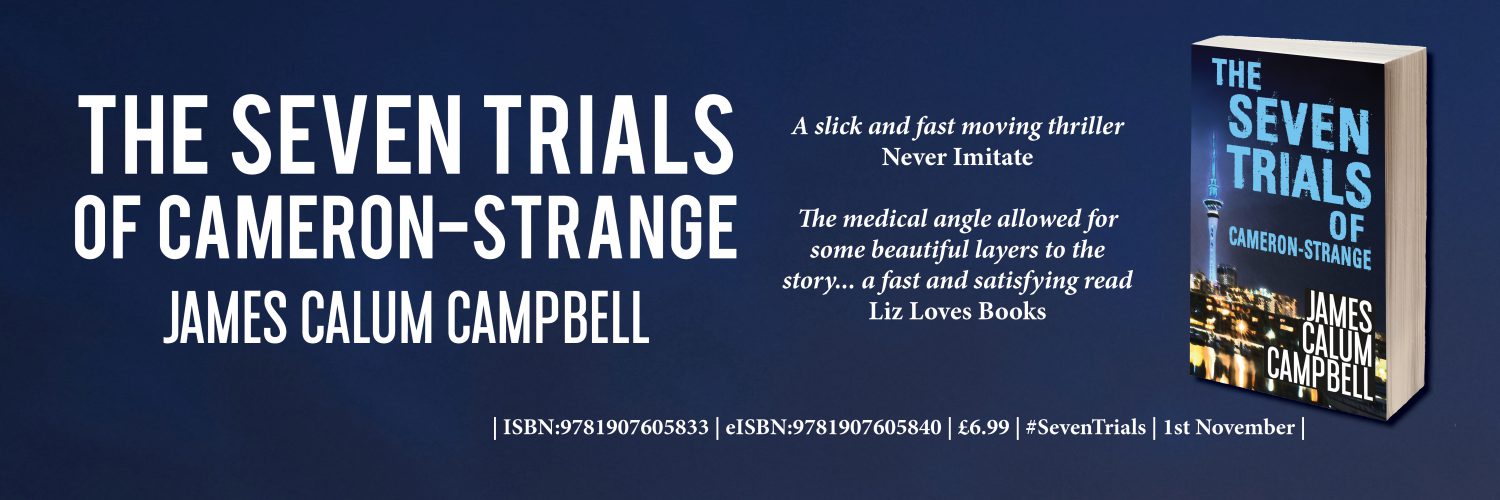
The Seven Trials of Cameron-Strange

God bless Impress Books.  They gave me a prize and published Click, Double-Click and then, even more generously, asked me for two more episodes in the life of the troubled doc.   Though I was preoccupied with literary forms non-fictional, I readily agreed.  Who would look a gift horse in the mouth?  This was last September.  Impress asked, when will episode 2 be ready?  I replied, perhaps cavalierly, by the end of the year.

Would it become an albatross round my neck?  Maybe, but I made it.  I sent the draft off and shortly afterwards disappeared to New Zealand.

Actually the seven trials, Alastair’s ordeals, take place in New Zealand.  I took the tome with me, on a laptop, with a back-up memory stick.

Never looked at it.  Too many places to visit, too many people to see, too many precious acquaintances to renew.

Moreover, even when I came back, I still could barely revisit it.  I’m not sure if writers aspiring to recognition are supposed to say this, but I would cast an eye over the tome, and say to myself, what a load of utter tosh!

Then I buckled down.  This is the essence of being a writer, the need to buckle down.  Remember the immortal words of Shelley in Prometheus Unbound

To suffer woes, which hope thinks infinite,

To forgive wrongs darker than death or night,

To defy power which seems omnipotent

Neither to change, nor falter, nor repent:

This… is to be

Good, great and joyous, beautiful and free,

This is alone life, joy, empire and victory.

I don’t in the least regret the fact that while I was in NZ I never once looked at my tome.  The best possible thing you can do with a draft, once completed, is, like a good wine, to put it down.  It sounds self-indulgent and pretentious to say that you are allowing time for your unconscious mind to work on it, but that is perfectly true.  Something mysterious happens to your creation while you conscientiously leave it alone.

The great spur for me, particularly over the last week, has been that I have revisited The Seven Trials with a sense of joy.  I’ve had a couple of creative ideas.  I saw a way of reorganising the architecture of the book in such a way as to signpost for the reader the journey he is about to undertake, even if more often than not he ends up far from the destination he might have anticipated.

Secondly, I’ve found a way of fitting some material into that architecture in a way that seems to solve several problems at once.  I suspect this only happens to a writer whose engagement with his material has become slightly obsessive.

I’m writing this on March 27th.  From tomorrow I’ve got four working days to meet my deadline, and if I’m spared I think I might just make it.  The extraordinary thing is, I relish the challenge.

What is the most important attribute a writer can have?

Inspiration?  Readability? Eloquence?  Message?

No.

Sheer bloody-mindedness.

The Scotoma in The 20-20 Vision

Audit Scotland got stuck into the Scottish Government last week because it has thus far failed to realise its “20-20 Vision” of health care delivery.  2020 is a 5 point plan.  In brief, by 2020 we should have:

Integrated health and social care.

A focus on prevention, anticipation, and self-management.

If hospital input is needed, day case treatment will be the norm.

(Virtually meaningless statement about patient centred quality and safety to the highest standard.)

Focus on getting the patient home with minimal risk of readmission.

I wrote to The Herald.  Disgruntled curmudgeon of Breadalbane.  I was particularly exercised about Point 3.  Which particular diagnosis is going to be shoehorned into a day case?  Fractured neck of femur?  Pneumonia?  Sepsis?  Myocardial infarction?  Stroke?  You can’t design a utopian system of health care just by wishing it were so, and by ignoring the slings and arrows of outrageous fortune.  It’s not really the government’s fault; they are in an impossible position.  The medical profession should have told them something of the nature of human pathophysiology.

This agenda is all about the care of the elderly.  It is apparent that the population of over 75s is increasing in Scotland – as elsewhere – and that medical provision for this population must be provided.  You often hear this issue discussed in terms of an intractable problem – the impending crisis of care arising from the aging population.  I don’t care for this notion of the elderly posing intractable problems.  In my experience, the elderly are the least demanding population of all.

I grew up surrounded by old people.  Both my mother and my father were one of seven siblings.  My mum had three brothers and three sisters.  All the girls came down to Glasgow from Skye.  All of my aunts were prematurely widowed.  They all went into business in Glasgow and ran nursing homes for the elderly.  My mum was crucial to this venture because she was a state registered nurse and a midwife (she delivered many of my cousins) and her presence was critical to what would now be described as issues of clinical governance, quality, and safety.

From the earliest age, I became comfortable with people who were decrepit, incontinent, and mentally confused.  It never bothered me.  My mum used to say, it’s not difficult to look after an old person.  All you need is loving kindness, and a bed-pan.

The idea of sustaining sick elderly people at home may sound attractive but if you think about the way in which people now live, it is not always desirable.  Many elderly people live alone.  If not, if they have a surviving spouse, the spouse is likely also to be frail and to have health issues that will impinge on their ability to be the principal carer.  Let’s suppose the elderly patient is living with an offspring and spouse; chances are both will be out working, in order to pay off the enormous mortgage on their property, and support the children in their private education, designed to support them in the ghastly pursuit of advancement to a position of authority in the running of a dark Satanic mill.

There is nobody at home who has the inclination, the time, the skill, and the capacity for a particular kind of intimacy; nobody is willing to remove their outer garments, put a towel round their waist, and get down on their hands and knees to wash a loved one’s feet.


March 13th, 2016

March 13th 2016.  Lord’s Day – as Pepys would say.  To Dunblane Cathedral.  Nothing special about that.  I always go if I’m within coo-wee (Kiwi expression).  Well, something special after all.  It is twenty years, to the day, since the Dunblane massacre.

The town was not taking any official notice of the day.  Yet I can hardly think it coincidental that the cathedral was packed.  The minister did make a short, dignified statement, culminating in a two minute silence.  And the organist, a master musician, played, on the magnificent Flentrop organ, the Passacaglia and Fugue in C minor, by J S Bach.

After the Dunblane massacre, the UK introduced some of the strictest gun control laws in the western world.  Have they worked?  It’s an impossible question.  All one can say is, with the occasional setback, so far, so good.  Today, in Scotland, firearms account for just 2% of all homicides.  In the USA, they account for about 70% .There, there are over 300 million firearms; 8,855 people were shot dead in 2012.  Thanks to The Sunday Herald for these statistics.

Something else caught my eye in the papers this week.  In yesterday’s National, there was a brief report that on Thursday a 77 year old Glasgow pensioner had been arrested for lying down on the road in front of a convoy conveying nuclear warheads through central Scotland.  This is Brian Quail.  Mr Quail is well known to readers of The Herald because he writes letters of the utmost eloquence on the imperative necessity that we get rid of Trident.  I take my hat off to Mr Quail, a man who does not merely express his opinion, but who lives it out.  He reminds me of the man who stood in front of the tank on Tiananmen Square.  I find it ironic that he has been charged with “breach of the peace”.

Mr Obama is tearing his hair out because he cannot persuade the American people that the National Rifle Association has got it all wrong.  Meanwhile here in Scotland the notion of having a population that is essentially disarmed is generally acceptable to all.  Should we not take this further, and not merely ban handguns, but ban the bomb?  Mr Quail thinks so, but for the most part he is a lone voice in the wilderness.  The current government policy (Westminster government, Defence being a reserved matter) is that Trident be renewed for the next 50 years at a cost variously estimated at between 100 billion and 160 billion pounds.  The argument is that nuclear “deterrence” has kept the peace now for over 70 years.  Campaigners for unilateral nuclear disarmament are characterised as being well-meaning but hopelessly naïve, and ultimately dangerous.

Yet little is said about the dangers of having these hellish contraptions on our doorstep.  I have no doubt that people of less noble intent than Mr Quail will have read the report in The National, and thought, well, if a 77 year old Glasgow pensioner can stop a nuclear convoy that easily…

It’s a catastrophe waiting to happen.


The isle is full of noises

I picked up a hardback copy, in good nick, of Bernard Levin’s “The Pendulum Years: Britain in the Sixties” (Cape, 1970) in a second hand bookshop in Whangarei, NZ.  I can’t walk past these great, shambling, labyrinthine shops stacked floor to ceiling with fusty old books as if by some sufferer of Diogenes Syndrome.  I’m looking for two items – a hardback Casino Royale and a hardback Moonraker, to complete my Fleming collection.  I didn’t find them.  But you know how it is; you spend so long in the shop that it becomes an embarrassment if you don’t buy something.  Hence, The Pendulum Years.  You know you’ve got a problem if you buy a book you’ve already read.  But I thought it worth the revisit.  How perverse, to cross half the world and then read about a place 12,000 miles and fifty years away.  I was curious to know if Levin’s thesis had stood the test of time, that the sixties in Britain were characterised by a tension between the pull towards the future and the pull towards the past.

It’s an enjoyable read.  I always admired Levin’s outspoken journalism.  Yet I found myself to be more critical on this reread.  The title of the book is misleading.  I doubt if its preoccupations were the preoccupations of most of the inhabitants of these islands at the time.  A more accurate title would be, “The Pendulum Years: Metropolitan London in the Sixties”.  Then I found myself irritated by the tone; everything is described with an air of supercilious above-the-battle ironic detachment.  No wonder somebody threw a punch at Levin, live on air on That was The Week That Was.

  Yet some of the chapters are spellbinding.  Vassall, the Profumo affair, Churchill’s funeral.  I’d single out Wives and Servants, Levin’s description of the prosecution of Lady C under The Obscene Publications Act.  Levin sat through all six days of the trial, a feat of endurance in itself.  His account is brilliant, and very funny.  The chapter well exemplifies Levin’s theme of past v future.  It is hard to imagine from our current perspective that Lady Chatterley’s Lover might have continued to be suppressed.  Levin’s notion is that change in the sixties was unstoppable, that a nostalgic longing for Britain past, real or imagined, was futile.

But then there are lacunae.  Science is the obvious one.  It was after all in 1962 that F R Leavis, in his Richmond Lecture launched his vicious attack on C P Snow following Snow’s 1959 Rede Lecture on “The Two Cultures”.  There really was a tension between the roles of science and the arts in the sixties.  Mr Wilson wanted to re-forge Britain’s greatness amid “the white heat of technology”, but little of this gets a mention.  And occasionally Levin is just plain wrong.  He thought the Beatles’ output would be ephemeral!

If Levin never became “establishment”, he mellowed, as perhaps most enfants terribles do.  My favourite of his books is Enthusiasms, in which he ditches his Vanity Fair view of human affairs and exalts his great passions, from music to Shakespeare to friendship even to the life spiritual, with – well – an enthusiasm that is unalloyed.

As for final judgment on The Pendulum Years, I’m not so sure even after all these years that Britain, the country I flew back into on March 1st, in some respects has changed so very much.  There have been 53 Prime ministers since Robert Walpole.  More than a third of them were educated at Eton, including the present incumbent.  The first duty of the establishment is to perpetuate itself.  At this, for better or for worse, Britain has proved extraordinarily successful.

Gridlock in Auckland

Auckland has a problem.

Start with the traffic. Wedged as it is in a narrow isthmus between the Waitemata and Manukau Harbours, Auckland cannot be bypassed. If you have the misfortune to have to travel through Auckland in a week day late afternoon, you will join a traffic jam, a crawling nose-to-tail procession stretching from Sunset Road in the north to the Bombay Hills in the south, that is literally 100 kilometres long.

Greater Auckland accounts for over 50% of New Zealand’s population growth in the past decade. Housing and transport have struggled to keep up. Housing prices in central Auckland have sky-rocketed, so that people obliged to work in Auckland cannot afford to live there. Instead, they live in a satellite town like Papakura in the south, and commute. There is no substantial public transport system, so they drive.

Auckland Harbour Bridge has always been a bottleneck. When I lived on Auckland’s North Shore towards the end of last century, and worked in Middlemore Hospital in South Auckland, I would get over the bridge before 7 am, or I’d be sunk. Now, it’s 6 am. Traffic in Auckland has moved from the farcical to the surreal. There has been talk of a second harbour bridge, or a tunnel, but word on the street is there is no money. Personally I would favour greater investment in public transport; cars and cities don’t really mix.

But the traffic problem is merely symptomatic of a deeper malaise. It has been niggling away at me all through February while I’ve been here. I can best characterise it by contrasting a night I spent in NZ’s northland with a night in Auckland. I was in Waipapakauri on Ninety Mile Beach (where, incidentally, Alastair Cameron-Strange lived when he was a child). I came down the west coast and crossed the ferry to Rawene to meet a dear friend. I lost track of time and had an unscheduled stop in Rawene in the Old Postmaster’s House, a B & B of charm and character. My host gave me a door key and the run of the place.

Later, I had a similar unscheduled stop in downtown Auckland. I try to avoid the swanky hotels in the CBD, but I chose a brand new place in Britomart, handy for the occasion. It was the absolute antithesis to the Old Postmaster’s House. Security was tight to the point of paranoia. Yes I could park my car in the catacomb beneath the hotel. My “passport” was 124. I asked, “Is that the number of the parking bay?” The unsmiling man at the desk was implacable. “Your passport is 124.” It turned out to be the number of the parking bay. When I eventually got in, and ascended to the hotel proper, I laughed out loud. The interior resembled a penitentiary, an atrium with tiered galleries of prison cells. I was a bit player in The Shawshank Redemption. It started to rain and I noticed the roof leaked really badly. Not so; there was no roof. I retired to my “apartment”.

Funny word, “apartment”, but apposite. To stay in an hotel like this is truly to be “apart”. You are not going to meet fellow inmates for breakfast, exchange confidences and, as in Rawene, get an invite to Switzerland. Rather, you are in solitary confinement. The “apartment” was brand spanking new, beautiful after the manner of a supermodel’s sullen hauteur, and utterly sterile. If I slept well it was because I was exhausted.

In the morning I had difficulty breaking out. I eschewed the lifts and then got lost in a labyrinth of corridors leading to the hotel laundry, or to a door beyond which the world outside tantalised me, but which I could not open. I might have been in Kolditz.

I think I’ve had it with posh hotels. Miserable places. It is easier for a camel to pass through the eye of a needle than for a rich man to enter the kingdom of heaven. I went out on to Queen Street and sat down on the pavement and played chess with a seven year old Indian kid trying to raise money to play in a chess championship. He beat me hollow.

Twice.