A Joyous Yule!

Sunday December 20th.   Nativity Play in Dunblane Cathedral in the morning.  Charming.  I felt I was on the set of Love Actually, but did not run into Claudia Schiffer.  In the evening, I dusted off my sadly neglected viola and played in a ceremony of Lessons and Carols in Glasgow.  It was a day spent in contemplation of the miraculous.  Dare I speak of the miraculous?  I will sound like a self-appointed sage in a pub, like either Peter Cooke or Dudley Moore in the old Pete and Dud sketches.  Why not?

I read in the papers this week that Mother Theresa is edging towards sainthood on the basis of her apparent posthumous intercession on behalf of a patient with stomach cancer, followed by a second patient with a brain tumour.  Both are in remission.  From time to time you hear a story like this.  Two adolescent girls in a remote village in Andalusia see visions and cure people and a team of cardinals go to investigate, in precisely the way a team of scientists might visit a remote location to study any unusual phenomenon.  The process has a rather medieval flavour to it.  Not that the Roman Catholic Church is the only denomination solely preoccupied with the miraculous.  Friday’s Herald devoted profligate column inches to the issue of whether incredible reports of shepherds and Magi following a wandering star to encounter a virgin birth (parthenogenesis) should be taken literally.  The Reverend Andrew Frater of Cairns Church in Milngavie has described it all as a “fanciful fairy tale” and wants to “disentangle the truth from the tinsel.”  Apparently, however, the Free Kirk are not best pleased at Rev Frater’s “offering inert, gelatinous, non-offensive niceness.”   This is all part of an ongoing debate as to whether New Testament reportage should be taken literally or metaphorically.  The Free Kirk are giving metaphor a bad press.

Yet metaphor is all we have. Everything is metaphor.  Jesus spoke in metaphor all the time when he said “The kingdom of heaven is like…” in his many parables.  Oddly enough, the people who understand best of all that everything is metaphor are scientists.  Jacob Bronowski thought that the great triumph of quantum mechanics lay in its demonstration that absolute truth is unattainable.  Our understanding of nature is uncertain not because our laboratory instruments are imperfect, but because uncertainty is knit into the fabric of the universe.  (I can just hear Pete saying all that to Dud in a nasal whine, over his pint of bitter, and making Dud corpse with laughter.)   It was Richard Feynman who pointed out that, while we can do sums involving energy, nobody actually knows what energy is.  That makes “e = mc squared” a metaphor.  Feynman said that the fact that he could never know anything for sure didn’t bother him.  He was just happy to keep searching.  Newton described his scientific work metaphorically.  He said it was like turning up a nice pebble on the beach, while all the time the great ocean of truth lay out there, waiting.  To do that which you are called upon to do, to the best of your ability, and not to get hung up about all the rest, is surely an act of faith.

I remember when I was about ten years old spending half a morning in my primary school sick bay with a belly ache.  I drifted off to sleep for a couple of hours.  When I woke, the ache was gone.  I lay still, with the hyperacusis of the newly wakened, listening to the banter of the school secretarial staff through the partition.  It was perhaps the first time in my life that I felt a sense of wonder at the gift not only of consciousness, but of consciousness of an underlying moment to moment order in existence that meant that existence was neither chaotic, nor null.

It seems to me that the great miracle of existence, of the ordor essendi, is that miracles are precluded.  Existence is subject to physical laws.  If a law appears to be transgressed, then it merely means that our understanding of the law is incomplete.  Is that an anti-religious sentiment?  Not at all.  Existence constantly shows itself to be infinitely more amazing and inspiring and – if you like – miraculous, than anything we have to date been able to conceive.  We need to stop trying to quest for literal certainty in any matter.  Get over it.

Faith, Hope, and Love.  It’s enough.

Have a wonderful, and a safe Christmas.

JCC


The Advent of Alastair Cameron-Strange

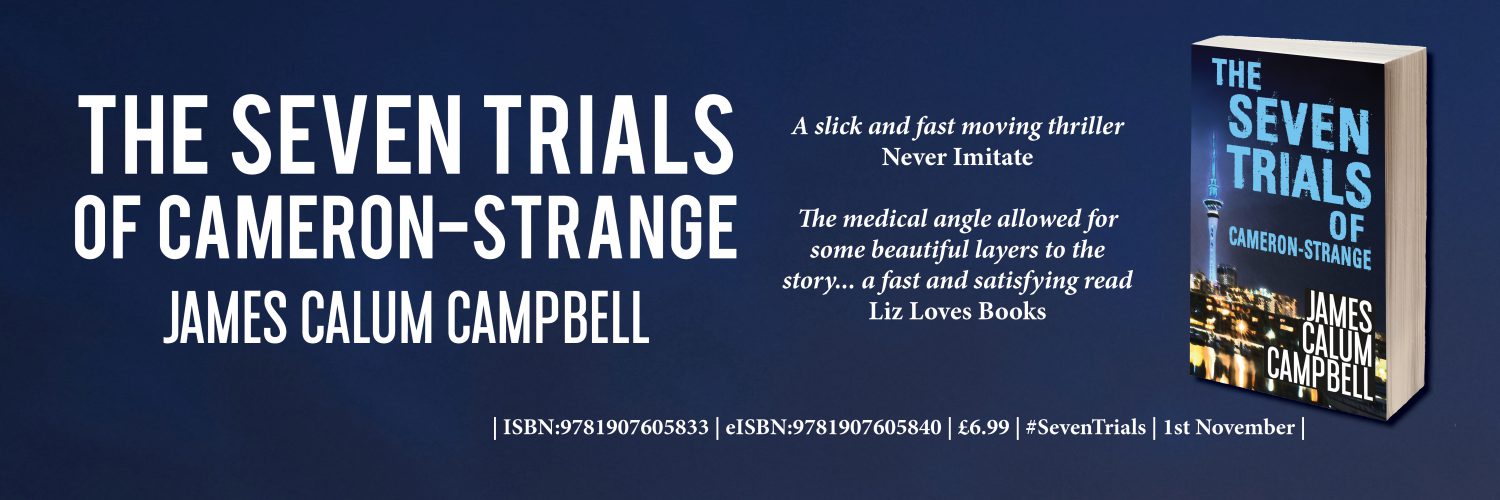
Update on the sequel to Click, Double-Click, aka The Seven Trials of Cameron-Strange.  65,000 words on the slate, maybe about 10,000 to go.  To paraphrase Eric Morecombe, they are the right words, but they are not necessarily in the right order.  I want to finish the draft by the end of the year, and hope to do so, if I’m spared unforeseen catastrophes, or, indeed, if I’m spared.  Having done a solid chunk last week, I rewarded myself with some R & R this weekend to coincide with the onset of the festive season, and enjoyed various lunches, suppers, and parties in Glasgow, Stirling, and Aberdeen.  If you spend your whole life in a garret you just get cabin fever.  And besides, how can you write about life if you don’t live it?  I think it was Doris Lessing who said that the difficult part of life for the writer was not the writing, but the living.

I met some wonderful people, but I suspect I wasn’t very good company.  I might have had the glazed look of somebody suffering from what the psycho-geriatricians call “cocktail-proof dementia”, that is, the ability to conduct a conversation when you don’t have a clue what’s going on.  So you interject at various points, “Is that so?  My goodness!  How extraordinary!”  And all the time you are thinking, “How the hell is the troubled doc going to get himself out of the fix you’ve put him in?  Of course, episode A actually needs to follow episode B, and he really doesn’t need to explain about such-and-such when the context makes it self-evident, and he really mustn’t chase Ms X because she’s professionally off limits …”

“…Sophie’s gap year helping Venezuelan street kids is going really well and Cameron is really looking forward to Brasenose…”

“Is that so?  My goodness!  How extraordinary!”

You slip out of the hubbub of the party for a moment to write in your notebook, “ACS – he’s like St Paul, twice shipwrecked…”  You’re driving from Stirling to Aberdeen and you pull over to scribble down something you hear on the car radio: “Exploit malware – some sort of IT scam… what would ACS make of it?”   You wake in the night with an idea that seems so crucial that you have to get up and write it down in case you forget it.  Frankly you are living in an alternative universe and because that universe is of your own concoction and therefore capricious, are you not technically insane?

What can I tell you about Seven Trials?  I like to think of a piece of music that suggests the mood of a book.  The mood of Click, Double-Click was in the music of Sir James MacMillan.  A Child’s Prayer would open a televised episode, and St Aloysius Pray for Us would close it.

Seven Trials has an epilogue.  It is the epilogue of Arnold Bax’s Second Symphony.  ACS’s beloved twin sister MacKenzie is the viola player in the Arnold Bax Quartet.  MacKenzie knows that Bax is a composer of the highest order.  Bax wrote seven symphonies.  Four of them have epilogues – numbers 2, 3, 6, and 7.  The epilogue of Bax’s Second Symphony says to us, quite clearly, this is not the end; this is merely a break, a moment of respite in a long saga.  You may contrast this with the epilogue to the seventh symphony which, for all that it is understated, is one of the most – well – final farewells in all of music.  But we have not yet come to that.  It’s in the distance.

If Seven Trials is Bax 2, then ACS must come back.  He comes back in Speedbird.  I can only tell you one thing about Speedbird.  The atmosphere of Speedbird is the atmosphere of Arvo Part’s In Memoriam Benjamin Britten.           

  So it goes on.

William McIlvanney, 1936 – 2015

I was saddened to hear of the passing of William McIlvanney.

Mr McIlvanney had a very expressive face.  I thought of his face as that of a man who had lived, and, perhaps, suffered, much, but who always retained his sense of humanity.

When I read Laidlaw, the first in the Laidlaw trilogy, I recognised instantly the world in which Laidlaw moved; I recognised its authenticity.  I understood the geography of Laidlaw’s world.  This was because my Dad was also a Glasgow cop.  And he spent the greater part of his career working out of Police Headquarters as it then was, by St Andrews Square on the edge of the east end.  This is ancient Glasgow, the Glasgow of the Toll Booth and the Cathedral and Provands Lordship and the Necropolis and Glasgow Green.  It’s on the edge of one of the most deprived and disadvantaged precincts in Europe.

Mr McIlvanney captured the atmosphere of this environment perfectly.  The atmosphere of the gangster underworld is faithfully recorded in a Glasgow accent.  It’s full of dark humour.  And also, surprisingly, compassion.

When I was a child, struggling to wrestle the best of three falls with words, it would never have occurred to me to write about Glasgow.  On the contrary, I wanted to escape from Glasgow and fly to the Caribbean and dine off oeufs en cocotte with a sophisticated mademoiselle and bla bla bla.   It never occurred to me that I was living right in the middle of one of the craziest, most bizarre, exotic places on earth.  That much did occur to me, in a slow witted way, later on.  This is what happens when you stop thinking of writing as escapism and start thinking of it as therapy.

Let me tell you about something I once witnessed from that ancient tract of land bordered by Saltmarket, Gallowgate, Glasgow Green, and the Clyde.  I had gone to Glasgow Police HQ to meet my father for lunch.  It was July 15th, 1969.  I’d often come here for lunch, and enjoyed the joshing and ribaldry of my father’s colleagues, the policemen and the typists and the dinner ladies.  But today was different.  The place was buzzing.  Two policemen had gone out on a routine enquiry to a flat in the city’s west end, to interview a man from Rochdale named James Griffiths about his connections with an alleged Glasgow criminal.  Mr Griffiths himself had a troubled background and had in fact spent 17 of the last 25 years of his life in various corrective institutions.  He opened fire on the police, then started firing at passers-by from an attic window.  He then escaped the flat, hijacked a car, and went on a shooting spree across North Glasgow.  He crashed the car in Possil.  He went into a public house, had a drink, and shot and fatally wounded another customer.  Unbelievably – and this part of the tale is quintessentially Glasgow – the barman said to him, “Why did you do that? He was just an old man!”  And he grabbed Griffiths by the scruff of the neck and chucked him out of the pub.  Griffiths hijacked another vehicle, drove into Springburn, broke into a flat and carried on with his shooting spree.

Meanwhile I carried on with my tomato soup, mince and potatoes, and Eve’s pudding and custard.  Half way through, a friend of my father’s came in briefly and joined us.  He was carrying a rifle and pouring with sweat.  We got an update.  Mr Griffiths was cornered.  There was a stake out.  Another friend of my father’s shot Mr Griffiths through the letter box.  By that time Mr Griffiths had shot thirteen people.

Looking back on it, I’m amazed at what little effect it had on me, a big mass shooting of the sort that now makes international headlines and calls from the US president to reform gun laws etc etc.  I just wolfed down my Eve’s pudding.  You sometimes see pictures of kids in trouble spots where life is disrupted by war, famine, ethnic cleansing, and terrorism.  There’s no security; it’s hell on earth.  What do the kids do?  They play a game of football.

Now, I can hardly bear to read the newspapers.  We are at war.  It’s nothing new; the war has merely been extended.  People are desperately trying to migrate out of zones of chaos.  Sea levels are rising.  Storm Desmond is wreaking havoc in Cumbria and the temperatures for December are preternaturally warm.   Mr Obama is wringing his hands about the latest atrocity in California.  But he has been rendered powerless by the Senate.

I wonder about the position of the Church with respect to Syria.  What is the position of the Lords Spiritual?  How do they interpret the words of Our Lord – love thine enemies, do good to those who hate you?  What makes William McIlvanney’s Jack Laidlaw unusual, and something of a maverick, is his ability to solve a crime, and apprehend a murderer, by understanding the humanity of the murderer.  He gets his man.  Then he visits him in his cell and offers him a cup of tea.


The Psychology of a Child Vigilante

When I was ten years old, I wanted to be Jack Trent.  And I wanted my best friend to be Philip Mannering.  Jack and Philip were creations of Enid Blyton.  Jack had freckles and red hair.  He was older than me, maybe about fourteen.  Philip’s hair stuck up in front and I thought that was cool.  He was about thirteen.  They both had sisters.  Philip’s sister was Dinah and she was dark and hot tempered and feisty.  She was about twelve.  Lucy-Ann was red-haired and freckly like her brother and unlike Dinah she was sweet natured and openly affectionate.  She was about my age but I thought she sounded younger than me.  She adored Jack.  Their parents had been killed in a plane crash and they lived with a cross old uncle who did not love them.

Philip and Dinah’s father was dead, but they had a mother who ran an art agency and was young and clever and pretty.  They went to boarding school and spent holidays with a recluse antiquarian uncle and a sour and exhausted aunt.

They all met one year at a summer cramming school, and got on famously.  They had shared interests.  Very out-doorsy.  Jack was crazy about bird watching and had a talkative pet parrot who sat on his shoulder.  Her name was Kiki.  Philip had the quality of animal magnetism.  No animal was afraid of him.  Consequently his person was frequently crawling with all manner of Insecta, invertebrates, reptiles, to Dinah’s intense disgust.  He would tease his sister by threatening her with some repulsive creepy-crawly and she would lose her temper and yell at him, and slap him while Lacy-Ann got upset and Jack tried to pour oil on troubled waters.  Yet Dinah’s tempers never lasted long.  That was the good thing about Dinah; she would never…

Mrs Miller snatched the book from my hands and peered at it.

“What’s this?”

“A book,” I said, stupidly.  It was the bulky MacMilllan edition, handsomely bound in yellow hardback covers, with illustrations by Stuart Tresilion.

“Blyton.”  She sniffed.  “I’m surprised at you.”  You would have thought I had been discovered concealing libidinous literature under my desk lid.  The girl across the aisle gasped, as if she had encountered me in the midst of a lewd act.

Mrs Miller announced to the class, “James is reading Blyton.”  So, it was to be a public humiliation.  “I cannot recommend Blyton.  It is, frankly, childish.”

But, I am a child.

“Her books do not stretch you.  There are no figures of speech.”

That was the defining quality of literature, the presence of metaphor, simile, metonymy, oxymoron, synecdoche, zeugma…  Suddenly I was panic-stricken that Mrs Miller was going to confiscate The Island of Adventure.  I said desperately, “I’m writing a critique.”  A giggle rippled through the class.

“Oh really.”  Mrs Miller looked arch.  “And what is the title of your analysis?”

The Psychology of a Child Vigilante.”  I blushed crimson.  Mrs Miller blushed too.  I could not have said why.  She opened her mouth to say something, and then thought better of it.

She handed the book back.

Much later, I came across the arresting opening line to E.C .Bentley’s Trent’s Last Case.  When I first came across it, I imagined that the eponymous hero was my old pal, Jack Trent, in adulthood.   It seemed quite feasible.  I had grown up and Jack had moved on too, had abandoned his childhood dream of becoming an ornithologist and, following in the footsteps of Bill Smugs, had become a gumshoe.  What would he do about Kiki?  Parrots can be very long lived.  It was quite conceivable that Kiki could outlive Jack.  The Chief Super would summon Jack to his office.

“Sit down, Trent.  Smoke if you like.  We need you to go under cover.  Trouble is, the bird makes you very conspicuous.”

“Wipe your feet!  Shut the door!”

On The Edge

When I was a medical student I went to the Highlands of Papua New Guinea for four months to work in Immanuel Lutheran Hospital, Wapenamanda, Enga Province.  One Friday night a group of us drove 25 miles up the road to the town of Hagen to see a film.  Hagen was pretty rough; bit of a Wild West town.  The theatre was packed.  I can’t remember what the film was, but I have a vague notion Barbra Streisand was in it.  What the burghers of Hagen made of her I can’t say.

Half way through the second reel there was a commotion, the film came to a halt, and the house lights came on.  The police had entered the theatre, in force, looking for a man on the run.  Suddenly the fugitive broke cover and made a dash for the exit, bottom left.  But the police had the exit covered.  He scrambled across the people in one of the front row stalls to the right hand aisle and sprinted up to the rear right exit where half a dozen officers overpowered him and pinned him to the floor.  It was clear that the audience as a whole found all this infinitely more entertaining than the film, and there was laughter and applause as the fugitive was led out.

I found it all reminiscent of the denouement of the Hitchcock version of The Thirty Nine Steps.  The entire scenario was intensely theatrical precisely because of the location.  I didn’t so much observe a fugitive being apprehended by the police, as a thespian playing the part of a fugitive, being apprehended by a troupe of thespians whose police uniforms were from wardrobe.

On another occasion we were driving to a remote location to carry out a paediatric clinic when our vehicle got diverted to an Aid Station and we started to receive injured patients from a pitched battle.  Most of the injuries were spear wounds.  I was given the task of moving from patient to patient, putting up as many intravenous drips as possible.  I had the same sense as I’d had at the movies, that I was not so much treating a group of warriors, as a repertory company depicting the activities of a battlefield dressing station.  The atmosphere was strangely euphoric; even people with serious injuries seemed quite happy.  I wondered if they were overacting.  It all seemed a bit hammy.  Yet their blood was not ersatz.

I have this notion that when we elect to behave at the dangerous edge of things, we first apply the greasepaint and put on a costume.  Psychiatrists call it “acting out”.  Most of the rage you see in hospital emergency departments is sham rage.  The trick of the emergency physician is to find a formula that will permit an aggressive person to step over the footlights, come out of role, “corpse”, and act like a human being.

But occasionally the rage is real.  You have to recognise that.  And it’s a mistake to imagine it’s only other people who can go berserk.  It’s in all of us.  A couple of years ago I had the most hellish toothache.  The dentist couldn’t pinpoint the problem and ended up giving me a course of metronidazole.  I won’t say it was a fob off, but I took it without much confidence.  A week later I had an entirely sleepless night spent pacing the floor, swallowing codeine and gargling with whisky.  Nothing touched it.  I went back to the dentist determined to get an extraction.  She could do a total clearance for all I cared, so long as I was rid of this “hell of all diseases”.  You sometimes hear of an elephant in a zoo with an undiagnosed tusk abscess who suddenly loses the plot and wrecks the joint in a frenzy.  I might have wrecked a dental surgery.   Maybe the dentist sensed it.  At any rate, the extraction worked, God bless her.

But don’t imagine there’s not something out there that will make you flip.

Colourless green ideas sleep furiously

Man walks into a pub…

…and asks the barman for a glass of water.  The barman pulls out a loaded revolver, cocks it, and points it at the man.  The man says, “Thank you”, and leaves.

This is known as a situational puzzle.  What is the meaning of it?  You need to think laterally.  The game can be played out in the form of 20 questions demanding only the answers yes or no, or, as a third possibility, “not relevant”.  Was the barman angry?  No.  Was the man thirsty?  No.  Were his thanks genuine?  Yes.    Did the man and the barman know one another?  Not relevant.  And so on.  If you ask the right questions, you might eventually tease it out.  Hint: hiccups.

A man lives on the 100th floor of a skyscraper.  When he goes home, why does he only use the lift on rainy days?

Dwarf with an umbrella.

The body of a dead scuba diver is discovered amid the charred debris of a bush fire.

Answer: he had been scooped from the ocean by a helicopter picking up water to fight the fire.  This last one is true.

Writing a piece of fiction is a bit like solving a situational puzzle.  You set up the conundrum and think, what’s the meaning of that?  How did it happen?  And in the process of answering, you write a book.  I don’t say it’s the best way to write a book, but it’s certainly the way I’m landed with right now.  People have been kind enough to ask me, what is my working method?  Do I rise at 5 in the morning and write 2000 words?  No.  I go to my local gym.  I get on the treadmill and run 5,000 metres.  Then I go into the sauna, 90 degrees +, lie down, and go into a reverie.  It must be the combination of all these endorphins and incipient heat stroke.  Ideas beset me.  I have to admit that, on emerging and plunging into the pool’s cool waters, most of them evaporate.  But a few remain.

So I write my first chapter.  And all of a sudden, my character is in a heck of a fix.  I’ve now got to spend the next 24 chapters seeing if I can get him out of it.  That involves an awful lot of visits to the gym.

Talking of “20 Questions”, are you old enough to remember the radio quiz programme?  The panel had to identify an object.  It was animal, vegetable, mineral, a combination of all three, or abstract.  A disembodied voice (I suppose all voices on the radio are disembodied) would announce to the audience (but not the panel), that the next object is:

“A colourless green idea.

“A colourless green idea…”

And the timbre of the voice would be such that you might imagine it had been recorded in a nuclear bunker.

Some of the panellists were extraordinarily adept at the game.  There was a lady named Joy who was so good that she got a solo spot every week.

“And now, for Joy’s Solo…”

“Is it philosophical?”

“Yes.”

“Is it linguistic?”  (Applause.)

“Yes.”

“Does it sleep furiously?”  (Furious applause.)

“Is it… is it… a colourless green idea?”

Hysteria.

Dear Joy, I need your extraordinary imagination to tell my protagonist how to get out of the hole he has dug for himself.   It can’t be a good way to write a book.  You pose a conundrum before you know the answer to it.  It’s rather like composing a crossword clue back to front.  The clue turns out to be the answer and the solution turns out to be the question.  Hence…

“I… God yes mum I think so.  Blob!” (4,2,3,4,3,2,4)

Solution: Does my bum look big in this?

Sometimes I think I’m on the spectrum.

Emergency Medicine by Numbers

“Patient dies on hospital trolley”…

…says the headline on page 13 of Saturday’s Herald.  This is a recurring story in the UK and we are all quite familiar with it.  The subheading is “Pensioner death after six-hour wait for treatment at new super-hospital”.  If you read the ensuing article, you will encounter the following:  a review has been instigated – check; the department in question was under extraordinary pressure at the time, due to patient numbers – check; the incident occurred after-hours – check; staff are working flat out – check; the health secretary has been informed – check; lessons will be learned from the review and the health board will take immediate steps as required – check; the shadow health spokesperson says the incident is symptomatic of serious underlying problems – check; our hard working NHS staff are undervalued and our government is applying a sticking-plaster quick fix – check; they have no strategic vision – check; the government must be held to account if they fail to give the public the care it deserves – check; this must be done before winter sets in properly – check.

What is also predictable about such a report is that which is absent from it.  There is no indication as to what might serve as a suitable “strategic vision”.  And there are no numbers.  The report is neither qualitative nor quantitative.

For this, I have to say some of the blame lies within my own profession.  As a body, we doctors have not provided coherent leadership for the benefit of managers and politicians.  How can they be expected to know what to do if we don’t tell them?  The trouble is, there is no coherent consensus within the medical profession as a whole as to what kind of “strategic vision” might work.  Even in the twenty first century, medicine remains profoundly tribal.  The more subspecialised and super-specialised it has become, the more its practitioners operate within “silos”, largely oblivious to what goes on elsewhere, unless the silo falls under threat.

Yet much of what needs to be done is predicated on the numbers.  How do you manage the front door of your hospital?  What is a reasonable work load for a doctor working in this environment?  You seldom hear this matter discussed – not in the public domain anyway.  In my experience, a doctor working in a busy and a high acuity emergency department offering a high standard of care can see, on average, about 12 patients during an 8 hour shift.  If he is not merely triaging the patients, but actually working them up and managing them in a comprehensive fashion, 12 is enough.

Let us now suppose an emergency department sees 100,000 patients per annum.  That is on average 274 patients per day.  That is busy.  For each emergency physician to see a dozen patients, we need 23 doctors “on the floor” – maybe 9 in the day, 9 in the evening, 5 overnight, depending on local demand.   Let’s give everybody a five day week with 6 weeks holiday and 2 weeks study leave.  Then a doctor will work 220 days in the year.  You only have 0.6 of your medical workforce available on a given day.  So the total medical workforce is 38 full time equivalent doctors.  Let’s make the skill mix top heavy – say 20 consultants, 12 registrars in training, and 6 junior doctors experiencing a “taster” under supervision.

If politicians want a “strategic vision”, there, at least, is one part of it.  Pie in the sky?  My old stomping ground, Middlemore Hospital Department of Emergency Medicine in Auckland, sees about 100,000 patients per annum, and its medical staffing is actually rather better than the above.  But then, emergency medicine in Australasia is in an entirely different league.  That’s why all our junior doctors want to go there.

Gotterdammerung

Every so often, a news item comes along to refresh the Trident debate, and this week we had two at once.  Apparently the estimated cost of the upgrade of the weapons system has skyrocketed (sic!) from £100 billion to £167 billion, with the proviso that this could well be an underestimate.  Simultaneously, the historian Peter Hennessy was interviewed on the Jeremy Vine programme regarding his book (co-authored with James Jinks) “The Silent Deep”, a post-war history of the Royal Navy submarine service.  Much of the interview was taken up with the grizzly details of the mechanics of “pushing the nuclear button”, or, apparently more accurately, “firing the nuclear gun”.  Prof Hennessy got unprecedented access to the submarines in question, visited various nuclear bunkers, and had an unusually candid interview with the Prime Minister.  It seems that in the event of the nuclear balloon going up, the captain of the submarine gets a signal ordering him to open a “letter of last resort” written to him in advance by the PM and kept in a sealed envelope, in a safe.  The captain is then required to carry out the orders contained in the letter, whatever they might be.  If the order is to launch an attack, this involves the simultaneous actions of three people in the submarine.

Every time Trident rears its ugly warhead like this, there is a flurry of correspondence in the letters pages of The Herald, hardly surprising since The Herald offices, 200 Renfield Street, Glasgow G2 3QB, are 33 nautical miles from Coulport, the largest repository of nuclear warheads in Europe.  The burden of these passionate exchanges is always essentially the same as are indeed, the names of the eloquent correspondents themselves, well known to Herald readers.  Indefensible moral obscenity, useless and hellishly expensive, versus deterrent, and “insurance policy” that has kept the peace for 70 years.  The argument has continued throughout this time, with little, if any progress.

When I was a callow youth in the University Air Squadron, the Cold War was still pretty hot, and I remember having a conversation in the bar of the Officers’ Mess in RAF Abingdon, Oxfordshire, about the morality, or otherwise, of “taking out” Moscow.  This was not a theoretical debate; my instructor had taken two years off flying nuclear armed Vulcan bombers to a failsafe point over eastern Europe, to teach me and my pals how to fly Chipmunks.  He told me if ordered to do so, he would drop the bomb, because it was his “duty”.  I told him if I were in his flying boots, I would not, as it would be a war crime.  I wonder now that I had the nerve.  I was after all in the RAF Volunteer Reserve.  I had even signed an oath of allegiance to Her Majesty.  I recall having a conversation with my Squadron Leader, when called upon to sign said document, when I asked him what I should do if I were ordered to commit an act I considered morally indefensible.  To his great credit, the Squadron Leader did not give me a good bollocking (a stock response in the armed services of the time) but he took my question very seriously and gave me a reasoned and ultimately liberal reply that would have stood up at Nuremberg.  So I wasn’t clapped in irons, although I did gain my nickname in the Squadron, “the pacifist intellectual” (wrong on both counts).  “But enough of this airy persiflage, Campbell.  Take your kite out to the local flying area, climb to 7,000 feet, and spin it.  If you haven’t recovered by 3,000 feet, bale out!  Now b***** off, there’s a good fellow.”

If I were PM, you may imagine what I might write in my letter of last resort.  “If Blighty toast, proceed to friendly port.  Suggest Auckland.  Oh no!  They’re nuclear free.  Try Melbourne.  Peace.”  Mr Corbyn says something similar.

There is something very odd about these “letters of last resort”.  Nobody, apart from the PM, knows what’s in them.  At the end of the PM’s period in office, the letters are destroyed unopened, and the new incumbent writes new letters.  He becomes the sole arbiter at Armageddon.  He might decide the issue over a Ouija board, or with the toss of a coin.  That seems an extraordinary excess of power for one individual to have in a parliamentary democracy.  But this is how deterrence works.  The idea is to put any potential aggressor into a state of not-knowing.  It’s like a game of poker.  The opposition needs to be convinced that their act of aggression will set off a chain of events as surely as night follows day.  The Trident weapons system therefore is like a hand grenade whose pin has been removed; all the grenadier need do is cast the grenade, and it will explode.   Are we bluffing?  The reason why the establishment is so annoyed with Mr Corbyn is that he is not playing with a poker face.

We remain at an impasse.  Is there any way we can move this debate forward?  I think there is.  I can readily see that that unilateralists and multilateralists are nowhere near any agreement; but there is one point of view I believe we could all rubbish unreservedly.  It is the notion that the “nuclear umbrella” (I call it “GAMP” – Generally Assured Mutual Pulverisation) is anything other than a highly volatile and highly dangerous canopy to be under.)  Rather than creating a new generation Trident, we need to start – just start – dismantling these hellish contraptions.  The notion that the reason why we have avoided nuclear war for 70 years is because of the existence of these weapons, needs to be replaced by a different view: the fact that we have avoided a nuclear war for 70 years despite the presence of a plethora of these weapons, is nothing short of a miracle.  Sooner or later, our luck will run out.  You can conjure various nightmare scenarios and give them a name – the Strangelove Scenario of the rogue general, the Failsafe Scenario of the computer glitch, the Thunderball scenario of the international terrorist, the “win-win going forward” scenario of a modern manager’s absurd set of protocols…

To these I would now add the “TalkTalk scenario”.  This is the way the world ends.  A fifteen year old computer whizz in a bedroom in a West London suburb figures out a way to contact the silent deep, bypass the letter of last resort, and pull the trigger.

Just for the fun of it.

G’Day

In April, 1874, the Scottish geologist Charles Lyell received this letter:

Dear Sir,

I thank you for your great kindness in having sent me the new Edition of yr remarkable work; and I am very glad that it has been so highly successful for a 4th Edition to have appeared within so short a time.  Pray believe me Dear Sir,

Yours with much respect

Very faithfully

Ch. Darwin

Contrast this with the sign-off closing an email I received yesterday:

Best

I have to saying, knowing the sender, “Best” was uttered with a certain irony, by which I don’t mean he wished me the worst, rather he knew I’d be amused by the absurdity of “Best”.  The last time I got an email ending with “Best” was a couple of years ago when I sent a tome to a literary agent who sent me an acknowledgement of receipt, for which I was grateful, even though I immediately knew that we would not establish a connection.  “Best” was truly valedictory.  He might just as easily have written, “Later” which in this case would have signified “Won’t see you later.”  Getting a communication that ends with “Best” is like your girlfriend dumping you by text.

Saying goodbye seems to be inherently socially awkward.  What is the right formula for a given situation?  I once received a job application from a strong candidate whose covering letter was fatally flawed – at least in the eyes of a colleague of mine – by the fact that he had not ended with “Yours sincerely”, but with “Sincerely yours.”  My colleague thought it smacked of insincerity.  I defended the candidate on the grounds that he had worked for a time in the USA.  “Sincerely yours” has a trans-Atlantic ring to my ears.  It sounds insincere on this side of the Pond precisely because it’s so sincere.

“Yours faithfully” sounds old fashioned and formal.  It is the language of the bank manager.  You seldom see it now.  Maybe nobody takes seriously the idea that anybody “acts in good faith” any longer.  North of the border, you sometimes hear “Yours aye”.  I don’t care for it.  A military man at a Burns supper with whisky on his breath would say “Yours aye”.   “Yours truly”?  Yours truly wouldn’t adopt that either.  I’m either yours or I’m not yours.  I might say “Yours” and leave it at that but I’d have to know you just a little.

Whatever formula you apply, it generally needs to be preceded by a qualifier, to avoid a sense of abruptness.  It’s a bit like taking your leave from somebody’s house after a dinner party.  You can’t suddenly say “Goodbye” and vanish (though doubtless on occasion your hosts wish you would).  You need to linger for a moment on the doorstep.  The Canadian humourist Stephen Leacock wrote a short piece about a socially awkward young man invited to tea who stays for ever because he can’t find the right words on which to depart.

“With kind regards and best wishes…”  Best wishes are okay, but why are the regards kind?  Only the recipient of the kindness can evaluate it.  You could write, “With regards kindly meant…” but this sounds as if you are bestowing your pity on someone.  It’s a minefield.  “Best regards” sounded a bit gauche a few years ago but has become quite fashionable.

But to return to the email which ended with “Best”, I’ve just looked at my reply, which ends thus:

Go placidly amid the noise and haste.

That wasn’t entirely serious either.  It set me thinking, why have we stopped writing like Charles Darwin?  What is the fatal attraction to us in particular, who inhabit these islands, of irony?  Why are we embarrassed by an expression of sentiment?

I think of irony as a kind of perpetual in-joke.  The less foreigners understand it, the more it is valued.  Continental Europeans are exasperated by it and North Americans just don’t know it’s there.  The English in particular have this crazy compulsion to say that something is what it is not.  Some people’s entire mode of expression is like a Constance Garnett translation of a Dostoevsky novel, to the accompaniment of Shostakovich’s Fifteenth Symphony.  Every utterance has a hidden agenda.  Some people live out their entire lives at an ironic remove.   Irony is a survival mechanism for people who have been put in a bind.  It is the seditious expression of people compelled to live in a lunatic asylum.

Now I need to think of some way of winding up this rambling blog.  Enough already.  In the immortal words of Brian Matthew, that’s your lot for this week.  See you next week.   I thank you for your continued indulgence, hoping to remain, believe me, your most obedient servant

Best

Later

JCC

NewInBooks Interview

On September 2nd, the literary website NewInBooks interviewed me, and asked me some searching questions.  They kindly published my answers last week, and here they are!

Tell us a little bit about your new release, Click, Double-Click.

In Click, Double-Click, Dr Alastair Cameron-Strange, a bereaved and emotionally labile young doctor, solves an obscure cryptic crossword, and realises that, deeply embedded within the puzzle’s solution, lies a terrorist threat.  His attempts to alert the authorities are met with derision.  The more he struggles with the puzzle, the more unbalanced he becomes.  The question is, is he mad, or is he the only sane person in a vast lunatic asylum?

I was intrigued by the idea of constructing a plot around a crossword puzzle.  If you are not a cruciverbalist, never fear; Alastair does the solving for us.  Mind you, there is one vital piece of information buried in the solution that he never divulges.  To find it, you need to solve the puzzle.  And even then you might not see it.

What draws you to the crime thriller genre?  What about it makes you want to write?

Click, Double-Click is a bit subversive.  I’ve tried to turn the crime thriller on its head.  My protagonist, rather than discovering a crime and working through the clues towards a solution, discovers a solution that may or may not allow him to prevent a crime.  I supposed I’ve hijacked elements of the crime thriller genre for my own nefarious purposes.  I don’t think I quite knew what Click, Double-Click was about until I’d finished it.  Somebody pulling it off the “Crime” section in the bookshop might justifiably feel he’d been tricked.  Click, Double-Click is not about the detection of crime; it’s about the detection of humbug.

What are your favourite books to give – and get – as gifts?

Oddly enough, it’s my birthday today!  I’ve been given A Stranger in My Country, the 1944 Prison Diary, by Hans Fallada, translated by Allan Blunden (Polity Press, 2015).  I’d never heard of Fallada until this morning.  He was a German novelist who on 4th September 1944 was committed to the Neustrelitz-Strelitz state facility, a prison for “mentally ill criminals” in Mecklenburg.  At great personal risk, he kept a diary.  I can’t put it down.  It’s quite phenomenal. The description of life in Germany under the Third Reich is so vivid; I read it and think, yes, that must have been what it was like.

A gift, given or received, is something that comes out of the blue.  It should surprise the recipient, perhaps send him down a road he had not thought to travel.

What are you currently reading? 

I’m actually reading a textbook of Thermodynamics.  Nerdish I know.  Delta G = Delta H – T Delta S.  I’m determined to get to the bottom of it!

C P Snow used to accost his literary friends at cocktail parties and ask them if they knew what the Second Law of Thermodynamics was.  He told them that acquaintance of the Second Law was equivalent, in educational terms, to knowledge of a Shakespeare play.  F R Leavis the distinguished Cambridge literary critic famously demolished Snow’s “Two Cultures” argument and wiped the floor with him.  But I think Snow had a point.  How can you read PPE at Oxford and not know a bit of Thermodynamics?  I have this theory that economics is basically applied thermodynamics, and that every time the moguls of high finance land us all in deep trouble it is because they have tried to defy the First and Second Laws.

But what do I know?

Where is your happy place?  Why does it bring you joy? 

Is this a geographical location, or a region of the mind?

I’m sitting in Dunblane Cathedral, listening to a rendition, on the fine Flentrop organ, of the St Anne Prelude and Fugue in E flat major, BWV 552, by J S Bach.

What’s not to like?

What advice would you give your teenage self? 

Don’t be so miserable.  Stop trying so hard.  Take it easy.  Chill.  Don’t be a fake.  Just be yourself.  Go out with Jennifer Marsden.

Who are your literary heroes?

Richard Hannay and James Bond.

They’re actually quite alike.  Of course, Hannay would have found Bond’s womanizing unconscionable, but occasionally their dark worlds of espionage overlap.  In Mr Standfast, Hannay endures the after dinner conversation of a Conscientious Objector for whom he doesn’t have much time.  He stands with his back to the mantelpiece, smokes a cigarette, and looks steadily at the man’s face.  That could be Bond. There’s something cold and steely about that.

Yet Bond himself continually surprises us with little acts of courtesy and chivalry, even in the amoral carnivorous world in which he moves.  And he’s very funny.  He seems to walk a tight-rope between extreme menace, and extreme farce.

It has been virtually a lifelong ambition of mine to create a character who might surface and resurface in a series of books.  I hope he is Dr Alastair Cameron-Strange.  He’s nothing like Hannay or Bond.  Thank goodness.

What’s your favourite quote or scene from Click, Double-Click?

Favourite quote:  I rather like, “The atmosphere was thick with sycophantic, meretricious concupiscence.”  It’s way over the top.  Favourite scene: Dr Alastair Cameron-Strange stands up at a medical meeting, loses his temper, and tells the group that the particular piece of managerial pseudo-science they are peddling is the biggest load of tosh he has ever heard.  I once did that.  It was very satisfying.  Mind you, it didn’t do any good.  And Dr Cameron-Strange gets hauled before the Patient Safety Committee and suspended from his hospital post because he appears to have gone off his rocker.

Do you have a motto, quote or philosophy you live by?

I can’t resist opting for the last four words of Max Ehrmann’s Desiderata.  I’d better not quote them as Max Ehrmann died on September 9th 1945 so, at time of writing, he has one week of copyright left to run, and quoting Desiderata over the years has been a contentious copyright issue.  So look it up.  The words remind me of my late mother.  She was completely indifferent to worldly success and she could never understand why I got exercised about academic examinations.  Mind, she was a Queen’s Nurse and a midwife so she did sit a few in her time.  She once came up against an intimidating and irascible consultant obstetrician who barked, “Give me a cause of early miscarriage and don’t say syphilis.”  She said, “Syphilis!”  I once asked her what she would have liked to be if she hadn’t been a midwife.  She said she would have loved to mend roads.

What the hell.  Let’s risk it.  Strive to be happy.