The Least Powerful Person in The World

Behold, I shew you a mystery; we shall not all sleep, but we shall all be changed, in a moment, in the twinkling of an eye, at the last trump…

Is there a Special Relationship?  Will it survive the week ahead?

I declare an interest here.  My mother’s older brother emigrated from Skye to the USA, possibly not long after Donald Trump’s mother did the same from Lewis.  Consequently I have three American first cousins, two in New York and one in North Carolina.  The last time I was in New York I drove up New York State and into Canada at Niagara on the Lake, Thousand Island country, then round Lake Ontario, and back into the US via Buffalo.  The journey north was 007’s journey in a Studillac by Albany and Saratoga in Diamonds are Forever; the journey south was 007’s journey in a Thunderbird to rescue the French-Canadian Vivienne Michel in The Spy Who Loved Me.  (I inhabit cloud cuckoo land.)  The Adirondacks are very beautiful.

There was a cultural difference at the US/Canada border that I found exactly analogous to the difference at the Spain/Portugal border.  I’d flown into Faro in the Algarve and hired a car.  “Where you going?” said the girl at the car rental.  “Costa de la Luz.”  It’s in Spain.  She pulled a face and said, “Why you wanna go there?”  At the Canadian/US border at Buffalo it might have been the same girl pulling the same face.  “You wanna go back down there?”  I suppose it’s the natural defensive attitude you assume when you have a Big Neighbour.

Incidentally, up at Lake Ontario we stayed outside Toronto at the home of a family friend who happened to be a Pastor of somewhat evangelical leanings.  We arrived on a Saturday and it was arranged we attend his church service the following morning.  It so happened I got sick and spent Sunday morning vomiting up this hideous black bilious material (sorry, too much information).  I could tell from the look of horror on my host’s face that he was convinced he was entertaining an emissary of the devil.  It was like Omen Damien 3.  This is by the way.

I’ve spent time in North Carolina, Texas, Arkansas, LA, and San Diego.  I’ve always found American people extraordinarily welcoming and friendly.  But I’m also aware when I’m there that I’m in a foreign country.  I felt more at home in Canada, just as I always feel so much more at home in New Zealand than in Australia.  Was it Churchill who described Britain and the US as two nations separated by a common language?  Winston had more reason than most to feel an affinity for the US.  His mother Jennie Jerome was American.  It’s even said that Winston was one thirty-second Iroquois.  There is that famous quip of his when he addressed the joint meeting of the US Congress when he said that if his father had been American and his mother British, “I might have got here on my own.”  Yet he knew well enough that the “Special Relationship” is more special to the UK than it is to the US.  He spent a considerable part of his war effort wooing FDR first in his guise as “former naval person” in a series of phone calls, then face to face at Placentia Bay.  In the Lend-Lease agreement that secured US assistance he stacked up a huge war debt.  It was only Pearl Harbour that really guaranteed US alliance.  For all his affection for the US, Churchill’s admiration was not starry-eyed.  He said the US could always be relied upon to do the right thing once she had tried and exhausted all the other possibilities.

After 9/11, Tony Blair addressed George W Bush with words to the effect of “I am with you always, even unto the end of the world.”  Dubya listened to this with an expression of complete bewilderment.  Who can blame him?  Why do we pay such preeminent attention, with, let’s face it, fawning subservience, to our cousins (figuratively this time) on the other side of the Pond?  Even the demographics alone should give us a sense of proportion. The US population, at 322.5 million, represents approximately 4.3% of the population of the world.  Even the US land mass, at 3.8 million square miles, is only 6.6% of the landmass of the globe.

We call her the world’s only “super-power”.  Yet it has become apparent, especially during the last few weeks, that America’s domestic problems are huge.  The society is riven – as it is in so many other parts of the world – by inequality, poverty, violence, and hatred.  Moreover, the political mechanisms for addressing some of these issues do not appear to be there.  Who can say that the race for the White House has been edifying?  Who is manifesting leadership, moral courage, wisdom, and insight?  I don’t know what will happen on Tuesday but the US electorate has a history of voting, not for an Al Gore or a John Kerry – they are a bit suspicious of intellectuals – but for the man they would rather spend time with in a bar.  Whatever else you say about the Donald, he is a consummate performer.  He exercises a power over his audience that is hypnotic.  Most important of all, he is comfortable in his own skin.  He is having the time of his life.  Even when the secret service hustle him off the stage because they think somebody’s going to take a pot shot at him, he’s quite calm.  “Folks, nobody said it was going to be easy…”

By contrast, did you hear Mrs Clinton addressing the crowd during a torrential downpour in Florida?  She sounded as if she was on the rack.  She sounded like a wild animal, cornered, about to fight for her survival.

Whichever way it goes, it’s hard to envisage, after all this vituperation and bitterness, a calm and orderly transfer of power.  One can only imagine it’s going to carry on being dirty. There’s just too much hatred.  The political chasm between the parties is too deep.  America has lost the election.

Seven Trials

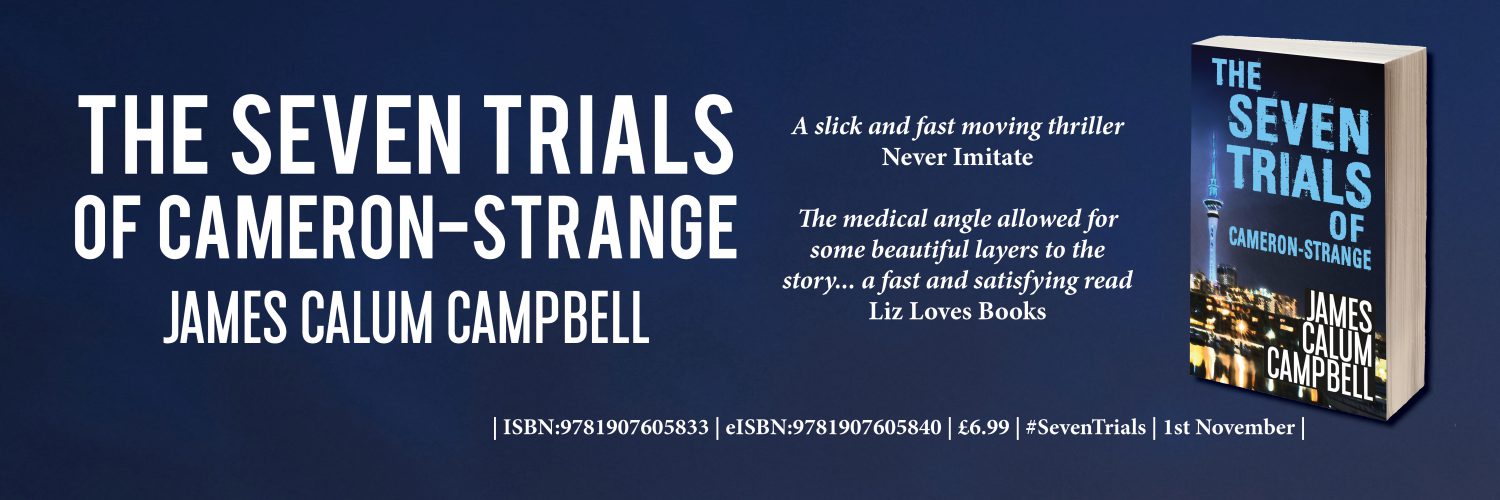
The Seven Trials of Cameron-Strange comes out on November 1st.  Impress kindly sent me some advance copies which I’ve distributed among friends.  It is very rewarding, and slightly surreal, to see one’s stuff out there and between covers (incidentally, I love the cover).  Let me divulge a confidence.  I wanted to call it The Seven Trials of Alastair Cameron-Strange but I was persuaded to drop the “Alastair” – too many words on the cover!  That reminded me of Amadeus, Peter Shaffer’s play (and subsequently film) about Mozart in which an aristocratic patron tells Mozart that his music contains too many notes.  (You can see I have delusions of grandeur.)  I canvassed the opinion of a group of friends (largely the ones who got advanced copies of the book) and they thought Impress were right, so I relented.  I wonder what Alastair would have done?  He’s a younger man, and on a bit of a short fuse.  I think he might have thrown a Beethovenian tantrum and said, “Don’t change a ******* word!”  But I’m practising the art of serenity.

A further confidence: I didn’t find it particularly easy to write.  Frankly I wasn’t in the mood.  I was preoccupied with other things, but I had a time schedule, largely of my own devising.  I just had to get up every morning and write another thousand, day upon day.  Given all that, I’m happy with the result.  I’ve just read a favourable review from the website neverimitate, for which much thanks.  What sort of a review would I have given it?  Let’s see… 21 chapters.  3 good, 16 OK, 2 bordering on the shonky, as they say Down Under.  And the overall effect?  Ah – that is where I’m least qualified, like the pilot in the eye of the hurricane, impervious to what’s going on around him.   I know I’m not supposed to say stuff like this.  I should be like a top level sportsman… “I was really awesome today.”

So, on to part 3, in “the life of the troubled doc”.  And, for whatever reason, this has been, thus far, an easier remit.  “You ask me why?  I cannot tell you.  I only know that it is so.”  I’ve become very fascinated by the creative process.  Do you just sit down and blurt, and see where it takes you?  Or do you pre-plan everything down to the finest detail?  Well, no doubt every writer has a different modus operandi, but I’ve certainly come to discover that, for me, I’m more of a blurter than a planner.  That’s not to say I don’t plan.  I come up with an idea (where it comes from I’ve no idea – subject for another blog).  And yes I sit in coffee shops with a note book and I try to expand it and structure it and see where it will go and what conclusion it might reach.  But I pretty soon learned that that approach, initially fruitful, brought me up against a brick wall.  For a time I thought this was a lacking on my part.  But I’ve changed my mind about that.  When you hit the wall like this, the Muse is merely telling you to stop faffing around and get on with it.  Just start writing and the solutions to all these unanswerable questions will sooner or later come along.

So Speedbird (working title) is a great mystery, even with 20,000 words on the slate.  And I love that.  I’m not even sure the title will remain.  A friend of mine asked me yesterday which character was critically injured at the end of Seven Trials, and I replied, how should I know?  All I know is that the putative Speedbird has about 24 chapters, of which 5 are written.  I know that every chapter has to “work” on its own, as an autonomous entity, and then – more difficult – that every chapter has to elide seamlessly into the next chapter, and that – most difficult of all – the entire construct must, as an entity in itself, “work”.

Will it work?  No idea.  But I can tell you I’m getting great satisfaction in the process of finding out.  I love it when I go for a run and swim and a sauna and then some utterly crazy idea comes to me out of left field and I think, “I can write about that…”  Suddenly Speedbird has gone off in a direction I’d never anticipated.  You say to yourself, where is this going to end up?  You don’t know.  All you can do is write your way to the conclusion, and only then will you find out.

Enigma Variations

A couple of reports in the Herald last week caught my eye.  On Thursday: Thousands of convicted gay people to be given pardon; and on Friday, Pressure mounts to strip BHS ‘spiv’ Green of knighthood.  Let us draw a connection.

The Westminster government is drawing up new legislation whereby gay people who were convicted under the laws against homosexuality will be posthumously pardoned.  This legislation has been dubbed “Turing Law” after Alan Turing, the mathematician and cryptographer who was convicted of homosexual offences in 1952.  He was offered the choice of imprisonment, or chemical castration, and opted for the latter.  He committed suicide in 1954.  He was posthumously awarded a royal pardon in 2013, 59 years after his death.  In 2009 Prime Minister Gordon Brown had highlighted the tremendous debt Britain owed Turing for his work at Bletchley Park during the war, deciphering the Germans’ Enigma code.  His contribution to the allied victory was immense.  He went on to develop the rudiments of computer science, information technology, and artificial intelligence.  He wasn’t really a household name until Benedict Cumberbatch played him in the film The Imitation Game in 2014, the year after he was pardoned.

I’m interested in this word “pardon”.  How does Chambers define “pardon”?

Verb, transitive, to forgive: to allow to go unpunished: to tolerate… to grant remission of sentence…

Noun, forgiveness, either of an offender or of his offence, remission of a penalty or punishment: forbearance: a warrant declaring a pardon (French, pardonner).      

With respect to Alan Turing’s Royal Pardon, you can actually view it on line:

NOW KNOW YE, that We, in consideration of circumstances humbly represented unto Us, are Graciously pleased to extend Our Grace and Mercy unto the said Alan Mathison Turing and to grant him Our Free Pardon posthumously in respect of the said convictions. 

Well, Alan Turing cannot be given a remission of punishment; too late for that.  It would therefore appear that he is being forgiven.  You can see from the dictionary etymology that the English “for-give” and the French “par-donner” are cognate words.  Pardon is a generous act of giving.  We may pray for forgiveness of sins and believe that a slate is being wiped clean, not through justice, but through Grace.  Yet this pardon has been given to Alan Turing precisely because there is nothing to forgive.  Alan Turing doesn’t deserve a pardon; he deserves an apology.  Were he alive, he might then offer his persecutors his pardon.

With respect to Sir Philip Green, Westminster is again minded to effect a volte-face, and reverse a previous decision.  Parliament has debated whether to strip the former BHS boss of his knighthood.  The debate was heated, not because there were opposing points of view – nobody spoke up for Sir Philip (although Jacob Rees-Mogg did aver outside Parliament, in his dulcet patrician tones, that it was really none of Parliament’s business) – but because many MPs were speaking up for constituents who had lost their jobs, and maybe their pensions.  So this was not faux-outrage, but genuine anger that somebody in a position of power and wealth should grossly mismanage a company and bring its employees to ruin.  It’s all reminiscent of 2012, when former Royal Bank of Scotland boss Fred Goodwin was stripped of his knighthood when RBS was on the verge of collapse and had to be brought into public ownership.  Yet, that Parliament should debate whether Sir Philip’s Honour should stand or fall is almost unprecedented.  Only the Honours Forfeiture Committee is in a position to withdraw an Honour.  Yet no doubt Parliament can bring pressure to bear.

What is the connection between Alan Turing’s rehabilitation and Sir Philip Greene’s putative excommunication?

It lies in the subtext.  Both represent the establishment’s attempt to rewrite history.  I can’t help feeling that the establishment is not so much interested in forgiving Alan Turing, as in forgiving itself.  It has occurred to them that Turing was treated abominably.  Much has been made of Turing’s contribution to society and to the country.  Mathematical genius who – some people go so far as to say – won the war.  Yet if he had been a coal miner or a brick layer, or for that matter a vagrant or a drug addict, would his treatment have been any less abominable?  We may look askance at the attitudes of sixty years ago but we cannot change them.  That which happened can be regretted, but it cannot be reversed.

With respect to withdrawing an Honour from a disgraced individual, I can’t help feeling that this has little to do with punishing an individual, and everything to do with rewriting history for the benefit of the great Ship of State.  The establishment loves to associate itself with the great and the good.  Successful entrepreneurs, Captains of Industry, billionaire tycoons, rock stars, superstars, masters of the universe… The establishment loves to woo such people in the hope that some of their glitter rubs off.  It’s a way of increasing establishment’s power and prestige and thereby bolstering its foundation and ensuring its continuity.

But once you blot your copy book, commit a misdemeanour, shame yourself, they will drop you, with the sanctimonious zeal of the Pharisees, like hot coals.  But not without first taking back their gong.  That man is not a knight.  He was never a knight.  It never happened.

We are far more likely to learn from the past if we don’t try to muddy it.  In the past, a man was handed down a criminal conviction and another received a knighthood.  These things happened.  Don’t tinker with history.  The past is irrevocable.

Notes from Underground

I have received a letter from a financial institution which contains the following mysterious sentence:

I am writing to inform you that, unfortunately, we have had to cancel your Payment Protection cover.  Within the Terms and Conditions of the policy there are certain eligibility criteria, and while these criteria were met previously, due to a recent change in circumstances, you are no longer eligible for cover. 

I can’t imagine what my change of circumstances might be.  But it would appear to be “unfortunate”.  Has a misfortune befallen me?  If so, I would rather my financial institution spelled it out.  I don’t care for “certain eligibility criteria”.  I can’t imagine what these are, but I have a notion it would be quicker, easier, and more cogent, to delineate them.

I rang them up.

“Welcome to ***.  You will now hear 4 options.  If you have lost your credit card or had it stolen… to make a payment with a debit card… to hear about your points… or for anything else…”

I pressed 4.

“You will now hear 5 options…”

I pressed 5.

Wonder of wonders!  A human voice.  I asked for an interpretation of the arcane rune I had received.  He hadn’t a clue.  I don’t hold it against him.  Darker powers are operating behind him.  The critical thing to understand about these call menus (“You now have 27 options…”) is that they are not for the benefit of the caller, but merely for the convenience of their designers who are unaware that every conundrum is unique, and cannot be understood, let alone solved, by a piece of software.

Meanwhile HMRC has been trying to contact my doppelganger.  Both he and I have been getting mail from the Inland Revenue.  It has come to their notice that I’m not who I say I am.  I’m under cover.  I have a notion they are suspicious of my Jekyll and Hyde existence.  But it’s not unusual for doctors who write to use a nom de plume.  I would not wish my patients to read me and imagine they recognise themselves.  But I’m not really trying to trick anybody.  I think it’s more subtle than that.  Writing under another name is a way of signalling that the two endeavours, medicine and writing, are entirely separate.  When I took a medical history I like to think I was entirely focused on my patient and on the task of making him whole.  The last thing I was doing was looking for copy.

Anyway I braced myself, took a deep breath, and phoned HMRC up.  Once again I negotiated the “if this, press that; if that, press this” menu but went for the wrong option.  I had to start again and go for “a change in my circumstances” – that mysterious phrase recurring like a leitmotiv or idee fixe.  What a relief finally to speak to a human being.  Not only that – and I’m not even sure if it is permissible nowadays to own up to this – I was greatly encouraged that she had a Scottish accent.  It may not be PC to admit it, but it’s just a fact; I knew communication was going to get a whole lot easier.  Why?  Because we would share a culture, an identity, and a history.  In particular, we would have a common understanding of what it is to battle against a bureaucratic machine that is operating from a remote location.  My confidence wasn’t even dented when she said at the end of the call, “Don’t worry, I’ll sort that out for you, Dr Campbell.”

I’ve just read His Bloody Project by Graeme Macrae Burnet (Contraband, an imprint of Saraband, 2015).  It has been shortlisted for the Man Booker Prize.  No wonder.  It is an utterly compelling piece of writing.  It concerns a gruesome triple murder, committed in a dismal hamlet just south of Applecross in the mid nineteenth century, by a 17 year old boy who, in modern parlance, I venture to say was “on the spectrum”.  He and his family eke out a miserable existence in a hovel, growing crops in poor soil, and paying rent to the landed gentry, under the watchful eye of the constable, and the factor.  In an atmosphere of relentless bullying and persecution, the boy’s father approaches the factor and asks that he may see the “regulations” governing his life, so that he may avoid transgression.  The impudence of the man.

It’s unremittingly bleak.  His Bloody Project reminded me a little of Sebastian Faulks’ Engleby, which concerned another murder, and another young man on the spectrum.  But mostly, in the depiction of a struggle of a helpless individual against an impersonal and inimical authority, I was reminded of Kafka.  The first time I read The Trial I thought it was the weirdest book, but increasingly it’s looking to me to be a straight and unembellished narrative of the way life is.  You only have to look at the annual ordeal of submitting a tax return.  Our tax gathering arrangements are labyrinthine.  They are incomprehensible.  When I contact HMRC to seek elucidation, I feel as if I am approaching the factor to ask for sight of the “regulations”.  It would appear that the lowlier your circumstances, the more likely you are to come a cropper.  If you happen to be a billionaire you have developed the knack of tax avoidance. If you are a huge multinational conglomerate you have the knack of keeping your corporation tax to a minimum.  It’s the little guy who makes a mistake and gets it in the neck.  I suppose it was ever thus.  Look at the tax gatherers in the New Testament.  Despicable lot.

I wonder if this sense of helplessness in the face of Power’s bureaucratic juggernaut is what is driving the wave of volatility and uncertainty currently sweeping across the western democracies.  People feel disenfranchised and helpless.  In Scotland, Westminster is remote.  In London, Brussels is remote.  In Florida, the White House is remote.  So vote for change.  Vote for Brexit, vote for Trump.  Anything’s got to be better than the status quo.  Messrs Johnson, Davis, and Fox say, “I want my country back.”  (Funnily enough, they don’t think much of Ms Sturgeon for saying the same thing.)  When the European Union begins to creak round the edges, Mr Farage looks on with undisguised schadenfreude.

And yet, it seem to me there’s another sense in which, without any protest at all, the entire population of the world is sleep-walking into a dystopia that is Kafkaesque, perhaps even Orwellian.  I’m thinking of the uncritical idolatry, particularly amongst young people, of information technology and the digital world.  Is there any sight more disheartening than that of a group of teenagers walking along the road all staring individually at their own mobile phones and tablets?  Nothing is more isolating and alienating than being connected.  I see that the BBC want us all to sign in to iPlayer, not, apparently, so they can get our post codes and check we have a licence, but so that they can enhance our consuming experience and give us a bespoke broadcast menu.

We all have to rail against this.  Don’t allow yourself to be put in a box.  Every time you fill in a form, seek out the “free text” option and say something different from what’s on the menu.  After all, we are all unique.  Was it Evelyn Waugh who pointed out that there is no such thing as the man in the street?  But that we are all immortal souls who, from time to time, need to use streets.

This is a joint letter of protest.

Truly yours,

JCC

HMCM (my cover is brulee.)

Happy 125th!

I’ve had a fabulous weekend.  It got off to a great start with the arrival of some advance copies of The Seven Trials of Cameron-Strange.  I love the cover, in lurid blue, of the Auckland cityscape from the Waitemata Harbour as it might be perceived by somebody who is stoned or psychotic.  And I’m proud of chapter one.  Can I sustain it as the book progresses?  Well, that is why we writers keep writing.

To the Glasgow Royal Concert Hall on Saturday night to meet up with a coterie of musicians and to hear the opening concert of the Royal Scottish National Orchestra’s 2016-17 season.  Nicola Benedetti played the Tchaikovsky violin concerto.  Consequently the hall was full, including the choir stalls (where I was) and with standing room only (also full) in the upper gallery.  I like sitting in the choir stalls.  You may have a restricted view, in my case, of the percussion section, and it may not be the ideal location in the hall for balance of sound.  But on the other hand you are facing a packed auditorium and there is an extraordinary sense of occasion.  It’s an ideal location for witnessing the communication between conductor and orchestra; you get something of the perspective of a performer.

Nicola Benedetti is held in great affection and esteem in Scotland.  If she performs at a Scottish venue, a full house is guaranteed.  In the course of her career she has had to put up with a certain amount of criticism by people who imagine her success is attributable to her appearance.  The virtuoso trumpeter Alison Balsom has had to endure similar criticism.  But as Ms Benedetti has rightly said, “I’m not going to apologise for the way I look.”

It’s all beside the point.  The point is that Nicola Benedetti is a phenomenal musician.  She is able to strip away all the barnacles and other Crustacea that Old Masters accrue, and get to the heart of the musical matter. There is an honesty and a directness, and an intimacy, to her playing that I am convinced is, at the profoundest level, the reason why she has established this deep bond of communication with her audience.  The audience also know that she is profoundly committed to the cause of introducing “serious” music, or “classical” music (whether any of it may be composed in the future is matter for another blog) to young people, listeners and performers alike.

The concert opened with Khachaturian’s Waltz from Masquerade, and concluded with Rachmaninov’s Second Symphony.  Following the Tchaikovsky, Ms Benedetti, rather than playing an encore, chose to say a few words and to wish the RSNO a very happy 125th birthday.  It was clear that she has a very close tie with members of the orchestra both professionally and personally.  She said she had listened to the Rachmaninov the previous evening (in Edinburgh) and she told us that we in the audience were in for a treat.  It crossed my mind that she was aware that she herself had been the big draw for the crowd, and she was exhorting all her supporters to stay the course.  If so, it worked.  For the second half of the concert the audience remained undiminished.

And she was right.  It was a treat.  I thought it was a clever piece of programme planning.  Ms Benedetti is a draw for a younger set (“set”? – I can’t believe I just said that) and surely the deeply romantic Rachmaninov 2 is a young person’s symphony.  It was all wonderful, but I particularly remember the second subject of the 2nd movement, a luscious theme in which the violins indulged in a sliding glissando that might have been cheesy, but wasn’t; then there was the clarinet solo in the 3rd movement, exquisitely played by Jernej Albreht.  The perfectly paced tempo of the last movement allowed the music to speak for itself.  It brought the house down.

Sunday… To Aberdeen to lunch.  Perfect autumn weather for the drive up.  Party of six.  We ate a fabulous curry, and there was much talk and laughter.  My late mother was very fond of a quotation, that went something like:

So let us feast, and to the feast be added

Discourse, the sweeter banquet of the mind.

Who said that?

On one of the last occasions I can remember my mum being at a social gathering – she was well into her 90s, she said to me, “People – that’s what it’s all about.”

She might have said it in Gaelic, her native tongue.  Alastair Cameron-Strange said it in Maori:

He aha te mea.

Nui o te ao?

He tangata!

He tangata!

He tangata!             

“The eternal reciprocity of tears”

Seventy years since the inauguration of the BBC Third Programme.  I’ve been tuning in all week to its metamorphosis, Radio 3.  On October 1st they were reviewing “iconic” recordings over the decades and, from the 60s, they chose the 1963 Decca recording of Benjamin Britten’s War Requiem, with soloists Galina Vishnevskaya, Peter Pears, and Dietrich Fischer-Dieskau, the composer conducting.  I still have it on vinyl, in its slim black box with the white lettering.  Britten had composed the work to be premiered in 1962 in the newly rebuilt Coventry Cathedral which had been destroyed by the Luftwaffe during the Second World War.  The soloists represented Britain, Germany, and Russia, the principal players in the First World War.  Ms Vishnevskaya (Mrs Rostropovich – she was a pal) couldn’t obtain a visa to come to Coventry, but she managed the following year to travel and take part in the Decca recording.

Radio 3 played the closing passages of the Requiem.  I heard it – so often it is the case – on the car radio.  I was driving to a cemetery in Falkirk to lay flowers.  October 1st is a day of remembrance for me.  It was very comforting to listen to the Britten, and Falkirk’s Garden of Remembrance is a very beautiful and peaceful place.

Radio 3 preceded the War Requiem extract with a recording of Britten in rehearsal.  Spellbinding.  The rather clipped, old-fashioned Received Pronunciation, the attention to detail, the master-musicianship… I can imagine that playing for the maestro would have been simultaneously exhilarating and intimidating.  At one point he told off the boys’ choir for inattention.  Terrifying.

I know the War Requiem quite well, partly because I studied it at school.  I wrote a dissertation on it as part of an English Literature course.  Aside from the Latin Requiem Mass, Britten sets the poetry of Wilfred Owen, hence the Eng Lit connection.  I recall that while I was a huge Owen fan, I was a bit lukewarm about the music.  As far as English music was concerned, RVW was my great hero. My adolescent self found the Britten somewhat precious.  Doubtless this view was reinforced by Dudley Moore’s spoof on Pears and Britten, Little Miss Muffet, in Beyond the Fringe, also from the early 60s.  (I’ve still got that on vinyl, too.)

I can vividly recall the first time I met Owen’s poetry.  The poem was The Dead Beat.

He dropped, – more sullenly than wearily,

Lay stupid like a cod, heavy like meat,

And none of us could kick him to his feet;

It was like nothing I’d ever read.  Poetry wasn’t supposed to be like this.  Poetry was removed from reality, spiritual, and high flown, like Keats:

Season of mists and mellow fruitfulness!

Close bosom-friend of the maturing sun;

And yet, as I subsequently discovered, Keats and Owen were inextricably bound up in one another.  Both died at 25, hand-writing uncannily the same, and, when you read early Owen, you realise he is obsessed with Keats:

I have been urged by earnest violins

And drunk their mellow sorrows to the slake…

And then something happened.  Well, the War happened.  It gave Owen both his subject matter and his tone of voice.  Owen uses the half-rhyme:

It seemed that out of battle I escaped

Down some profound dull tunnel, long since scooped…

And again:

Wearied we keep awake because the night is silent…

Low, drooping flares confuse our memory of the salient…

It gives the verse a half-lit, other-worldly mix of poignancy and despondency.  Could Owen have been a poet without the War?  Even when his subject matter is something other, it’s still the War, as in Miners:

There was a whispering in my hearth,

A sigh of the coal,

Grown wistful of a former earth

It might recall.   

And later, the abrupt change of tone:

And I saw white bones in the cinder-shard.

Bones without number; 

There’s no escape from the War.  Owen wrote a preface to a putative collection of his poems that he himself never saw:

This book is not about heroes… Nor is it about deeds, or lands, nor anything about glory, honour, might, majesty, dominion, or power, except War.

It’s easy to forget just how shocking, how uncompromisingly horrific, and how subversive is a poem like Dulce Et Decorum Est.  It’s as if Owen deliberately allows his art to be swamped and subsumed by his subject matter.  He says as much in the preface.  The Poetry is in the pity.

Listening to Britten on Saturday, it occurred to me that he too had deliberately rendered his artistry invisible in order that it serve a greater purpose.  He wanted to communicate with people.  Stravinsky was famously mocking of the War Requiem – or maybe the hype surrounding it – and told everybody to bring along their Kleenex.  It’s his “Little Miss Muffet” moment.  A cheap gag.  And how many contemporary “classical” composers now are bothered enough to communicate with people?

Aeons ago during a former life, Philip Hobsbaum my English tutor at Glasgow, who sat at the feet of F R Leavis in Cambridge, where he formed “The Group”, was kind enough to let me study whatever I liked.  He would say, “What are you going on to, Campbell?” and I would always have a reply ready.

“Wilfred Owen.”

“Excellent!  I interviewed his brother Harold for the BBC.”  So I read Harold’s book, Journey from Obscurity (1963) about his brother.  He describes an uncanny experience he had on board HMS Astraea off the coast of the Cameroons, of seeing Wilfred, sitting in a chair, shortly after he had died at the Sambre Canal a week before the Armistice.  What are we to make of such an apparent confabulation?  I imagine it to be a product of extreme mental stress and physical exhaustion.  But who can tell?

Later, while a medical undergraduate at Edinburgh, I played viola in the Bach St Matthew Passion in St Giles.  Peter Pears was the evangelist.  (I seem to recall that Kenneth Leighton played harpsichord continuo.)  I was only a few feet away from Pears and I was dumbstruck by the pure power of his voice, even in the twilight of his career, and by his complete devotion and artistry.  I remember rehearsing in the Reid School of Music and at the end of the rehearsal I chanced to walk out of the building with him.  He said, or rather sang to me, “I thought the choir sang beau-ti-fully!”  I was so overawed that all I could do was nod in agreement.


Man of Steel

Mr Corbyn’s victory over Mr Smith in the Labour leadership on Saturday, by approximately 62% to 38% of the vote, was very remarkable. Most opposition leaders faced with a rebellion of their shadow cabinet, front bench, and 80% of the Parliamentary party, not to mention the hostility of the press and the biased reporting – by its own admission – of the BBC, would have thrown in the towel long ago. Yet Mr Corbyn seemed to be entirely unfazed by any of this, and not only has he survived, he has increased his popular vote. Surely his position is now unassailable for the rest of this Parliament.

It seems to me that Mr Corbyn shares a quality with an unlikely and disparate group of contemporary political figures that includes Donald Trump, Nigel Farage, and Boris Johnson. He is at ease with himself; he is comfortable in his own skin. He is authentic, the real deal. He does not put on an act and he has no need for spin doctors and “special advisers”. If he makes a gaffe, it hardly seems to matter. Neither of his predecessors were like that. Mr Brown only looked at ease north of the border. Mr Miliband incurred political damage simply by eating a bacon sandwich. Mr Corbyn could be photographed dribbling a chicken vindaloo down his beard and it would matter not one whit. Similarly Mr Johnson can be stuck in mid-air in the harness of a flying fox and still look happy. Mr Farage is entirely himself with a cigarette and a pint outside an English pub. Mr Trump can be as outrageous as he likes and it never seems to do him any political harm. No matter what you think of their policies, these people have an ability to connect with the electorate simply because they look as if they are having the time of their lives. Alex Salmond and Nicola Sturgeon also possess this quality; interestingly enough, so I think does Ruth Davidson. All of the recent Scottish Labour leaders on the other hand have looked as if they are fighting toothache. It’s hardly surprising. When Joanne Lamont resigned the leadership she said that Scottish Labour were merely a “branch office” of the Westminster PLP. I think that did Scottish Labour immense damage.

It’s odd to me that the PLP should consider Mr Corbyn to be a loser. He is polite and mild mannered. He would never have threatened to “smash” (sic) Mrs May back on her heels, as Mr Smith did. While Mrs May is beginning to look and sound more and more like Mrs Thatcher, I think Mr Corbyn, if you can hear him above the absurd ya-boo taunts and jeers, performs rather well at PMQs. Last week, Mrs May more or less said goodbye to him over the dispatch box. Well, she was a little premature with that.

But the oddest thing of all has been the hostility of the right wing press. If Mr Corbyn is as deluded and feckless as they make out, why do they bother to attack him? If his continued presence as leader is going to ensure a Tory government for a generation, why are they so intent on unseating him?

It’s because they are frightened. They are frightened of the unknown. Mr Blair they understood, and tolerated. But they can’t understand why somebody as alien to them as Mr Corbyn could have risen to the position of leader in the first place, and now, against all the odds, strengthened his leadership. It’s intolerable to them. Maybe Mr Corbyn will be Britain’s next Prime Minister. And he’s a socialist. Shock horror.

Way Back When

We’d emerged from the 11+, “the quawlie”, more or less unscathed.  Well I say that, but that wasn’t true for all of us.  Some of us were going down.  Some of us would not proceed in two months’ time east across the playground from old to new building to start all over again.  Some of us would be herded up and force-marched Partick-wards to Hamilton Crescent, “Hammie”, the junior secondary.

Mrs Miller tried to talk Hammie up.  “There’s no shame in not being academically minded.  You will have plenty of opportunities.  In fact, you will enter life faster.  Typing for the girls and woodwork for the boys.”  It sounded like hell on earth.  Hammie had a fearsome reputation.  The pupils were all criminals-in-waiting and the teachers their gaolers.  It was borstal, thinly disguised.  You’d be beaten up in the playground and belted in the classroom.  I gave up a prayer of gratitude, not of intercession.  Thank God I’m not stupid.  Heavenly father I thank thee that I am not as one of these.

Half a lifetime ago Miss Haggart had invited me for a tete-a-tete at her desk in front of the class.  She was a terrifying woman but on this occasion she was fawning over me in a way I couldn’t understand.  She was like the big bad wolf in a bad red-riding-hood disguise.  She was almost obsequious.  Apparently I was top of the class.  It was news to me.  I’d just been trying to keep my head above water, keep my incompetence to myself.  Joyce Cooper had had to teach me how to tie my shoes laces and put on my tie.  I was backward.  There must be some mistake.

But I’d got to like it there, the view from the back of the class.  Marjorie sat across the aisle from me, with her lovely long straight red hair.  Proxime accessit.  I would flash her sickly smiles of meretricious, sycophantic concupiscence.  (I really must stop saying that.) The quawlie was no threat to me.  Smug little prig.

For seven years we had started the day with The Lord’s Prayer and then moved quickly on to sums.  We were drilled mercilessly in number for an hour and a bit, until I could blessedly escape to do the milk run.  The exams for this particular “R” of the 3-R triumvirate always took the same form: fifty marks for mechanical, 40 for problems, 10 for “mental”, total: 100.  In mechanical, we added, subtracted, multiplied, divided.  We manipulated vulgar fractions, and decimals.  We did it so often that we did it, indeed, mechanically.  We applied the techniques to problems of the sort that used to intrigue the Canadian humourist Stephen Leacock.  If it takes 4 men 6 days to dig a hole, 12 feet deep, how long does it take 3 men to dig a hole, 15 feet deep?

Well!  You could write an essay!  Is this second hole to be of the same width?  Are we digging through a similar consistency of substratum?  Are the 3 men to be chosen from the original group of 4, and, if so, do we leave out the laziest, or the strongest, or the union man?  Which is absurd.  It took a certain talent for abstract thought to realize that the problem being posed was not human at all, but that we were merely being introduced to algebra by stealth.  You tended to fare rather better at school, if you were a little bit obtuse.

One day Mrs Miller marked our papers and dished them back at us.  Ann Munro went out to dispute a mark.  I was vaguely aware of raised voices.

“The answer is 1.  You have written 100.”

“No I didn’t.  I wrote 1.”

I was summoned to adjudicate.  Ann had written 100, and then rubbed out the two nothings.  But she hadn’t rubbed hard enough.  That would have been my ruling, had I not been pressurised to take sides.  I said it was 100, and sat down feeling like Pontius Pilate, vaguely conscious that an opportunity had passed me by.  I cursed Ann for not using a cleaner eraser.  I cursed Mrs Miller, for putting me in that situation.  But mostly I cursed myself.  I wish I’d said Ann had written a 1.  Ann, I’m sorry.

After break we did parsing.

Down south, Mrs May wants to return to this.  She reminds me of the last line from The Great Gatsby.

So we beat on, boats against the current, borne back ceaselessly into the past.            

The Way We Live Now

Contemporary fiction-wise, I have an aversion to tales that are told in the present tense. It’s a relatively new phenomenon. Dickens didn’t start A Tale of Two Cities with “It is the best of times, it is the worst of times…” nor Charlotte Bronte, Jane Eyre, with “There is no possibility of a walk today.” I blame it on James Joyce and Charlie Chaplin, a conflation of Stream of Consciousness with the rise in the early twentieth century of Cinema. Now authors think cinematographically. The result is like a film script. “He stubs his cigarette out in the ashtray. He stares at me fixedly. (Beat.) He gets up, crosses the room, and closes the door.” Even worse is the present continuous. “I am conscious that I am staring at the curve of her lower back. I am loving the way she leans forward…” And so on. It seems to me to have an overblown quality. If it is happening in the present, it is always happening; it is happening for all time. It’s self-indulgent, inward, preoccupied, and narcissistic. In fiction, it’s almost impossible to be kind-hearted and outgoing in the present tense.

Yet, with respect to his most recent publication, Nutshell, (I keep wanting to call it Nutcase), I have to acknowledge that Ian McEwan could hardly have used any other tense than the present. His narrator is, after all, a foetus. What else can an unborn child know other than the present? Hence: “So here I am…” It’s vaguely reminiscent of Dante, the man “in the middle way”, lost in a wood.

It is – as ever with McEwan – a clever idea. But aside from the choice of tense, it presents the author with an ever present (sic) technical problem. How can the unborn child tell a tale that takes place ex utero? Answer – by a combination of imagination, and eavesdropping. That McEwan can do this, without “clunking” page after page, is technical achievement in itself.

I’m a McEwan fan. I’ve read the canon. I tend to read his books while travelling (I’m writing this in Keflavik Airport), which is perhaps a mistake; one shouldn’t speed-read literary fiction as if it were a murder-mystery (even though, in a way, that’s what Nutshell is). It’s a great gift if you have it, to be able to write a page-turner, and yet I suspect I’m not the only person who reads McEwan too quickly. It’s probably the reader’s fault that sometimes his books seem like Chinese meals; they are appetising and enjoyable yet leave one with a curious sense of non-satiety. They are certainly clever. Again like contemporary film, they often start with a “thesis” or “postulate” that is creative and imaginative. Foetus qua narrator is an example. My favourite of his books is Enduring Love, a tale of erotomania which is really an imaginative exploration and development of a medical case-history.   McEwan tells the story and then presents the medical case as an appendix, rather as Benjamin Britten’s Lachrymae presents a series of variations and ends with Dowland’s original theme. Is it a trick, a gimmick?

McEwan does play tricks on his reader, perhaps most notoriously in Atonement, where we are tricked about the authenticity of a narration, and again in Sweet Tooth, where we are tricked about the authenticity of an identity. I’m not at all sure about this. You had thought the information embedded in the text was what mattered, when all the time it was the author’s cleverness with respect to it. Too clever by half? Too self-absorbed? Moral power is to be found in a transcendence of the self.

Another charge laid against McEwan, that his characters and his world are too middle-class, seems to me less justified. You write about what you know, and what interests you. McEwan is interested in professions and their mysteries – medicine, the law, literature, science. If his characters seem to be self-centred, mirthless, and lacking in human warmth, maybe that’s because they are indeed all of these things. He can be funny, but in a dark way. You long for somebody to appear who is cheerful, and kind.

I enjoyed Nutshell but it left me feeling anxious and fretful. It’s hard enough living the present let alone reading it. But I know how to snap out of this. I will read a chapter of Jane Austen at bedtime. Then I will know that all is well with the world.

A la recherche du temps perdu

“Now listen to what I tell you,” said Mr Mackay the PE teacher. “When Mrs Biles announces the first dance, all of you, and I mean all of you, will step forward, advance, approach a young lady and ask her if she would like to dance.”  Next month we would hold our school dance in here.  But it didn’t matter how much tinsel and crepe you draped over the wall bars; you couldn’t disguise the gymnastic atmosphere of sweat and fear.  Mackay might have been a field commander issuing instructions on the eve of the Battle of the Somme. When the whistle blows, over the top.  Fix bayonets, don’t cluster, march, don’t run.  Mackay smiled a thin lipped, gloating smile.  “And if I see anybody lagging behind, believe me…” – he held up his opposed thumb and forefinger with the tips a millimetre apart – “I will make him feel this small.”  The summary court martial; the firing squad at dawn.  A brief moment’s writhing in the mud, calling for mother, and then the blessed coup de grace.  I glanced across no man’s land – the width of a badminton court – to the enemy trench.  They looked more confident than us.  They seemed to have a better handle on what was going on.  There was amusement and laughter and even a tinge of excitement.  But here and there was a silent one, cringing on the bench under the wall bars, in dread anticipation of the cold steel of that bayonet, looking down at the stain of blood on her own gym slip, wondering what it meant.

Mrs Biles rammed the stylus down on to the vinyl.  “Gentlemen, take your partners for a St Bernard’s Waltz!”  I glanced to my left.  Buckie, impossibly, had wedged himself behind the wall bars.  He was trembling.  I said, “Come on, Buckie, it’s not that bad.”

“Leave me alone!”

We left the redoubts and parapets, we crossed the salient, not to the strain of the bagpipe, but to the cosy blend of accordion, piano, and violin.  I had no agenda, no plan, save to stay upright and go through the motions and make sure Mackay didn’t make me feel this small.  I was afraid of Mackay but I didn’t respect him.  Even then I believe I knew him for what he was, a psychopath and a sadist.  I had come to this realisation a few weeks ago in the same gym when we had been practising floor exercises under his tutelage.  We lay supine staring at the ceiling.  Then we flexed our knees so our feet were flat on the floor.  Then we placed our palms flat on the floor behind our heads.  Then we lifted our hips and torsos off the floor in a high arch.  It was called “the crab”.  Buckie couldn’t do it.  Mackay was humiliating him.

“Get your fat bottom off the floor, Arbuckle.  Higher!  Higher!”

Buckie sweated and strained and by some monumental effort achieved the arc.  Mackay placed his foot on his stomach.  The superstructure collapsed.

“Arbuckle, you’re rubbish!”

I didn’t forget that.

Mackay had been something in the military, an NCO or something, I dunno.  I didn’t understand the hierarchies, had absolutely no inkling of the ingrained class structures of army life.  I just had the sense that Mackay had retained his military bearing and persona after he’d been demobbed so that he could carry on behaving badly.  He used to take us for rugby.  We were rubbish at rugby.  All these posh schools racking up scores like substantial snooker breaks against us.  It was the most dismal part of my education.  I learned how to lose.  I was very confused about rugby.  It was encouraged over football (some people even called it football) because it seemed to be an upwardly mobile activity for youngsters.  The oval ball, muscular Christianity and all that.  I wish I’d had the nerve to tell Mr Mackay where he could stuff his oval ball.