Haere Ra!

Off to New Zealand on Monday February 1st, Storm Henry permitting.  Glasgow – Dubai – Sydney – Auckland.  No stopovers.  I once swore I’d never do that again, but this time I bit the bullet.  28 hours in a hermetically sealed cigar tube.  I am anxious to board, and emerge into Eliot’s “unimaginable, Zero summer”.  It is better to arrive than to travel hopefully.

Auckland International Airport is certainly the friendliest airport I know.  Even the customs officers smile at you.  In no time at all you emerge into Arrivals and then walk out into the sweet New Zealand air.  There is a moment of déjà vu; it is as if everything has been in freeze frame.  And then, as if cued by your coming, the huge New Zealand flag above the carpark begins to flap lazily, and the traffic starts to move, and the people start to bustle.

It’s a fallacy.  It doesn’t take you long to realise that these people have not been in suspended animation at all.  They have moved on. Things are not quite as they were during your last visit.  In fact, you realise, it is you who have been in a deep hibernation and who now need to wake up and rediscover what it is you are doing down here.  I once toyed with the idea of spending six months in each hemisphere.  A life without winters might be attractive if you aren’t into winter sports.  Yet I’ve gone off the idea.  It’s not that I would feel guilty about dodging the rigours of the cold. After all, the birds do it.  They fly vast distances and come back six months later and land in the same pond.  No, it’s the sense of continuous displacement that puts me off.  Where do you live?  Where have you put down roots?  Answer – in an airport departures lounge.  I lived and worked in Auckland for 13 years and I do go back from time to time but I’m conscious of a sense of dislocation.  Despite the fact that you can text and telephone and skype and email and so on, there is a sense that there is no real point of connection between life here and life down under.  They are entirely separate entities, like parallel universes.  You have slipped through a worm hole and the other place has disappeared.

Yet that other world stays in the memory with extraordinary high definition.  Sometimes in the heart of Glasgow of a cold wet and blustery day I’ve closed my eyes and imagined myself on Narrow Neck Beach on Auckland’s North Shore, looking across to Auckland’s 48th volcano, Rangitoto.  And for one crazy moment I’ve believed that when I would open my eyes again, the characteristic twin peaked silhouette of Rangitoto’s caldera, in the Hauraki Gulf beyond the Waitemata Harbour, would be there before me.  Didn’t Yeats feel this way?  While I stand on the roadway, or on the pavements grey…  It’s my Innisfree moment.

Perhaps next Wednesday, if I’m standing on Narrow Neck Beach, I will think fondly, perversely, of Buchanan Street.  I’ll let you know!  It is the blessed dilemma of dual citizenship.  Am I a Scot in New Zealand or a New Zealander in Scotland?

He iwi kotahi tatau.

A Toast to The Bard

Sunday night.  Just returned from a Burns Supper – haggis without the mawkish sentimentality.  I was called upon to render the Selkirk Grace.  I looked to the ceiling and intoned “Some hae meat” and left it at that.  The purveyor of the offal intoned “Fair fa’ your honest, sonsie face” and left it at that.  We tucked in.

I like peasant food.  I think of the Address to a Haggis as the antidote to all these foodie programmes on the TV.  Cookery shows are very fin de siècle.  Imperial Rome was obsessed with matters culinary just before the fall of the Empire.  Surely the ultimate in decadence is captured in the recurrent reportage of money men, masters of the universe, going out to dinner at £5000 a head.  Fillet of bruised spatchcock phoenix drizzled in a cabriolated coulis of emblazoned pitchblended mud, drowned in a nuclear-wintered farce.  (£3000 surcharge).  Chateau Rubbische Swipes throughout.

They don’t even know how to boil a Brussels sprout.  To capture the charisma of a sprout, you must leave it for longer than you think, until it’s quite soft.  Then the flavour comes out.  This has got nothing to do with money.  Boiled cabbage is the same.  Add pepper.

In this context, I’m particularly fond of the fifth stanza of the Address to a Haggis:

  Is there that owre his French ragout,

  Or olio that wad staw a sow,

  Or fricassee wad mak her spew

  Wi perfect scunner,

  Looks down wi sneering, scornful view

  On sic a dinner?  

Notice that curious construction of the first line.  Burns is fond of this.  He means: “Is there (anybody) who, over his French ragout…”

He does the same thing in A Man’s a Man for A’ That:

Is there for honest Poverty

  That hings his head, an a’ that;

  The coward slave – we pass him by,

  We dare be poor for a’ that!  

That is to say, is there anybody that hangs his head for honest poverty?  Unthinkable.

En route, I caught “Words and Music” on Radio 3.  Just a snippet.  I was able to figure that the programme’s theme was “dreams”.   I heard the opening to Rebecca

Last night I dreamt I went to Manderley again…

Then, some of Ravel’s Daphnis and Chloe.

Then, Winston.  The close of the first volume of his history of the Second World War.  “I felt as if I were walking with destiny….  Facts are better than dreams.”

And then Yeats.  “Tread softly…”

I’m not sure that Words and Music is a successful programme.  What I have noticed is that the music transcends the literature, at least in terms of performance.   Somehow the translucence of the music makes the thespian luvvies sound completely over the top.   The secret of acting (Michael Caine has said as much) is not to act.  “Speak the speech trippingly…”  I found myself wondering what I would have included if I’d had to compile a programme about dreams.  I would certainly have included Martin Luther King.

“I have a dream…”

There is no greater orator than Martin Luther King.  He is a greater orator than Churchill and that is saying something.   He shares something with Churchill: substance.

  I have a dream that one day, down in Alabama, with its vicious racists, with its governor having his lips dripping with the words of interposition and nullification…

It’s Biblical.  He makes the governor sound like Herod.  What on earth are the words of interposition and nullification?  I’m not exactly sure, but I think in the broadest sense they refer to what we would now term, in a technical sense, “bullshit”.  Despite the fact that Burns contemplated more than once going to the Caribbean to run a plantation, I have a sense Burns and Martin Luther King might have got on quite well.  After all, Burns never actually went.  God bless him.


Primum non nocere

There’s a lovely story on the front page of this week’s West Highland Free Press.  A Gaelic singer performing at a ceilidh stopped mid-song and indicated he was feeling unwell.  He then suffered a cardiac arrest.  A member of the ambulance service, a firefighter, and a nurse who all happened to be in the audience commenced CPR.  They successfully used a defibrillator which had been installed at the venue.  An ambulance arrived minutes later, and the patient was transferred to Raigmore Hospital in Inverness where at the time of the report, he remained an in-patient.

The extraordinary thing is, this event took place at 11.30 on a Friday night in Poolewe.

Hold this thought.

This week I’ve been watching from north of the border, believe me without a trace of schadenfreude, the progress of the spat ongoing between Jeremy Hunt the Health Minister and the British Medical Association.  Mr Hunt wants to create a “24/7 NHS” in which high standards are maintained at all times, irrespective of the hour of the day or the day of the week.  “At the moment,” said Mr Hunt, “we have an NHS where if you have a stroke at the weekends, you’re 20% more likely to die.”  The doctors are worried that the contract on offer is going to leave them exhausted and burnt out; bad for doctors and bad for patients.  Talks have reached an impasse.  The doctors have gone on strike for the first time in over forty years.  That is a disaster.

Irrespective of the virtues or shortcomings of the proposed new contract I have to say I don’t think well of my medical colleagues.  In my opinion, doctors should not go on strike.  Strikes are designed to cause disruption.  Disruption in turn causes harm.  You might try to make a distinction between causing “inconvenience” and causing actual physical damage to patients, but you’d be hard pushed.  Even when the medical profession is firing on all cylinders, things can and do go wrong.  It is impossible to practise medicine in a half-hearted way.  It’s an all-or-nothing pursuit.  Hippocrates is said to have counselled us, “First, do no harm.”  The man who heckled the doctors’ demo and said, “This is against the Hippocratic Oath” – he was right.

I also find it reprehensible that the medical profession has failed to come together in order to tell Mr Hunt how to run a Health Service.  But the fact is that the medical profession has no clear leadership.  Medicine remains profoundly tribal.  All the specialties and subspecialties are preoccupied in claiming their slice of the budgetary cake and looking after it.

There is no meeting of minds between Government and the BMA.  It is not merely that they are not singing off the same hymn sheet; neither side appreciates what this argument is really about.  It appears to be about money and rosters and on-call commitments and pensions and all the nitty-gritty of a contract but deep down it’s about none of these things.  Deep down, it’s all about clinical medicine.  It’s about the delivery of health care.  It’s interesting that doctors talk about “managing” patients’ conditions; there’s no clear distinction to be made between clinical medical practice and the organisation of health care delivery.

What Mr Hunt is looking for (though I don’t suppose he knows it) and what the medical profession needs (they certainly don’t know it) is a Specialty of Emergency Medicine.  Think about it.  Medical specialties might be defined by age (paediatrics and geriatrics), gender (gynaecology), physiological system (chest physicians, cardiologists), pathological processes (oncology) and so on.  Emergency Medicine is defined by time.  Emergency physicians are interested in patients whose condition is time critical.  They know they can make the biggest difference within “The Golden Hour”.  That hour might be on a Monday afternoon or on a Sunday night.  Emergency Physicians are reconciled to the fact that they are liable to be busiest between Friday night and Monday morning.  They know that the most miserable day of the year for many of their patients is Christmas Day.  They are attuned to Mr Hunt’s idea of providing a round-the-clock service.  They also know about the huge and positive impact that early intervention and stabilisation (of the sort that occurred in Poolewe) can have on patient outcomes; and also the way that high quality prehospital and front-of-hospital care can take the pressure off intensivists, surgeons, interventional radiologists, endoscopy services and catheter labs by presenting them with stabilised patients and to some extent making emergency procedures semi-elective.

The tragedy of the NHS throughout the UK is that, although of course there are some wonderful emergency physicians and a few wonderful individual emergency departments, the Specialty of Emergency Medicine doesn’t really exist.  Emergency Medicine in the UK is about thirty years behind the times.  It’s reflected in the archaic language used to describe it.  “Cas”, “casualty”, “A & E”… If you talk to an Emergency Physician from Australia, New Zealand, or the United States, and you refer to your injured patient as a “casualty”, you will see him, or her, visibly shudder.

Doctors in training prop up acute care throughout the NHS.  They are demoralised and miserable, they are walking out, they are leaving for Australasia in droves, not because they are being asked to cover more weekends, but because they know in the deep heart’s core that they are propping up a ramshackle NHS.  Thirty years ago in Australasia a small group of doctors took on the combined might of the Royal Colleges and established the Australasian College for Emergency Medicine.  The college has never looked back.  This is a battle that has never been fought on these shores, let alone won.

Juventutis Veho Fortunas

On Tuesday January 5th, Jackie Brock, who is Chief Executive of Children in Scotland, wrote The Herald Agenda article “Food Poverty and its effect on our children can no longer be tolerated”.  I learned that 3.7 million children are living in poverty in the UK.  Locally, free school meals are taken up at Ibrox Primary in Glasgow by 71% of the pupils.  At Irvine Royal Academy in North Ayrshire almost half of pupils receive clothing grants.   I knew all this, and more besides, as my cousin is head teacher of a primary school in North Ayrshire.   She has told me that it’s virtually impossible to teach children who are constantly hungry.  This is a problem the world over.  Dunblane Cathedral currently has an outreach project in Likhubula Malawi which tries to ensure each school pupil there has one square meal every day.

By bitterly ironic coincidence, The Herald also published on January 5th a glossy magazine insert, “Independent Schools”, being an advertisement for in this instance nine Scottish private schools.

These two worlds, the world of the Agenda article, and the world of the glossy ad, could hardly be further apart.

If I say I found the glossy, frankly, repellent, I hope I will not be misunderstood.  The gulf between the privileged and the disadvantaged is as old as time itself.  Perhaps the best way to ensure that the world become a better place is to give our children the best possible start in life so that they in turn are in a better position to help those who are less fortunate.  All well and good.

No, it’s the mode of expression in the glossy that repels.  Contrast these.  First from Jackie Brock in Agenda

“Initially focusing on Ibrox and Irvine, our Food, Families, Futures programme will ensure the provision of meals in schools at weekends and during holidays.”

…cf Ken Mann’s feature article in the magazine:

“Maximum attainment is far more easily assured through accurate fit with individual pupil need and robust methods of imparting knowledge.”

And again, from Jackie Brock:

“We want to take action now to ensure our young people have an education that isn’t undermined by food poverty.”

…cf Ken Mann:

“Responsible jobs requiring knowledgeable people can bring the type of salary capable of setting desirable lifestyle levels for a lifetime.”

What a private education gives you is “polish”.

But is “polish” a desirable attribute?  Nicola Sturgeon, Scotland’s First Minister, went to state schools in Irvine, North Ayrshire (Dreghorn Primary and Greenwood Academy).  Putting party politics to one side, one of the reasons why she is so popular on a personal level both north and south of the border is that she is “normal”.  She doesn’t have a veneer.  She is entirely lacking in smarm.  She was able to visit the flooded-out folk in Aberdeenshire last week and talk to them in a sympathetic and entirely unaffected way.

I went to a state school in the west end of Glasgow.  It amuses me that there are more MSPs at Holyrood from my old school than there are old Etonians (3 to 2 when I last counted).  Maybe in the modern world “polish” is beginning to lose its lustre.

Thanks, Frank

The week before Christmas I was shopping at Sainsbury’s and rather carelessly managed to reverse my car into a wall in the carpark on my way out.  Nothing too horrendous.  A piece of Perspex over a rear light shattered, but the light itself was undamaged.  There were a few minor scratches on the bumper and adjacent paintwork.  I drove immediately round to my garage thinking – such was my naivety – that I might be able to have the Perspex replaced as I waited.  I was happy to touch up the paintwork myself.

Not a bit of it.  Estimate for the work from the body shop – £650.  The Perspex cover alone could not be replaced; it had to be the whole unit – value £200.  Part of the bumper could not be touched up and had to be replaced.

So I phoned my Insurance Company.  Yes they would fund that, minus the excess of £100 but the work would have to be done by a stipulated dealer – in a town 30 miles away.  I phoned them.  Yes they would do that – on January 26th.

Then on Hogmanay Storm Frank came along and blew a cover off a ventilation stack atop my bijou cottage.  I stuck my head up into the loft and could see a rectangle of broad daylight.  I phoned a roofer.  Stoney silence.  I phoned another roofer.  Yes he would be happy to fix that but was overwhelmed with work because of Storm Frank.  He’s going to phone me next week.

Small beer, I hear you say.

Then I read in the paper for the umpteenth time that the hospital managers and the local politicians were very disgruntled with a hospital not a million miles from where I live because their “A & E” (sic) waiting times were once more falling below “target” (sic) in that 93% rather than 95% of their patients had been “seen” (by which they actually mean discharged from the department) within four hours.

You can see where this is going.  No wonder all my medical colleagues are crumbling under the weight of expectation and deserting in droves to Australasia like economic migrants and asylum seekers.  600,000 working days have been lost across the Scottish health service in the last four years because of time taken off work due to staff mental illness.  The total has been increasing each year (86,500 in 2011 rising to almost 180,000 in 2014).

It’s not about to get any better.  The Royal College of General Practitioners last October gave a prize to the best academic paper in primary care.  It was a study, published in The Lancet, of the expectations of a substantial population (4,000+) of patients with regard to their perception of the level of risk at which they would wish to be investigated for a diagnosis of cancer.  If their risk of having a cancer (based on their clinical presentation) was 10%, would they wish to be investigated?  5%?  1%?

The overwhelming majority said they wished to be investigated at a level of risk of 1%.

I wonder if they were offered statistical advice about what this meant.  How many times would you need to be investigated (or, if you will, how many times would you need to attend a hospital out-patient clinic) before your 1% cancer risk became greater than 50%?

Answer:  70 times.

I like to think I’m a glass half full person.  If I have a 1% risk of developing a cancer, then I have a 99% risk of not developing it.   I’ll take my chances, thanks.  I’ve got higher priorities.  Like fixing the leak in my roof.

The Musing of Janus

It’s a slightly weird week, the week between Christmas and New Year.  The world is numb.  It’s a week of hibernation.  The natural world is – or should be, but for all this dreadful flooding – in deep repose.  Every day is a slow news day.  Is that a true reflection of reality, or merely a reflection that the BBC and the various media organs are themselves hibernating?  You turn on the telly at 6 to watch the news and instead you get a Morecambe and Wise rerun or another rendition of The Great Escape.  Bartlett and Mac are getting on the bus and the Gestapo guy says to Mac “Goot Luck!” and you send Mac a telepathic message.  “This time, Mac, don’t say it!”  But he does.  “Oh, thanks very much.”  And that, more or less, is that.  Have some more Christmas pudding with brandy sauce.

Much as a week of lotus eating has its attractions, for me it’s not an option.  I’ve got seven days to write a book.  Not quite as bad as that.  75,000 words now on the stocks.  But, face it, some of them have got to go.  Then I’ve got to glue the remains together.  Traumatic piece of surgery.  It’s too, too bloody.  At least I’ve got the beginning, and the end.  Just fix the middle.

Talking of beginnings and ends, this week I came across an ancient postcard a friend of mine sent me from Switzerland when I was a student.  It was just a piece of undergraduate nonsense:

  Call me Ishmael. There was no possibility of taking a walk that day.  It was the best of times.  It is a truth universally acknowledged that Marley was dead, to begin with.  As I walked through the wilderness of this world…      

It sounded like an encrypted message of the sort that a great escapee might have sent back to Stalag Luft III on his arrival at Scott’s Bar, Piccadilly.  An index of first lines.  It seemed to me to capture all the agony of writing a novel, of first putting pen to paper and committing yourself to a huge undertaking with no guarantee that it would lead you in any direction worth travelling.   I resolved that when I next holidayed, I would send my friend an equally enigmatic message, but of a single, last line.  If a first line presages agony, surely a last line is signal of some sort of victory, no matter how Pyrrhic.  I chose the last line of The Great Gatsby.

So, this rum week of suspended animation is also a week of beginnings and endings, during which we review the past year, and contemplate the one to come.  Regrets?  Well, I have a few.

But then again, too few to mention.  Resolutions?

Why is it that the universal experience of New Year’s Resolutions is that they are made with sincerity and almost immediately broken with guilt?  Lose weight, drink less, write more, (and better), don’t be so recluse, help the poor and needy…

It’s all good.  But the trouble is that such resolutions tend to be expressed in terms of giving up a vice.  The reason why our resolutions fall to bits is that we identify the vice we would eschew, but we fail to appreciate that the vacuum the vice leaves needs to be filled by a virtue.  If we can identify the virtue, and embrace it, then the vice will merely cease to matter to us.

Therefore there is only one resolution.  When a great opportunity comes out of the blue, and its fulfilment is noble and worthy, recognise it, and seize it.

That’s why I never sent my friend in Switzerland the last line of Gatsby.

So we beat on, boats against the current, borne back ceaselessly into the past.

It’s a beautiful line, but I’m done with it.  Nostalgia is the self-indulgent sentiment of a lotus eater.  As Lee Marvin said to Angie Dickinson in The Killers, “Lady, I just don’t have the time.”

A Joyous Yule!

Sunday December 20th.   Nativity Play in Dunblane Cathedral in the morning.  Charming.  I felt I was on the set of Love Actually, but did not run into Claudia Schiffer.  In the evening, I dusted off my sadly neglected viola and played in a ceremony of Lessons and Carols in Glasgow.  It was a day spent in contemplation of the miraculous.  Dare I speak of the miraculous?  I will sound like a self-appointed sage in a pub, like either Peter Cooke or Dudley Moore in the old Pete and Dud sketches.  Why not?

I read in the papers this week that Mother Theresa is edging towards sainthood on the basis of her apparent posthumous intercession on behalf of a patient with stomach cancer, followed by a second patient with a brain tumour.  Both are in remission.  From time to time you hear a story like this.  Two adolescent girls in a remote village in Andalusia see visions and cure people and a team of cardinals go to investigate, in precisely the way a team of scientists might visit a remote location to study any unusual phenomenon.  The process has a rather medieval flavour to it.  Not that the Roman Catholic Church is the only denomination solely preoccupied with the miraculous.  Friday’s Herald devoted profligate column inches to the issue of whether incredible reports of shepherds and Magi following a wandering star to encounter a virgin birth (parthenogenesis) should be taken literally.  The Reverend Andrew Frater of Cairns Church in Milngavie has described it all as a “fanciful fairy tale” and wants to “disentangle the truth from the tinsel.”  Apparently, however, the Free Kirk are not best pleased at Rev Frater’s “offering inert, gelatinous, non-offensive niceness.”   This is all part of an ongoing debate as to whether New Testament reportage should be taken literally or metaphorically.  The Free Kirk are giving metaphor a bad press.

Yet metaphor is all we have. Everything is metaphor.  Jesus spoke in metaphor all the time when he said “The kingdom of heaven is like…” in his many parables.  Oddly enough, the people who understand best of all that everything is metaphor are scientists.  Jacob Bronowski thought that the great triumph of quantum mechanics lay in its demonstration that absolute truth is unattainable.  Our understanding of nature is uncertain not because our laboratory instruments are imperfect, but because uncertainty is knit into the fabric of the universe.  (I can just hear Pete saying all that to Dud in a nasal whine, over his pint of bitter, and making Dud corpse with laughter.)   It was Richard Feynman who pointed out that, while we can do sums involving energy, nobody actually knows what energy is.  That makes “e = mc squared” a metaphor.  Feynman said that the fact that he could never know anything for sure didn’t bother him.  He was just happy to keep searching.  Newton described his scientific work metaphorically.  He said it was like turning up a nice pebble on the beach, while all the time the great ocean of truth lay out there, waiting.  To do that which you are called upon to do, to the best of your ability, and not to get hung up about all the rest, is surely an act of faith.

I remember when I was about ten years old spending half a morning in my primary school sick bay with a belly ache.  I drifted off to sleep for a couple of hours.  When I woke, the ache was gone.  I lay still, with the hyperacusis of the newly wakened, listening to the banter of the school secretarial staff through the partition.  It was perhaps the first time in my life that I felt a sense of wonder at the gift not only of consciousness, but of consciousness of an underlying moment to moment order in existence that meant that existence was neither chaotic, nor null.

It seems to me that the great miracle of existence, of the ordor essendi, is that miracles are precluded.  Existence is subject to physical laws.  If a law appears to be transgressed, then it merely means that our understanding of the law is incomplete.  Is that an anti-religious sentiment?  Not at all.  Existence constantly shows itself to be infinitely more amazing and inspiring and – if you like – miraculous, than anything we have to date been able to conceive.  We need to stop trying to quest for literal certainty in any matter.  Get over it.

Faith, Hope, and Love.  It’s enough.

Have a wonderful, and a safe Christmas.

JCC


The Advent of Alastair Cameron-Strange

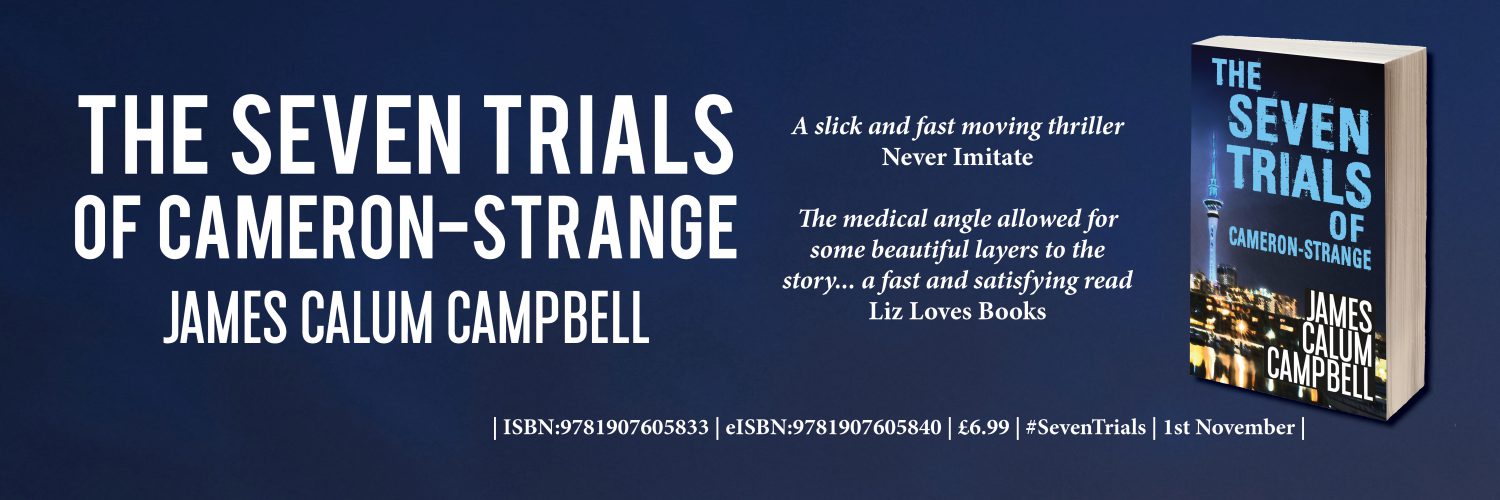
Update on the sequel to Click, Double-Click, aka The Seven Trials of Cameron-Strange.  65,000 words on the slate, maybe about 10,000 to go.  To paraphrase Eric Morecombe, they are the right words, but they are not necessarily in the right order.  I want to finish the draft by the end of the year, and hope to do so, if I’m spared unforeseen catastrophes, or, indeed, if I’m spared.  Having done a solid chunk last week, I rewarded myself with some R & R this weekend to coincide with the onset of the festive season, and enjoyed various lunches, suppers, and parties in Glasgow, Stirling, and Aberdeen.  If you spend your whole life in a garret you just get cabin fever.  And besides, how can you write about life if you don’t live it?  I think it was Doris Lessing who said that the difficult part of life for the writer was not the writing, but the living.

I met some wonderful people, but I suspect I wasn’t very good company.  I might have had the glazed look of somebody suffering from what the psycho-geriatricians call “cocktail-proof dementia”, that is, the ability to conduct a conversation when you don’t have a clue what’s going on.  So you interject at various points, “Is that so?  My goodness!  How extraordinary!”  And all the time you are thinking, “How the hell is the troubled doc going to get himself out of the fix you’ve put him in?  Of course, episode A actually needs to follow episode B, and he really doesn’t need to explain about such-and-such when the context makes it self-evident, and he really mustn’t chase Ms X because she’s professionally off limits …”

“…Sophie’s gap year helping Venezuelan street kids is going really well and Cameron is really looking forward to Brasenose…”

“Is that so?  My goodness!  How extraordinary!”

You slip out of the hubbub of the party for a moment to write in your notebook, “ACS – he’s like St Paul, twice shipwrecked…”  You’re driving from Stirling to Aberdeen and you pull over to scribble down something you hear on the car radio: “Exploit malware – some sort of IT scam… what would ACS make of it?”   You wake in the night with an idea that seems so crucial that you have to get up and write it down in case you forget it.  Frankly you are living in an alternative universe and because that universe is of your own concoction and therefore capricious, are you not technically insane?

What can I tell you about Seven Trials?  I like to think of a piece of music that suggests the mood of a book.  The mood of Click, Double-Click was in the music of Sir James MacMillan.  A Child’s Prayer would open a televised episode, and St Aloysius Pray for Us would close it.

Seven Trials has an epilogue.  It is the epilogue of Arnold Bax’s Second Symphony.  ACS’s beloved twin sister MacKenzie is the viola player in the Arnold Bax Quartet.  MacKenzie knows that Bax is a composer of the highest order.  Bax wrote seven symphonies.  Four of them have epilogues – numbers 2, 3, 6, and 7.  The epilogue of Bax’s Second Symphony says to us, quite clearly, this is not the end; this is merely a break, a moment of respite in a long saga.  You may contrast this with the epilogue to the seventh symphony which, for all that it is understated, is one of the most – well – final farewells in all of music.  But we have not yet come to that.  It’s in the distance.

If Seven Trials is Bax 2, then ACS must come back.  He comes back in Speedbird.  I can only tell you one thing about Speedbird.  The atmosphere of Speedbird is the atmosphere of Arvo Part’s In Memoriam Benjamin Britten.           

  So it goes on.

William McIlvanney, 1936 – 2015

I was saddened to hear of the passing of William McIlvanney.

Mr McIlvanney had a very expressive face.  I thought of his face as that of a man who had lived, and, perhaps, suffered, much, but who always retained his sense of humanity.

When I read Laidlaw, the first in the Laidlaw trilogy, I recognised instantly the world in which Laidlaw moved; I recognised its authenticity.  I understood the geography of Laidlaw’s world.  This was because my Dad was also a Glasgow cop.  And he spent the greater part of his career working out of Police Headquarters as it then was, by St Andrews Square on the edge of the east end.  This is ancient Glasgow, the Glasgow of the Toll Booth and the Cathedral and Provands Lordship and the Necropolis and Glasgow Green.  It’s on the edge of one of the most deprived and disadvantaged precincts in Europe.

Mr McIlvanney captured the atmosphere of this environment perfectly.  The atmosphere of the gangster underworld is faithfully recorded in a Glasgow accent.  It’s full of dark humour.  And also, surprisingly, compassion.

When I was a child, struggling to wrestle the best of three falls with words, it would never have occurred to me to write about Glasgow.  On the contrary, I wanted to escape from Glasgow and fly to the Caribbean and dine off oeufs en cocotte with a sophisticated mademoiselle and bla bla bla.   It never occurred to me that I was living right in the middle of one of the craziest, most bizarre, exotic places on earth.  That much did occur to me, in a slow witted way, later on.  This is what happens when you stop thinking of writing as escapism and start thinking of it as therapy.

Let me tell you about something I once witnessed from that ancient tract of land bordered by Saltmarket, Gallowgate, Glasgow Green, and the Clyde.  I had gone to Glasgow Police HQ to meet my father for lunch.  It was July 15th, 1969.  I’d often come here for lunch, and enjoyed the joshing and ribaldry of my father’s colleagues, the policemen and the typists and the dinner ladies.  But today was different.  The place was buzzing.  Two policemen had gone out on a routine enquiry to a flat in the city’s west end, to interview a man from Rochdale named James Griffiths about his connections with an alleged Glasgow criminal.  Mr Griffiths himself had a troubled background and had in fact spent 17 of the last 25 years of his life in various corrective institutions.  He opened fire on the police, then started firing at passers-by from an attic window.  He then escaped the flat, hijacked a car, and went on a shooting spree across North Glasgow.  He crashed the car in Possil.  He went into a public house, had a drink, and shot and fatally wounded another customer.  Unbelievably – and this part of the tale is quintessentially Glasgow – the barman said to him, “Why did you do that? He was just an old man!”  And he grabbed Griffiths by the scruff of the neck and chucked him out of the pub.  Griffiths hijacked another vehicle, drove into Springburn, broke into a flat and carried on with his shooting spree.

Meanwhile I carried on with my tomato soup, mince and potatoes, and Eve’s pudding and custard.  Half way through, a friend of my father’s came in briefly and joined us.  He was carrying a rifle and pouring with sweat.  We got an update.  Mr Griffiths was cornered.  There was a stake out.  Another friend of my father’s shot Mr Griffiths through the letter box.  By that time Mr Griffiths had shot thirteen people.

Looking back on it, I’m amazed at what little effect it had on me, a big mass shooting of the sort that now makes international headlines and calls from the US president to reform gun laws etc etc.  I just wolfed down my Eve’s pudding.  You sometimes see pictures of kids in trouble spots where life is disrupted by war, famine, ethnic cleansing, and terrorism.  There’s no security; it’s hell on earth.  What do the kids do?  They play a game of football.

Now, I can hardly bear to read the newspapers.  We are at war.  It’s nothing new; the war has merely been extended.  People are desperately trying to migrate out of zones of chaos.  Sea levels are rising.  Storm Desmond is wreaking havoc in Cumbria and the temperatures for December are preternaturally warm.   Mr Obama is wringing his hands about the latest atrocity in California.  But he has been rendered powerless by the Senate.

I wonder about the position of the Church with respect to Syria.  What is the position of the Lords Spiritual?  How do they interpret the words of Our Lord – love thine enemies, do good to those who hate you?  What makes William McIlvanney’s Jack Laidlaw unusual, and something of a maverick, is his ability to solve a crime, and apprehend a murderer, by understanding the humanity of the murderer.  He gets his man.  Then he visits him in his cell and offers him a cup of tea.


The Psychology of a Child Vigilante

When I was ten years old, I wanted to be Jack Trent.  And I wanted my best friend to be Philip Mannering.  Jack and Philip were creations of Enid Blyton.  Jack had freckles and red hair.  He was older than me, maybe about fourteen.  Philip’s hair stuck up in front and I thought that was cool.  He was about thirteen.  They both had sisters.  Philip’s sister was Dinah and she was dark and hot tempered and feisty.  She was about twelve.  Lucy-Ann was red-haired and freckly like her brother and unlike Dinah she was sweet natured and openly affectionate.  She was about my age but I thought she sounded younger than me.  She adored Jack.  Their parents had been killed in a plane crash and they lived with a cross old uncle who did not love them.

Philip and Dinah’s father was dead, but they had a mother who ran an art agency and was young and clever and pretty.  They went to boarding school and spent holidays with a recluse antiquarian uncle and a sour and exhausted aunt.

They all met one year at a summer cramming school, and got on famously.  They had shared interests.  Very out-doorsy.  Jack was crazy about bird watching and had a talkative pet parrot who sat on his shoulder.  Her name was Kiki.  Philip had the quality of animal magnetism.  No animal was afraid of him.  Consequently his person was frequently crawling with all manner of Insecta, invertebrates, reptiles, to Dinah’s intense disgust.  He would tease his sister by threatening her with some repulsive creepy-crawly and she would lose her temper and yell at him, and slap him while Lacy-Ann got upset and Jack tried to pour oil on troubled waters.  Yet Dinah’s tempers never lasted long.  That was the good thing about Dinah; she would never…

Mrs Miller snatched the book from my hands and peered at it.

“What’s this?”

“A book,” I said, stupidly.  It was the bulky MacMilllan edition, handsomely bound in yellow hardback covers, with illustrations by Stuart Tresilion.

“Blyton.”  She sniffed.  “I’m surprised at you.”  You would have thought I had been discovered concealing libidinous literature under my desk lid.  The girl across the aisle gasped, as if she had encountered me in the midst of a lewd act.

Mrs Miller announced to the class, “James is reading Blyton.”  So, it was to be a public humiliation.  “I cannot recommend Blyton.  It is, frankly, childish.”

But, I am a child.

“Her books do not stretch you.  There are no figures of speech.”

That was the defining quality of literature, the presence of metaphor, simile, metonymy, oxymoron, synecdoche, zeugma…  Suddenly I was panic-stricken that Mrs Miller was going to confiscate The Island of Adventure.  I said desperately, “I’m writing a critique.”  A giggle rippled through the class.

“Oh really.”  Mrs Miller looked arch.  “And what is the title of your analysis?”

The Psychology of a Child Vigilante.”  I blushed crimson.  Mrs Miller blushed too.  I could not have said why.  She opened her mouth to say something, and then thought better of it.

She handed the book back.

Much later, I came across the arresting opening line to E.C .Bentley’s Trent’s Last Case.  When I first came across it, I imagined that the eponymous hero was my old pal, Jack Trent, in adulthood.   It seemed quite feasible.  I had grown up and Jack had moved on too, had abandoned his childhood dream of becoming an ornithologist and, following in the footsteps of Bill Smugs, had become a gumshoe.  What would he do about Kiki?  Parrots can be very long lived.  It was quite conceivable that Kiki could outlive Jack.  The Chief Super would summon Jack to his office.

“Sit down, Trent.  Smoke if you like.  We need you to go under cover.  Trouble is, the bird makes you very conspicuous.”

“Wipe your feet!  Shut the door!”